
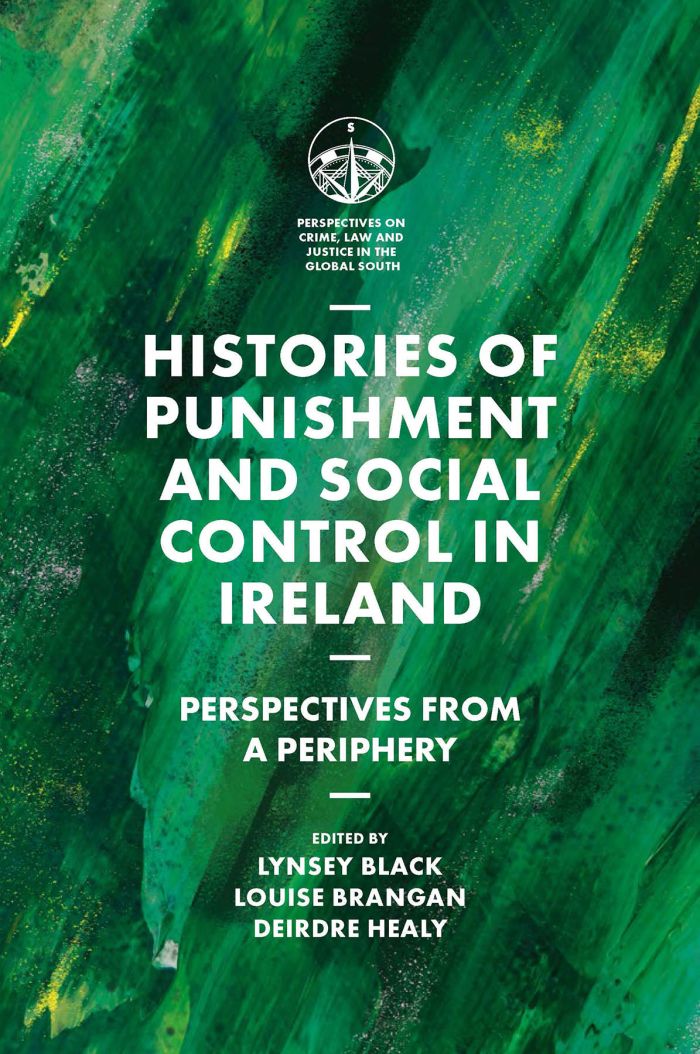

Histories of Punishment and Social Control in Ireland
Perspectives from a Periphery

This book can be opened with

Note on our eBooks and Audiobooks: you can read our eBooks (ePUB or PDF) and listen to audiobooks on the free Emerald Books app on iOS, Android, and desktop. Or read and listen on Emerald's online reader (ePUB eBooks and audiobooks only). To purchase a digital book you will need to create an account if you don’t already have one. After purchasing you will receive instructions on how to get started.
- Description
- Contents
- Reviews
- About
This volume contains an Open Access Chapter
As a peripheral state within English-speaking criminology, Ireland is often overlooked in mainstream Anglophone theories of punitiveness and penal transformation. This edited collection addresses this deficit by bringing together leading scholars on Irish penal history and theory to make a case for Ireland’s wider theoretical relevance.
Together, these chapters show in rich detail the trends and debates that have surround patterns of punishment in Ireland since the formation of the State in 1922. However, by being about twentieth century Irish penal history, the volume inherently foregrounds often absent perspectives in criminology and punishment, such as gender, postcoloniality, religion, rurality, and carcerality beyond the criminal justice system. This is more than a collection of Irish criminology, therefore; the social analysis of Irish penal history is undertaken as a contribution towards southernising criminology. The authors each seek to engage criminology in a wider epistemological re-imagining of what is meant by punitiveness, penal culture, and 'Anglophone' penal history.
Opening up new avenues of exploration and collaboration, and showing how researchers might look beyond the usual problems, refine the mainstream trends, and rework the obvious questions, this collection demonstrates how the Irish perspective remains relevant for international researchers interested in punishment and history.
Introduction
- PART I. BEYOND CRIMINAL JUSTICE
- Chapter 1. The Past in the Present: A Historical Perspective on Probation Work at the Intersection between the Penal Voluntary and Criminal Justice Sectors; Deirdre Healy and Louise Kennefick
- Chapter 2. 'Straightening Crooked Souls': Psychology and Children in Custody in 1950s and 1960s Ireland; Fiachra Byrne and Catherine Cox OPEN ACCESS
- Chapter 3. ‘Coercive Confinement’: An Idea Whose Time has Come?; Ian O’Donnell and Eoin O’Sullivan
- Chapter 4. A Certain Class of Justice: Ireland’s Magdalenes; Katherine O’Donnell
- Chapter 5. Ireland’s ‘Historical’ Abuse Inquiries and the Secrecy of Records and Archives; Maeve O’Rourke
- PART II. RETHINKING CRIME AND PUNISHMENT
- Chapter 6. Against Hibernian Exceptionalism; Louise Brangan
- Chapter 7. Capital Punishment and Postcolonialism in Ireland; Lynsey Black
- Chapter 8. The Ultimate Sacrifice: Irish Police (Gardaí) Murdered in the Line of Duty, 1922-2020; Liam O’Callaghan, David M. Doyle, Diarmuid Griffin, and Muiread Murphy
- Chapter 9. Gender, Punishment and Violence in Ireland’s Revolution 1919-23; Linda Connolly
- Chapter 10. Histories of Penal Oversight; Mary Rogan
- Chapter 11. "Nothing to Say?" Prisoners and the Penal Past; Cormac Behan
- Chapter 12. Peripheral: Women’s Imprisonment in Twentieth-Century Ireland; Christina Quinlan
This exciting volume leverages the unique trajectory of Irish criminology’s 21st century emergence and its distinctive commitment to historical inquiry to raise important questions for criminology as a field about what might have been and, moving forward, what could be. Editors Lynsey Black, Louise Brangan, and Deirdre Healy invite readers to reconsider assumptions and received theories that have dominated a field whose tunnel vision for the US and UK has weakened our historical and criminological imaginations. Instead, by immersing themselves in the history of criminological theory and penal practices (broadly construed) of an under-explored nation, they observe large and small differences that challenge our conventional expectations and that draw our focus to the importance of gender, religion, rural settings, and ongoing colonial legacies for understanding penality and how these considerations can play different roles from those we’ve come to expect from the standard national case studies. Histories of Punishment and Social Control in Ireland is a thus contribution not only to Irish Criminology, but to both broader Anglophone and global discussions about criminology, southern criminology, criminological history, punishment and society.
The Irish Republic, at barely 100 years old, offers an important new lens onto the history of modern penality and an alternative to the Anglo-American bias in mainstream criminology. Across twelve engaging, original chapters, this comprehensive volume builds to a fascinating story that is greater than the sum of its individual parts.
The collection is an important showcase for Irish historical criminology ... More than that, it sketches possible approaches to histories designated as peripheral because they do not meet the standards or fit the concepts that dominate Anglophone criminology.
Lynsey Black is Lecturer in Criminology at the Department of Law, Maynooth University. Her research interests include gender and punishment, the death penalty, and historical and postcolonial criminology.
Louise Brangan is a Chancellor’s Fellow in Criminology at the University of Strathclyde. Her research focuses on penal culture, social history of punishment, penal politics, and the comparative sociology of punishment.
Deirdre Healy is Director of the UCD Institute of Criminology and Criminal Justice and Associate Professor at the Sutherland School of Law, University College Dublin. Her research interests include desistance from crime, community sanctions, and victimisation.