
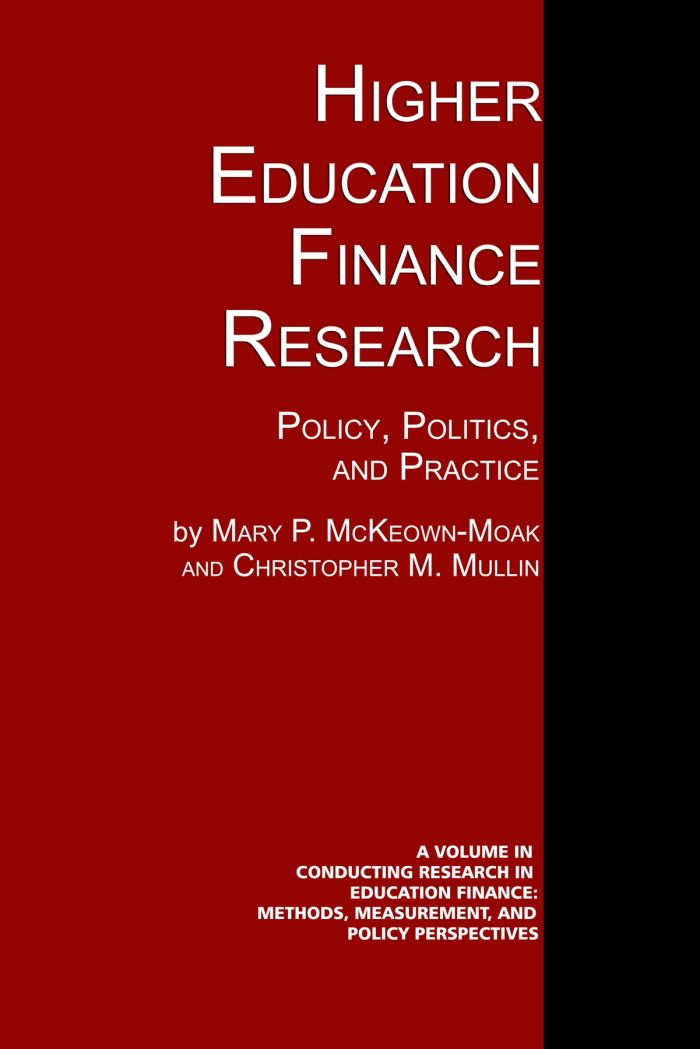
Higher Education Finance Research
Policy, Politics, and Practice

This book can be opened with

Note on our eBooks and Audiobooks: you can read our eBooks (ePUB or PDF) and listen to audiobooks on the free Emerald Books app on iOS, Android, and desktop. Or read and listen on Emerald's online reader (ePUB eBooks and audiobooks only). To purchase a digital book you will need to create an account if you don’t already have one. After purchasing you will receive instructions on how to get started.
- Description
- Contents
There is a void in the literature on how to conduct research in the finance and economics of higher education. Students, professors, and practitioners have no concise document that examines the field, provides history, definitions of terms, sources of data, and research methods. Higher Education Finance Research: Policy, Politics, and Practice fills that void.
The book is structured in four parts. The first section provides a brief history and description of the general organization of American higher education, the sources and uses of funds over the last 100 years, and who is served in what types of institutions. Definitions of terms that are unique to higher education are provided, and some basic rules for conducting research on the economics and finance of higher education are established. Although in some ways, conducting research in higher education funding is similar to that for elementary/secondary education, there are some important distinctions that also are provided. The second section introduces guiding philosophies, sources of data, data elements/vocabulary, metrics, and analytics related to institutional revenues and expenditures. Chapters in this section focus on student oriented revenues, institutionally-oriented revenues, and funding formulas. The third section introduces accountability-related concepts by first examining the accountability movement in higher education and performance-based approaches applied in budgeting and funding, then looking at methods to determine public and private returns on investment in postsecondary education, and closing with an examination of finance from the perspective of the primary consumer: students. The fourth and last section of the book focuses on presenting postsecondary finance research to policy audiences to assist in connecting academic research and policy making. Chapters focus on accounting for time considerations in analysis, the placing of data in context to make the data and findings relevant, and ways to effectively communicate findings to various policy-making audiences.
Foreword.
- Section I. Introduction to Higher Education Finance Research
- Chapter 1. Organization of Higher Education.
- Chapter 2. Foundations of Fiscal Analyses.
- Section II. Revenues and Expenditures
- Chapter 3. Student-Oriented Revenues and Expenditures.
- Chapter 4. Institutional Revenues and Expenditures.
- Chapter 5. State Funding Formulas.
- Section III. Accountability and Return on Investment
- Chapter 6. Accountability in Higher Education.
- Chapter 7. Performance-Based Approaches in Postsecondary Finance.
- Chapter 8. Human Capital Development and Returns on Investment.
- Chapter 9. Student Perspectives on College Costs and Price
- Section IV. Presenting Research
- Chapter 10. The Influence of Time.
- Chapter 11. On Groups and Events.
- Chapter 12. Presenting Research to an Audience of Policymakers.
- List of Figures.
- List of Tables.
- References.
- About the Authors.