
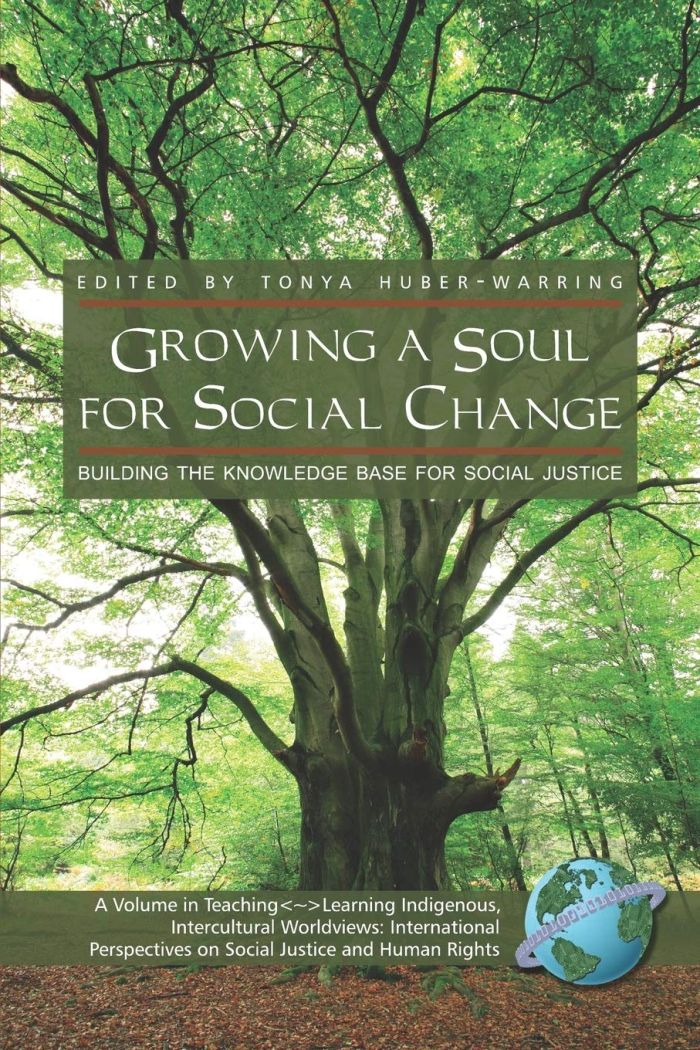
Growing a Soul for Social Change
Building the Knowledge Base for Social Justice

This book can be opened with

Note on our eBooks and Audiobooks: you can read our eBooks (ePUB or PDF) and listen to audiobooks on the free Emerald Books app on iOS, Android, and desktop. Or read and listen on Emerald's online reader (ePUB eBooks and audiobooks only). To purchase a digital book you will need to create an account if you don’t already have one. After purchasing you will receive instructions on how to get started.
- Description
- Contents
For readers new to the field of multicultural education and human relations education, the recency of these publications heralded as seminal may be confusing, for certainly the concepts building the field of multicultural education and human relations education have been around much longer. True. But, for the first time, we found the conceptual framework, guiding principles, and critical works across disciplines and fields in Smith's encyclopedic organization. Because of the comprehensive nature of Pritchy Smith's knowledge bases, they have been employed as the organizing themes for this volume. I would clarify that I have not burdened authors to study Smith’s analysis and then apply it to their works; the categorization is my own. And, as is true of any topic, the interpretation and application may be broadly applicable. One of my major goals in founding this series has been to further develop the knowledge bases with voices from those in the trenches (literally and figuratively) and at the chalkface—while proverbial for some parts of the world, chalk remains a teaching staple in many regions of the world.
Throughout this volume, authors will explore and research their own discoveries on this journey—narratives of crossing cultures and developing communities, reconceptualizing democracy and reinterpreting traditions, seeking solidarity and sowing the seeds of social justice. Through critical reflection in the shade of these giants, the reader may discover Ming Fang’s bamboo tree.
Preface: Growing a Soul for Social Change—The Trees We Have Planted: An Introduction; Tonya Huber-Warring.
- Part I. Foundations of Indigenous, International, and Global Education.
- Chapter 1. An Introductory Reflection—Excerpt From "An Angel Behind the Camera, Filming Angels in the Dust: An Interview With Activist Filmmaker Louise Hogarth"; Tonya Huber-Warring.
- Chapter 2. Can There Be a Postsecular Education for Peace? Danielle Celermajer.
- Chapter 3. Narratives of Experience: Crossing Cultures, Crossing Identities; Betty C. Eng.
- Chapter 4. Fuel Efficient Stoves and Community Development in San Lucas Tolimán; Guatemala, John D. Abell.
- Chapter 5. Evolution or Revolution? The Forces of Internationalization and Technology on Higher Education in the U.S.; Patricia Aceves.
- Part II. Principles of Culturally Responsive Teaching and Culturally Responsible Curriculum Development.
- Chapter 6. An Introductory Reflection—An Essay on Reconceptualizing Democracy Education; Larry Hufford.
- Chapter 7. Language, Culture, Identity, and Power: Asian American and Asian Canadian Students' Experience of Schooling; Ming Fang He, Elaine Chan, and JoAnn Phillion.
- Chapter 8. The Relationship Between Reading and English Composition Writing: Implications for Community Junior Secondary School Teachers in Botswana; Deborah Adeninhun Adeyemi.
- Chapter 9. Developing Multicultural Sensitivity Through International Student Teaching: The Challenges Faced by a Southern University; Judy C. Davison and Terrence K. McKain.
- Part III. Sociocultural Identities and Contexts of Human Growth and Development.
- Chapter 10. An Introductory Reflection—Science and Spirituality: A Synergy Made in Heaven; Clay M. Starlin.
- Chapter 11. Experiencing Tribes: Perceptions of Teacher Education Students; Richard G. Berlach and Annette Sanders.
- Chapter 12. A Sense of Purpose and Mission: Graduate Students' Perceptions of Writing Their Ethical Belief Statements; Ilene L. Ingram and Kevin H. Brockberg.
- Chapter 13. Identity Development for Holistic Global Interconnectedness; Douglas F. Warring.
- Chapter 14. Emotional Intelligence in the Classroom: A Behavioral Profile of an Effective Teacher; Melinde Coetzee and Cecelia A. Jansen.
- Chapter 15. Women and Development: The Case of Women in Military and Police Barracks in Nigeria; Eno Edem.
- Part IV. Experiential Knowledge.
- Chapter 16. An Introductory Reflection—Paper Clips: A Holocaust Survivor Remembers; Barbara Wind.
- Chapter 17. Seeking Solidarity Through Global and Indigenous Service Learning; Kelly C. Weiley.
- Chapter 18. Helping Beginning Teachers Shape Their Personal Practical Knowledge: An Essential Process in Teacher Education; Chun-kwok Lan, Wai-ming Yu, and Francis Nai-kwok Chan.
- Chapter 19. Promise and Perils of Study Abroad: White Privilege Revival; JoAnn Phillion, Erik Malewski, Eloisa Rodriguez, Valerie Shirley, Hollie Kulago, and Jeff Bulington.
- Chapter 20. Sowing Seeds of Social Justice Through Performative Pedagogy: Middle School Students Explore Genocide; Mary Ann Reilly and Rob Cohen.
- About the Contributors.
- Recognizing Reviewers.