
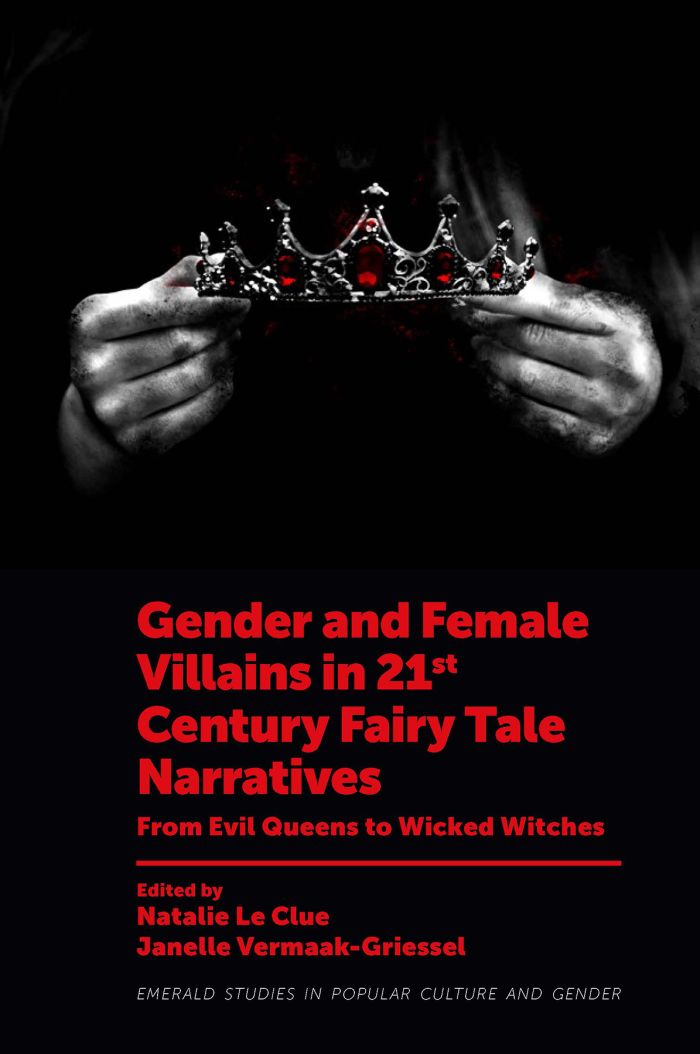

Gender and Female Villains in 21st Century Fairy Tale Narratives
From Evil Queens to Wicked Witches

This book can be opened with

Note on our eBooks and Audiobooks: you can read our eBooks (ePUB or PDF) and listen to audiobooks on the free Emerald Books app on iOS, Android, and desktop. Or read and listen on Emerald's online reader (ePUB eBooks and audiobooks only). To purchase a digital book you will need to create an account if you don’t already have one. After purchasing you will receive instructions on how to get started.
- Description
- Contents
- About
For every hero, there is a villain, and for every villain there is a story. But how much do we really know about the villain? Filling a gap in the field of gender representation and character evolution, the chapters in this edited collection focus on female villains in the fairy tale narratives of 21st Century media.
Within the realm of fairy tale study, the characters of princess, prince, hero, and damsel in distress have been researched extensively, however the female villain has rarely been the central focus of academic study. Gender and Female Villains in 21st Century Fairy Tale Narratives: From Evil Queens to Wicked Witches features chapters from different academic disciplines such as television and film studies, fan studies, character analysis, gender studies, feminist studies and audience analysis. Through the primary lens of gender studies, the collection delves into issues such as vanity, body dysmorphia, femslash fandom, the lesbian gaze, the queering of the villain-hero dichotomy, and morality and femininity.
Concluding by looking into physical disability, maternal subversion, and social exclusion, as well as the construct of beauty 'ideals' as applied to female villains, this collection breaks fresh ground by putting the female villain at the centre of academic study.
Introduction; Natalie Le Clue and Janelle Vermaak-Griessel
- Gender
- Chapter 1. “‘To destroy. To hate. To sow seeds of chaos. You know, just girly things’”: Evil Queens, Femslash Fandom and Monstrous Happiness; Alice M. Kelly
- Chapter 2. Scary Good: Queering the Villain-Hero Dichotomy in Contemporary Fairy Tale Retellings; Alba Morollón Díaz-Faes
- Chapter 3. A Tale of Two Mothers: Recombining Villainy and Motherhood in Maleficent: Mistress of Evil (2019); Rebecca Rowe
- Chapter 4. When the Magic Mirror Lies: Gender, Vanity, Body Dysmorphia, and the Wicked Queen; Sara Austin
- Screen Narratives
- Chapter 5. ‘Pretty ballads hide bastard truths’: Patriarchal Narratives and Female Power in Netflix's The Witcher; Kirsty Worrow
- Chapter 6. Positioning Mrs. Coulter in BBC/HBO His Dark Materials; Giulia Bigongiari
- Chapter 7. Female Power and Corruption: Snow White and the Evil Queen Through the Ages; Sarah Faber
- Chapter 8. The Reimagined Female Villain in George R.R. Martin’s A Song of Ice and Fire; Amit Kardosh
- Character Reformations
- Chapter 9. The Stepmother Problem: How an Information Deficit in Film Creates Female Villains; Rebecca Gadd
- Chapter 10. These Violent Delights’: Remodeling the fembot archetype in Ex Machina and Westworld; Kirsty Worrow
- Chapter 11. The Fairest Evil Looming over Earth: Representations of the Evil Queen in 21st Century “Snow White” Adaptations; Svea Hundertmark
- Chapter 12. “Evil isn’t born, it’s made”: Redefining the fairytale villain for contemporary television storytelling; Natalie Le Clue
- Physicality
- Chapter 13. Maimed Wings and Broken Hearts: Physical Disability, Social Exclusion, and Maternal Love in Disney's Maleficent and Maleficent: Mistress of Evil; Hannah Helm
- Chapter 14. “Poor, unfortunate souls”: Fan Perception of Ursula the Sea Witch from Disney’s The Little Mermaid (1989); Janelle Vermaak-Griesse
- Chapter 15. A Rhetoric of Evil: The clichéd motif of the Evil Queen; Natalie Le Clue and Janelle Vermaak-Griesse
- Conclusion
Natalie Le Clue is currently teaching in the department of Media and Communication at Nelson Mandela University in Port Elizabeth, South Africa. Her research focuses on television studies with a particular emphasis on fan studies, fairy tale mythology, and elements of new media.
Janelle Vermaak-Griessel is a Senior Lecturer in the Department of Media and Communication at the Nelson Mandela University, South Africa, and teaches in a varied range of disciplines including, but not limited to, scriptwriting, film Studies, communication studies and written communication.