
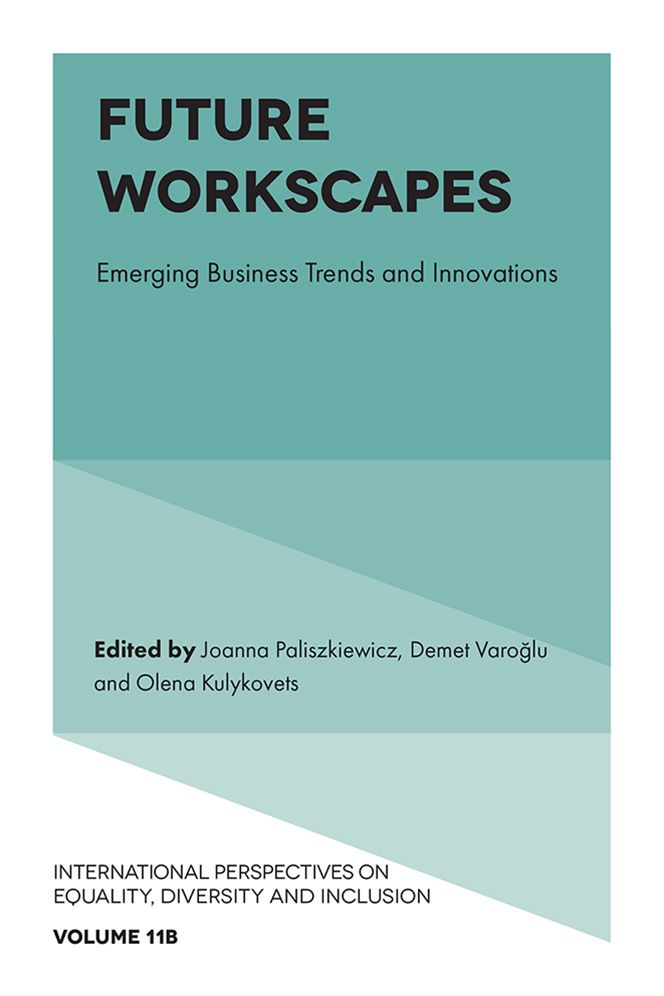

Future Workscapes
Emerging Business Trends and Innovations

This book can be opened with

Note on our eBooks and Audiobooks: you can read our eBooks (ePUB or PDF) and listen to audiobooks on the free Emerald Books app on iOS, Android, and desktop. Or read and listen on Emerald's online reader (ePUB eBooks and audiobooks only). To purchase a digital book you will need to create an account if you don’t already have one. After purchasing you will receive instructions on how to get started.
- Description
- Contents
- About
In an era where technological advancements, shifting societal norms, and global challenges are fundamentally reshaping the landscape of work, Future Workscapes emerges as a pivotal publication.
The second of two parts, this volume delves into critical aspects of the modern workplace by analyzing emerging business trends and innovations and business practices. Chapters focus on branding and consumers, career commitment, work satisfaction, strategic management schools, management theory, internal communication, and more. Through qualitative research and case studies, authors provide insights into creating technologically advanced, human-centric and inclusive organizations.
Both Part A and B of Future Workscapes offers an in-depth exploration of the evolving work environment and human resource strategies, addressing the urgent need for organizations to adapt to rapid changes, fostering environments that are not only technologically advanced but also human-centric, sustainable, and inclusive.
Foreword; Ireneusz Dąbrowski
- Foreword; Fatih Çetin
- Section I. Emerging Business Trends
- Chapter 1. Spiritual Branding Attributes and Consumer Buying Intention: The Proposal of Conceptual Model; Ngoc Bich Do, Y Nguyen Nhu Luu, Vi Thai Huyen Kim, and Viet Chi Duong
- Chapter 2. Factors Affecting Career Commitment of Public Servants in Vietnam: Perspectives of Investment Model and Moderation Effects of Perceived Economic Conditions; Quang-An Ha
- Chapter 3. Effects of Working Motivation on Efficiency and Work Satisfaction: Case of Employees at the Software Company; Pham Duc Chinh, Yen Nguyen Thi, and Ma Thi Ngan
- Chapter 4. Rethinking Organizational Hierarchy: A Critical Analysis of Strategic Management Schools; Mehmet Barca and Semih Ceyhan
- Chapter 5. Placing Non-Managerial Employees in the Management Theories: Towards a Theoretical Advancement; Mehmet Barca
- Section II. Innovations and Business Practices
- Chapter 6. A Study on Environment, Social and Governance Disclosure in the Case of the Packaging Sector in Romania; Anca Draghici, Gabriela Banaduc, Roxana Mihaela Sirbu, and Tamas-Szora Attila
- Chapter 7. Is Digitalization Bad for Trade Union Density in OECD Countries in the Age of Globalization?; Orhan Cengiz and Ömer Demir
- Chapter 8. The Role of Internal Communication and Employee Participation in Creating Health and Safety Climate: A Monographic Study; Elif Sungur, Nevin Kılıç, and Çiğdem Vatansever
- Chapter 9. Importance of Corporate Social Responsibility (CSR) in the Global Food Processing Industry; Małgorzata Wiktoria Paprocka
Joanna Paliszkiewicz is full Professor at the Warsaw University of Life Sciences (WULS—SGGW), Poland.
Demet Varoğlu is full Professor at TOBB University of Economics and Technology, Turkey.
Olena Kulykovets is Assistant Professor at the Warsaw University of Life Sciences, Poland.