
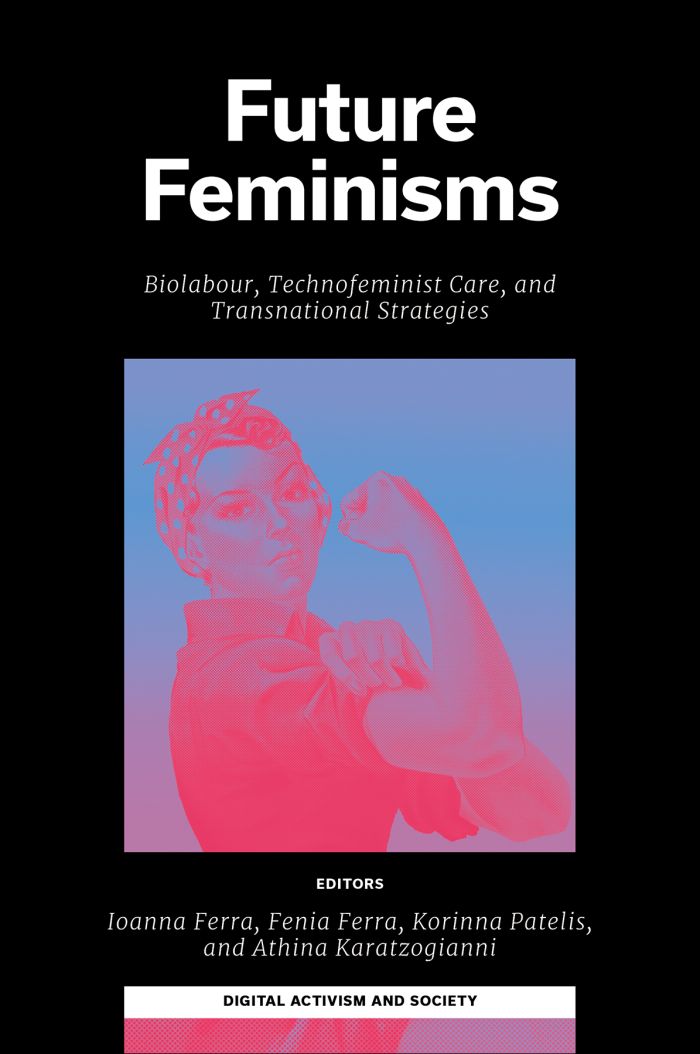

Future Feminisms
Biolabour, Technofeminist Care, and Transnational Strategies

This book can be opened with

Note on our eBooks and Audiobooks: you can read our eBooks (ePUB or PDF) and listen to audiobooks on the free Emerald Books app on iOS, Android, and desktop. Or read and listen on Emerald's online reader (ePUB eBooks and audiobooks only). To purchase a digital book you will need to create an account if you don’t already have one. After purchasing you will receive instructions on how to get started.
- Description
- Contents
- About
Recent debates regarding abortion law in the US, China, and many EU countries, the rise of far-right politics, and conservatist and extremist movements indicate elevated threats for women rights and the LGBTQ community in a global context. At the same time, ‘#Metoo’ movements were structured through online platform monopolies. In Future Feminisms, female academics from around the globe critically discuss the contemporary postfeminist media culture and bring different stories together to provide opportunities to imagine a connected feminist future.
Future Feminisms is an interdisciplinary exploration of the contemporary experiences of women within three different contexts - the private, public, and online spheres. Chapters explore women’s experiences of insecurity, instability and change, migration, and diaspora as experienced in both physical and digital communication environments. The diversity of the topics and the thought-provoking chapters are divided into the three sections of ‘Gender, Migration, and Decolonization’, ‘Digital Gender Activism’, and ‘Motherhood, Home, and Work’.
The juxtaposition of how women experience technology, digital media, activism, and feminism is explored through performative practices, including digital, thereby providing an innovative approach in relation to the interplay between political action, the body and artistic works.
Chapter 1. Introduction to Future Feminisms: Biolabour, Technofeminist Care, and Transnational Strategies; Athina Karatzogianni, Korinna Patelis, Fenia Ferra, and Ioanna Ferra
- Part 1. Technofeminist Care and Future Strategies
- Chapter 2. Care, Not Capital: A New Foundation for a Planetary Economy; Mikala Hyldig Dal
- Chapter 3. Spells and Specula: Some Technofeminist Strategies to Decolonize the Body; Christina Grammatikopoulou
- Chapter 4. Galatea Awakens: Agency and Artificial Female Bodies in Contemporary Cinema; Teresa Sorolla-Romero
- Part 2. Motherhood, Myths, and Resistance
- Chapter 5. Motherhood Struggles: The Lived Experience of Mid-Stage Maternal Identity; Treisha Peterson
- Chapter 6. “Mere Paas Maa Hai (I Have My Mother)”: A Systematic Review of Myths and Realities of Motherhood in India; T K Krishnapriya, Padma Rani, and Manjushree G. Naik
- Chapter 7. Online Communities An Act of Resistance: Mothers' Longitudinal Digital and Physical Lived Experiences of the Universal Credit System; Robyn Fawcett
- Part 3. Biolabour, Remote Work, and Pandemic
- Chapter 8. Young Women During the Pandemic in Mendoza, Argentina: The impact of unpaid childcare on their lives; Victoria Seca and Emiliana Segatore
- Chapter 9. Saudi Women in Mixed-Gender Workplaces: Remote Work Challenges in the Age of the COVID-19 Pandemic; Abeer Aldawsari, Mai Alshareef, Abdulmajeed Albalawi, and Abeer Bajandouh
- Part 4. Gender, Migration, and Transnational Reality
- Chapter 10. Women Challenging the Coloniality of Gender and Migration in Sub-Saharan Africa; Khanyile Mlotshwa
- Chapter 11. Imagination, “Peerage” and Reality of Young Korean Women in Diaspora: A Journey from Korea to the UK; Cherie Hu
Ioanna Ferra is Associate Professor in the Institute of Media, Faculty of Creative Industries, HSE University, Russia.
Fenia Ferra works as a postdoctoral researcher at the Department of Criminal Law and Criminology at VU University Amsterdam. She is involved in research looking at cross-cultural communication in investigative interviewing contexts. She has obtained her PhD in Psychology from the University of Sheffield, UK. Her PhD thesis focused on interviewing of child witnesses in Greece.
Korinna Patelis is a 25-year Internet veteran with a Ph.D. in Internet Communications from Goldsmiths College embarked upon when the web was still in its infancy, just after she read Philosophy at Warwick University, and is Partner at Minimedia, Greece.
Athina Karatzogianni is Professor of Media and Communication at the University of Leicester, UK.