
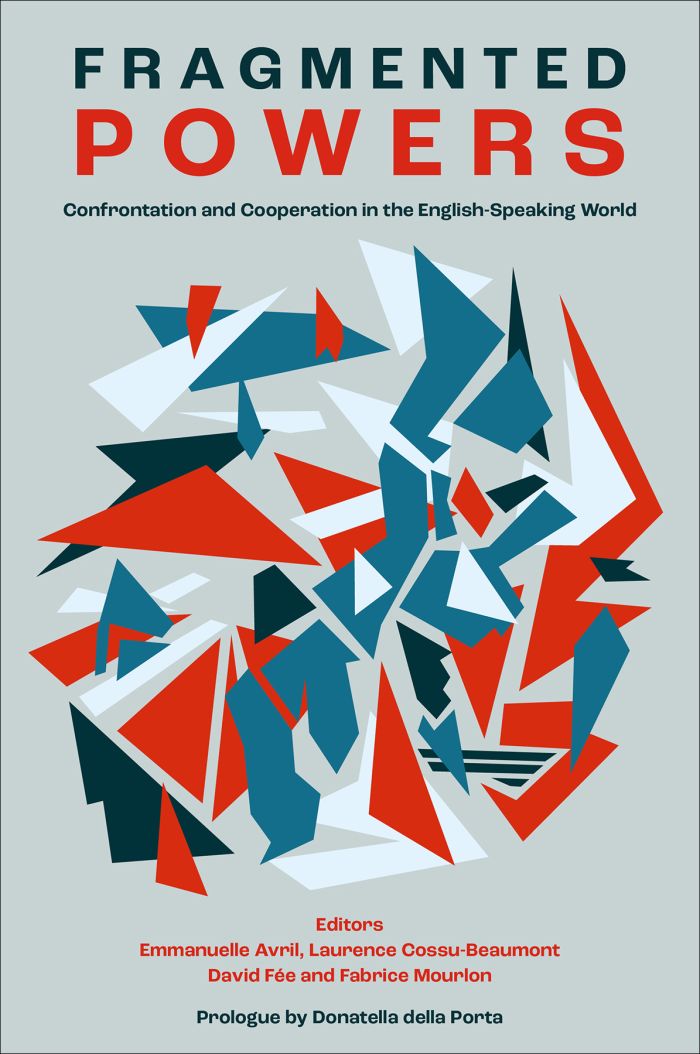

Fragmented Powers
Confrontation and Cooperation in the English-Speaking World

This book can be opened with

Note on our eBooks and Audiobooks: you can read our eBooks (ePUB or PDF) and listen to audiobooks on the free Emerald Books app on iOS, Android, and desktop. Or read and listen on Emerald's online reader (ePUB eBooks and audiobooks only). To purchase a digital book you will need to create an account if you don’t already have one. After purchasing you will receive instructions on how to get started.
- Description
- Contents
- About
Against the backdrop of an increasingly unstable and multipolar modern world, this edited collection takes an interdisciplinary approach to explore institutional, political, social and media fragmentation in today’s increasingly polarised English-speaking world environment. Taking fragmentation as either conflictive or resulting in cooperation, it evaluates to what extent the changes induced are long-lasting and irreversible.
Introducing 20 new case studies which analyse national-level politics, local governance, civil society mobilisation and more, the chapters examine the trajectories of American and British societies. Uncovering both the positive and negative effects of fragmentation, the former materialising in shifts in power away from centralised structures towards private economic actors, citizens and consumers, as well as local authorities, thus allowing for economic innovation, individual freedom and progressive policies, and the latter leading to disunity and the inability to guarantee basic rights, or devise common strategies, maintain stable and functioning economies, and organise effective opposition to state power. Adopting a multi-level approach to exploring the various meanings of fragmentation, chapters cover a variety of political, social, and geopolitical topics. These include fragmented constitutional frameworks and settings; fragmented governance; fragmented political parties; fragmentation in activism and social mobilisation; fragmented cities and urban environments; fragmented public services provision; as well as fragmentation in media and social media.
Fragmented Powers is a rich resource for scholars of public policy, urban studies, political science, sociology, international relations, and more.
Prologue. Fragmentation, Coordination and Convergence: Some Reflections; Donatella Della Porta
- General Introduction – ‘Fragmented Powers’ – A Critical Evaluation; Emmanuelle Avril, Laurence Cossu-Beaumont, David Fée, and Fabrice Mourlon
- Part 1. Taking Stock: The Challenges of Fragmented Governance
- Chapter 1. Second Thoughts: American Attitudes to the Westminster Model and to Political Fragmentation; Mark Wickham-Jones
- Chapter 2. American Foreign Policy and Secession Abroad; Christopher Griffin
- Chapter 3. The Indian Child Welfare Act Entangled between Federal, State Powers and Tribal Sovereignty in the USA; Claire Palmiste
- Chapter 4. The Fragment of a Boston Home: A Wealthy Metropolis in the Throes of Unaffordable Housing; Cécilia Smith
- Chapter 5. De-Fragmenting the (Post 1997) Social Housing Sector in England? Privatisation, Power and Provision, 1980-2023; David Fée
- Chapter 6. The End of Multiculturalism? The British State and the Muslim Council of Britain: From Cooperation to Non-Engagement Policy; Donia Touihri-Mebarek
- Part 2. Drifting Apart in the Political, Media and Cultural Spheres
- Chapter 7. Fragmentation in the Scottish Independence Movement; Nathalie Duclos
- Chapter 8. Fragmented Campaign Assemblages: Stratarchy and Multi-Level Cooperation in the Liberal Democrat 2021 Greater London Authority Election Campaign; Clémence Lévêque
- Chapter 9. From Fragmentation to Unity? Brexit and the Conservative Party under the Leadership of Boris Johnson; Bianca Polo del Vecchio
- Chapter 10. Fragmented Late-Night: From One King to Numerous Subjects; David Lipson
- Chapter 11. Constructing the Fragmentation of the United States: A Discourse Analysis of a White Nationalist Strategy after the November 2020 Elections; Sarah Louette-Rodriguez
- Chapter 12. The Centre for Contemporary Cultural Studies: A Historical ‘Utopian’ Enclave in the Political World of Academia?; Eléana Sanchez
- Part 3. Coming Together? Beyond Frictions, Divisions and Mobilisations
- Chapter 13. Fragmenting Labour Movements: The Knights of Labor and White Labourism, 1880-1900; Steven Parfitt
- Chapter 14. The Equal Rights Amendment and Conservative Women’s Activism against the Federal Government in the 1970s-80s; Amélie Ribieras
- Chapter 15. Fragmented Neighbourhoods in the Borough of Southwark: A Study of Three Different Pro-Gentrification Schemes in Peckham, Bermondsey, and Elephant and Castle; Habiba Jelali
- Chapter 16. The Redevelopment of the Truman Brewery in London’s East End: From a Multi-Dimensional Fragmentation to a Coalition on Anti-Gentrification and Historic Preservation; Marie-Pierre Vincent
- Chapter 17. Young People’s Climate and Environmental Activism in Britain: Cooperation, Confrontation and Fragmentation in Intersectional Prefigurative Politics; Dena Arya and Sarah Pickard
- Chapter 18. The Past as Prelude: Ethnonationalism, War and the Second Breakdown of Global Liberalism; Philip S. Golub
- General Conclusion; Emmanuelle Avril, Laurence Cossu-Beaumont, David Fée, and Fabrice Mourlon
Emmanuelle Avril is Professor of British Politics and Society at the Université Sorbonne Nouvelle, France.
Laurence Cossu-Beaumont is Professor of American Studies at the Université Sorbonne Nouvelle, France.
David Fée is Professor of British Studies at the Université Sorbonne Nouvelle, France.
Fabrice Mourlon is Professor of British and Irish Studies at the Université Sorbonne Nouvelle, France.