
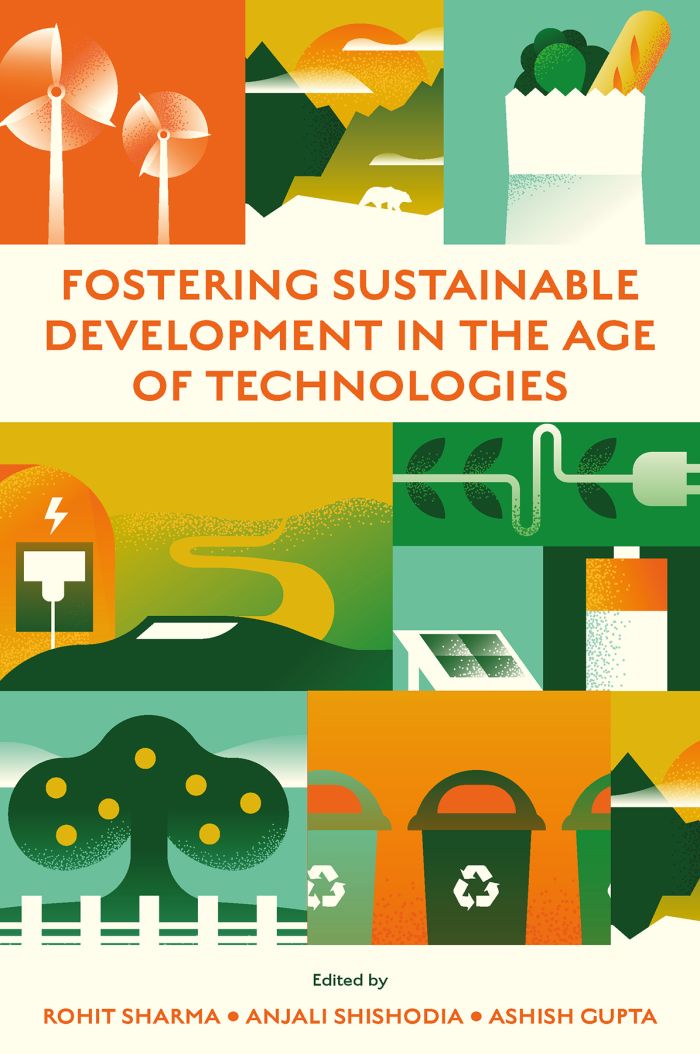

Fostering Sustainable Development in the Age of Technologies

This book can be opened with

Note on our eBooks and Audiobooks: you can read our eBooks (ePUB or PDF) and listen to audiobooks on the free Emerald Books app on iOS, Android, and desktop. Or read and listen on Emerald's online reader (ePUB eBooks and audiobooks only). To purchase a digital book you will need to create an account if you don’t already have one. After purchasing you will receive instructions on how to get started.
- Description
- Contents
- About
The world is changing at an unprecedented pace and organizations worldwide are finding it difficult to match their operational efficiency and sustainable development targets with the United Nations Sustainable Development Goals (UNSDGs). Due to massive scarcity of resources, global supply chains are under immense pressure, leading to social, economic, and environmental challenges. Holistic sustainable development across social, economic, and environmental dimensions to create an equitable society varies widely in its efficiency towards creating a resilient and inclusive future.
Fostering Sustainable Development in the Age of Technologies highlights the interplay between various disruptive technologies such as Artificial Intelligence, Autonomous robots, Big Data Analytics, Blockchain, Cloud Computing, and Digital Twins, and holistic sustainable development. In the highly dynamic business environment, there is an urgent need to catch up with the paradigm shift being created using these technologies. The studies brought together here emphasise how various disruptive technologies can aid in sustainable development, offering possible strategies to help tackle the challenges we face today and embrace the new normal. Collaboration, adaptation, and continuous learning hold the key in overcoming the grand societal challenges and maintaining a balance between social, economic, and environmental dimensions.
This edited collection appeals to a wide range of academics and professionals including graduate, postgraduate, and PhD research scholars, and faculty members in the areas of International Management, International Business, International Marketing, Finance, Human Resources and Corporate Governance. They are also of interest to Government Agencies, Practicing Managers, Research Agencies, and Libraries of Business Management Colleges and Universities.
Chapter 1. The Role of Digital Technology in achieving Sustainable Development Goals (SDGs): A Systematic Literature Review, Bibliometric Analysis, and Content Analysis; Arushi Bathla, Priyanka Aggarwal, and Kumar Manaswi
- Chapter 2. Digital Technologies, Sustainable Development Goals And The Grand Societal Challenges In The Context Of Slum Dwellers Of Kolkata, India; Atiba Batul, K. D. Ghosh, and S. Palit
- Chapter 3. Applications of Disruptive Technologies in Professional Services; Chandan Jha and Amit Sachan
- Chapter 4. Confrontation Strategy for Evolution of Future Employment; Donghun Yoon
- Chapter 5. Framing the digital transformation journey for sustainability from the lenses of integrated skills and competencies for the future work; Joseph O. Onyango
- Chapter 6. Role of Social Networking Technologies in developing Public Services Supply Chain during COVID-19; Kali charan Sabat and Som Sekhar Bhattacharyya
- Chapter 7. Adopting Technology for Sustainable Development: Reflections on Innovative Ecosystem; Jasmandeep Kaur, Kirandeep Kaur, and Ramanjeet Singh
- Chapter 8. Exploring the Relationship between Digital Initiatives, Dynamic Capabilities, and Market Performance: A Conceptual Framework; Lan Phuong Ho Dang
- Chapter 9. Reverse Logistics: Rebuilding smart and sustainable transformation based on Industry 4.0; Leena Wanganoo and Rajesh Tripathi
- Chapter 10. Reflections on sustainable development, sustainability, and business practice: lessons from measurement, scalability, and bias in AI; Luisa F. Melo
- Chapter 11. Digital Healthcare and Patient Transformation: Review research and future agenda; Nimesh P. Bhojak, Suresh N. patel, and Mohammadali K. Momin
- Chapter 12. A Comparative Framework Analysis of The Strategies, Challenges, And Opportunities For Sustainable Smart Cities; Oluwagbemiga Paul Agboola and Meryem Muzeyyen Findikgil
- Chapter 13. Leveraging Blockchain Technology in Adopting Digital Tokenisation of Green Bonds; Pulak Chugh
- Chapter 14. Digital Technologies & Education for Sustainable Development; Renji George Amballoor and Shankar B. Naik
- Chapter 15. Safety Management in the era of emerging industrial revolution: The conceptualization of Safety 4.0; Shatrudhan Pandey, Kirtika Kiran, Shreyanshu Parhi, Abhishek Kumar Singh, and Sanjay Kumar Jha
- Chapter 16. Spiritual approach among techies: An approach for achieving sustainable development; Snehal G. Mhatre and Nikhil K. Mehta
- Chapter 17. The Evolution of Manufacturing: A Comprehensive Analysis of Industry 4.0 and its Frameworks; Somayya Madakam, Rajeev Kumar Revulagadda, Vinaytosh Mishra, and Kaustav Kundu
- Chapter 18. Application of Industry 4.0 Technologies in Climate-Smart Agricultural Practices; Soumya Sucharita Panda, Sudatta Banerjee, and Swati Alok
- Chapter 19. The digital revolution- Implications of digital technologies on women’s workforce participation; Tanaji Pavani Prabha, Swati Alok, Rishi Kumar, and Swati Singh
- Chapter 20. Building Resilience against Ongoing and Future Pandemics: Blockchain Technology to the Rescue; Taab Ahmad Samad and Yusra Qamar
- Chapter 21. Impact of Awareness on the Adoption of Electric Vehicles: A Systematic Literature Review; Divya Singh and Ujjwal Kanti Paul
Rohit Sharma is working with the Faculty of Business, University of Wollongong in Dubai.
Anjali Shishodia is an Assistant Professor at LM Thapar School of Management, Chandigarh, Punjab, India.
Ashish Gupta is Assistant Professor in Marketing Area at Indian Institute of Foreign Trade (IIFT), New Delhi, An Autonomous Institution Under Ministry of Commerce and Industry, Govt. of India, New Delhi, India.