
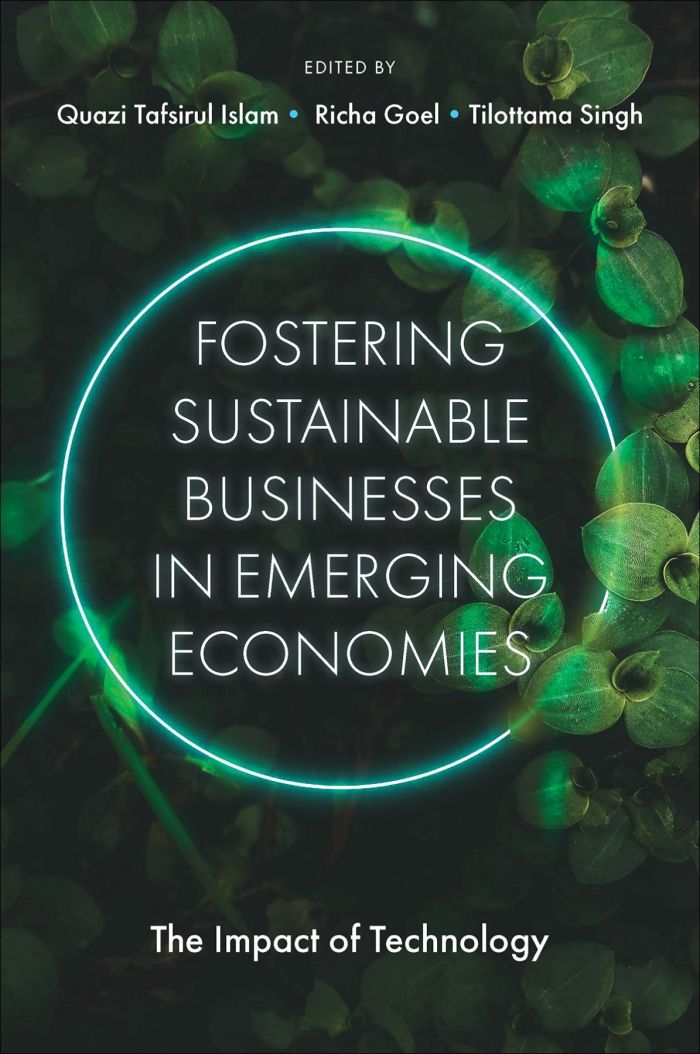

Fostering Sustainable Businesses in Emerging Economies
The Impact of Technology

This book can be opened with

Note on our eBooks and Audiobooks: you can read our eBooks (ePUB or PDF) and listen to audiobooks on the free Emerald Books app on iOS, Android, and desktop. Or read and listen on Emerald's online reader (ePUB eBooks and audiobooks only). To purchase a digital book you will need to create an account if you don’t already have one. After purchasing you will receive instructions on how to get started.
- Description
- Contents
- About
Fostering Sustainable Businesses in Emerging Economies presents a series of case studies and exploratory studies, using quantitative analysis, scientific studies, and qualitative studies showing how innovation and technology enable emerging economies to achieve business sustainability and also achieve the Sustainable Development Goals (SDGs). Most of all, the authors answer the question: What are the most important lessons policymakers need to consider when promoting sustainable business development?
Chapter 1. Technology-driven social innovation in the emerging market; BilkisuMaijamaa, M.U. Adehi, Babagana Modu,and Muhammad Idris Umar
- Chapter 2. Digitization and Integration of Sustainable Development Goals (SDGs) in Emerging Economies; Quazi Tafsirul Islam, Jashim Uddin Ahmed,and Afnan Ahmed
- Chapter 3. A dimensional mapping and comparative study of csrs and sdgs; Pooja Singh and Surabhi Yadav
- Chapter 4. Understanding the level of digitization in emerging economics: implications for sustainable development goals; Farzana Nahee and Sudipa Sarker
- Chapter 5. Green technology practices and local well-being. Inspiring insights from a Brazilian case study; Michaela Floris
- Chapter 6. Contributions of Machine Learning in Industry 5. O to Sustainable Development; Mohammad Shamsu Uddin, Mehadi Hassan Tanvir, Md. Yasir Arafat, and Jakia Sultana Jane
- Chapter 7. Industry 5.0 - Its Role Towards Human Society: Obstacles,Opportunities and Providing Human - Centered Solutions; Bhabajyoti Saikia
- Chapter 8. Addressing the complexity of the digital divide and the role of government in addressing it; Khawaja Sazzad Ali and Anisur R. Faroque
- Chapter 9. Blockchain technology for secure and intelligent industry; Vasim Ahmad, Lalit Goyal, Tilottama Singh, and Jugandar Kumar
- Chapter 10. Is new wine in a new bottle? re-engineering poverty architecture through the finnish model of education in india; Tushar Soubhari, Sudhanshu Shekhar Nanda, and Mohd Asif Shah
- Chapter 11. Leveraging Technology to Enhance Access to Healthcare and Manage Medical Waste:Practices from Emerging Countries; Zarjina Tarana Khalil and Samira Rahman
- Chapter 12. A study of stimulating sustainable women empowerment through fintech applications; Ajay Sidana, Richa Goel, and Mashiur Rehman
- Chapter 13. Role of Sustainable Development Goal and Digitization in Hospitality Industry: A Systematic Literature Review; Pratim Chatterjee and Rita Karmakar
- Chapter 14. Digital Payments transformation in India: trends , issues & opportunities; Anupkumar Dhore, Vijay D Joshi, Amir Hafizullah Khan,and Sukanta Kumar Bara
- Chapter 15. Integrations of new-age technologies with sdgs in theemerging economies; Vijay Gupta
Quazi Tafsirul Islam, Senior Lecturer of Strategy and HR, at the School of Business of Economics at North South University, Bangladesh.
Richa Goel, Associate Professor at Symbiosis Centre for Management Studies, Noida and Symbiosis International (Deemed) University, Pune, India.
Tilottama Singh, Associate Professor at Uttaranchal University, Dehradun, India.