
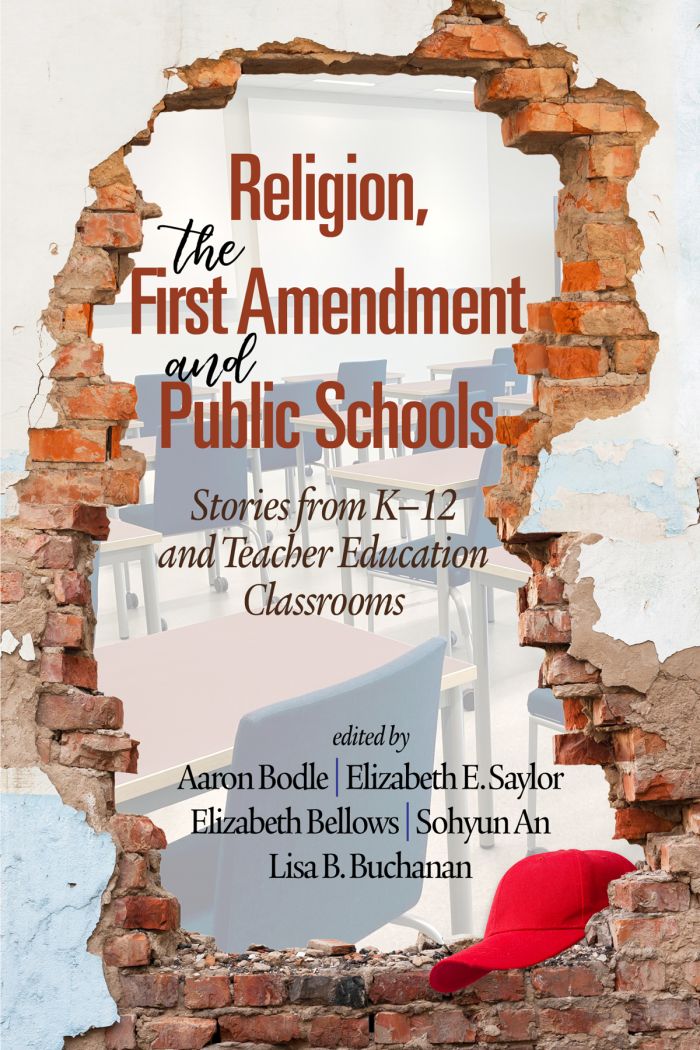
Religion, the First Amendment, and Public Schools
Stories from K-12 and Teacher Education Classrooms

This book can be opened with

Note on our eBooks and Audiobooks: you can read our eBooks (ePUB or PDF) and listen to audiobooks on the free Emerald Books app on iOS, Android, and desktop. Or read and listen on Emerald's online reader (ePUB eBooks and audiobooks only). To purchase a digital book you will need to create an account if you don’t already have one. After purchasing you will receive instructions on how to get started.
- Description
- Contents
White Christian Nationalism is “an ideology that seeks to idealize and advocate a fusion of American Civic life with a… White Christian ethnoculture” rooted in traditionalism, anti-immigration, and their judicial codification (Gorski & Perry, 2021). Though the Establishment Clause clearly delineates a boundary between religion and state. Despite the clarity of this division in the Establishment Clause, this bedrock of our democracy has faced nearconstant pressure from Christian right. Recently, this pressure has taken the form of strategic efforts to stack the Supreme Court of conserative judges and control local school boards by waging fear and misinformation campaigns. Political division, a lack of healthy discourse about religious diversity, and misunderstandings about the Establishment Clause have left many educators unsure about their role in valuing religious diversity in their schools and classrooms, and their responsibilities to maintain religious freedom for all students.
This book leverages the power of story to animate the dangerous legal and cultural assault on the separation of church and state in U.S. public schools. All of the chapter authors attend to these themes from distinct vantage points across education theory and research, K-12 education, and teacher education, addressing issues such as religious freedom, education law, teacher and student identity, and teaching for inclusive, critical citizenship in a contentious U.S. political context. Additionally, authors offer practical resources for responding to enemies of religious freedom, White Christian nationalism, and xenophobia as it is manifested in policy and practice within K-12 and higher education.
Introduction—Towards the Humanity of Religious Diversity and Freedom of Religion: A Letter From the Editors; Aaron Bodle, Elizabeth E. Saylor, Elizabeth Bellows, Sohyun An, and Lisa Buchanan.
- Part I: Public Education And Religion: Theory, Research, And The Law.
- Chapter 1. Part I Introduction; Elizabeth E. Saylor and Aaron Bodle.
- Chapter 2. At the Intersection of Teacher Education, the Social Studies, and Religious and Theological Studies: A Space for Preparing Preservice Teachers to Incorporate Religion Into Their K-12 Classrooms; Rory P. Tannebaum and Russell Olwell.
- Chapter 3. Religious Freedom, Public School, and the Law; Elizabeth E. Saylor.
- Chapter 4. Religion and Teacher Education: Lessons for Preservice Teachers; Kimberly R. Logan and David F. Callaway.
- Chapter 5. Disrupting Christian Normalcy in U.S. Elementary Schools: The Potential of Idealism in a System of Forced Neutrality; Elizabeth Bellows and Aaron Bodle.
- Part II: Stories From The K-12 Schools: Problem, Challenge, Possibility.
- Chapter 6. Part II Introduction; Jennifer Hauver.
- Chapter 7. Feminist and Liberatory Voices in Islam and Christianity: Teaching Diversity Within Religious Faith; Esther June Kim and Lina Kassem.
- Chapter 8. Pulling Apart the Sides of Islam and Phobia: Children's Literature as Opportunities for Engaging With Sociophobic Reactions; Nermin Vehabovic.
- Chapter 9. Appropriation and Encounter in Religious Literacy Education for Pre-Service Teachers; Brett Bertucio.
- Chapter 10. Billboards, Blowback, and Fear: Teaching About Islam in the American South; Nick Bardo.
- Chapter 11. This Is Not About Religion: Troubling the Perceptions of Palestine and Palestinians; Hanadi Shatara and Muna Saleh.
- Part III: Stories From The Teacher Education Classrooms: Problem, Challenge, Possibility.
- Chapter 12. Part III Introduction; Shin Ji Kang.
- Chapter 13. I Used to Think Religion—I mean Christianity—was a Cult: Examining Christian Hegemony in Student Understandings of Religion; Emma Nicosia and Ryan Oto.
- Chapter 14. A Deterrent to the Religious Beliefs of Many of Our Families: Opposition to an Elementary Social Studies Curriculum; Anna M. Yonas and Stephanie van Hover.
- Chapter 15. Learning About World Religions Through Local Sacred Spaces; Sarah Brooks.
- Chapter 16. Understanding Educator Motivations for Participating in Religious Literacy Professional Development; Kate E. Soules and Gayle Pagnoni.
- Chapter 17. Released Time Education: The Public Bible Education Program; Grant Johnson.
- Chapter 18. Using Inquiry to Teach About Religion in Middle and High School Classrooms; Kimberly R. Logan, John K. Lee, and David F. Callaway.
- Chapter 19. The Complexities Around Religious Freedom, Positionalities, and K-12 Schools: A Narrative Self-Study of International and U.S. Teachers; Ana Herrera Castillo, Hannah Wilpon, and Lisa Brown Buchanan.
- About the Editors.
- About the Contributors.