
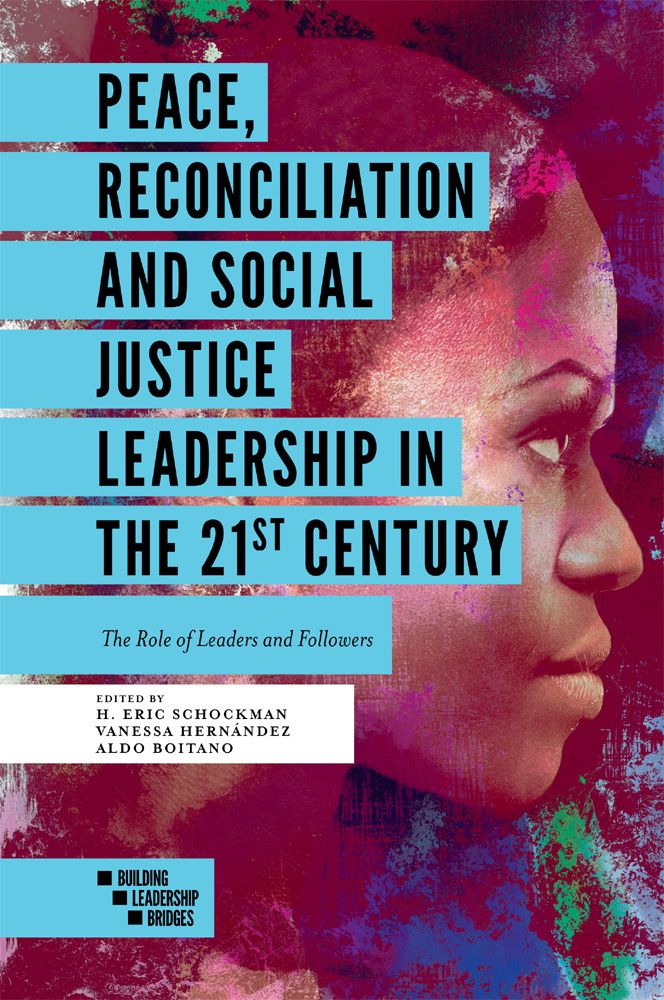

Peace, Reconciliation and Social Justice Leadership in the 21st Century
The Role of Leaders and Followers

This book can be opened with

Note on our eBooks and Audiobooks: you can read our eBooks (ePUB or PDF) and listen to audiobooks on the free Emerald Books app on iOS, Android, and desktop. Or read and listen on Emerald's online reader (ePUB eBooks and audiobooks only). To purchase a digital book you will need to create an account if you don’t already have one. After purchasing you will receive instructions on how to get started.
- Description
- Contents
- Reviews
- About
Foreword: Rick Barton Introduction: On Peace, Reconciliation and Social Justice; H. Eric Schockman, Vanessa Hernández, Aldo Boitano Part I: Reconciliation 1. Leading and Following for Transformation in a Society Shaped by its Traumatizing Racial History; Ira Chaleff 2. The Role of Work with Psychological Traumatization and Self-Help in Peacebuilding and Reconciliation; Charles Tauber and Sandra Marić 3. Mercy, Justice and Reconciliation: Pope Francis, Inclusive Leadership and the Roman Catholic Church; Douglas Cremer 4. Uses of A Holding Environment as Container for Stepping Up and Stepping Back in the Context of Truth and Reconciliation; Sara Chace Part II: Community Building: To Make, Build, and Maintain Peace 5. Second Generations Perspectives and Practices on Reconciliation After Genocide: A Case Study of Rwanda; Chantal Marie Ingabire & Annemick Richters 6. Research Leader-Follower Development for Peacebuilding and Social Justice: The African Young Graduate Scholars Development Program; Sylvester Maphosa & Alphonse Keasley 7. Women Can Make A Difference: Economic Marginalization of Women's Right to Equity in Post-Conflict Context of Sri Lanka and the Revival of Challenges Beyond UNRSC 1325; Ziyana Nazeemudeen 8. Economically Empowering Women as Sustainable Conflict Resolution: A Case Study on Building Peace in Uganda Through Social Enterprise; Lisa Liberatore Maracina Interlude: The Geneva Leadership Alliance: learning to lead (and follow) in peacebuilding and social justice; Patrick Sweet Part III: International Law and Social Justice 9. Women’s Post-War Activism in Bosnia-Herzegovina: A Human Right Approach to Peacebuilding and Reconciliation Through Liminal Space; Edin Ibrahinefedic & Randal Joy Thompson 10. Climate Justice: Building Opportunities for Women's Participation and Leadership in the Climate Change Regime; Douglas de Castro 11. Toxic to Transformational Leadership: Peace, Reconciliation and Social Justice as the Paradigm; Lorraine Stefani 12. Bosnia-Herzegovina: Upstanders and Moral Obedience; Bruce C. Pascoe 13. The Leadership of the Vicariate of Solidarity During the Dictatorship in Chile (1973-1990); Fátima Esther Martínez-Mejía & Nelson Andrés Ortiz Villalobos Part IV: Peacebuilding 14. Peace Leadership for Sustainable Change: Lessons from Women PeaceMakers; Whitney McIntyre Miller & Miznah Omair Alomair 15. Beyond Ubuntu: What the World Can Learn About Community Building in Africa; Lyndon Rego, Katleho Mohona & Gavin Peter 16. Enhancing Peace Through Survivor's Leading Transitional Justice Efforts: A New Paradigm; Malini Laxinarayan & Benjamin Durr 17. Conflict Management in Extractive Industries in Indonesia: Leaders-Followers Dynamic to Achieve Perceived Social Justice in Communities; Josephine Marieta, Bagus Takwin, & Corina D. Riantoputra Epilogue: Democratizing Leadership: Pre-Conflict Preventative Peacebuilding; Mike Klein
In all my years as a public servant, I have always looked for guideposts to help me better understand a fractured world. This outstanding interdisciplinary volume provides an excellent roadmap to piece together the mosaic of peace, reconciliation, and social justice not just from a leader’s perspective, but from the voices and actions of followers. This book forms an essential praxis through the lens of gender, diversity, spirituality, inclusiveness to better deal with global restoration of a more beloved community.
In this ambitious interdisciplinary volume, the authors seek to understand the concept of peace and reconciliation through leadership and followership theories and practice from the current generation’s perspective in the midst of today’s turbulent and unsettling times. The immediate need for this global analysis of peace and reconciliation from a trans-disciplinary lens is crucial. The authors of this volume provide a solution through the concept of decolonization by first giving a voice to those most impacted by conflict and then by listening to those voices in order to bring about social justice.
At a time when the global order founded by liberal democracies is in retreat, beset by authoritarian rivals on one side and failing states on the other, academia might be ready for the tonic of a “peace and conflict studies” approach to the study of leadership – leading to an understanding of the moral, spiritual, and political roles of leaders in healing a divided society. This book lays the groundwork.
Social oppression, civil war, and state genocide are often a direct product of leadership failures, but recovery from them can be facilitated by other leaders and even followers who appreciate and exercise the powers of truth telling, community reconciliation, and national rebuilding. H. Eric Schockman, Vanessa Hernández, and Aldo Boitano have gathered a host of penetrating and informative accounts of just that in Peace, Reconciliation, and Social Justice in the 21st Century, which serves as both an inspiration and a roadmap for those whose wish to apply their own leadership to recovering and coming back from human calamities.
An excellent view of the study of leadership and a just world order, the book provides a trans-disciplinary approach to issues of equity, inclusion, and trust. The building of sustainable peace is basic to the text as each chapter examines the themes of reconciliation, community building, international law, and social justice. This book is important and I give it my highest recommendation.
Contributors to this book include academics and practitioners in international law, social justice, leadership studies, conflict studies, international studies, and international human rights; many are practitioners in social justice and reconciliation initiatives around the world. In their papers on reconciliation, community building, international law, and peacebuilding, they present issues and ideas for both leaders and followers, centering on the positive impact of public policies on national and international order. Case studies detail experiences in post-conflict societies including Rwanda, Uganda, Sri Lanka, Indonesia, Bosnia-Herzegovina, and Chile. Many of the papers offer profiles of women peacemakers and deal with the importance of women’s activism, women’s economic empowerment, and reparation for survivors of conflict-related sexual violence. Distributed in North America by Turpin distribution.