
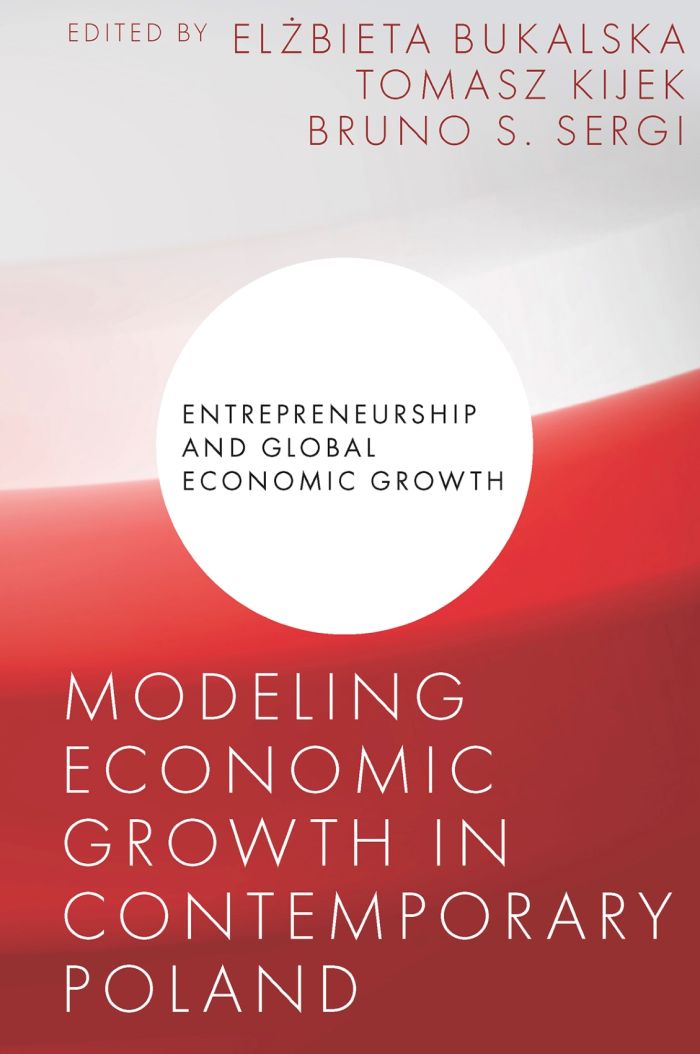

Modeling Economic Growth in Contemporary Poland

This book can be opened with

Note on our eBooks and Audiobooks: you can read our eBooks (ePUB or PDF) and listen to audiobooks on the free Emerald Books app on iOS, Android, and desktop. Or read and listen on Emerald's online reader (ePUB eBooks and audiobooks only). To purchase a digital book you will need to create an account if you don’t already have one. After purchasing you will receive instructions on how to get started.
- Description
- Contents
- About
Over the past 15 years, Poland has been one of the fastest-growing countries in the European Union. Trying to explain the sources of Poland’s economic success and decouple it from simple stylized facts on economic convergence anchored in the neoclassical growth models, the authors show how the Polish economy rapidly moved away from the communist economic system, which had ended up in an economic collapse, and moved towards unprecedented growth in income and the quality of life.
Analyzing the transition and contemporary challenges of the Polish economy – including resilience to COVID and the Ukraine war, issues relating to Polish economic growth’s institutional and policy framework, and the prospects of economic growth in Poland from the micro, mezzo, and macro perspectives – Modeling Economic Growth in Contemporary Poland is suitable for practitioners and academics interested in discovering the foundations for Polish growth, exploring whether this growth will likely last in the future.
Entrepreneurship and Global Economic Growth presents modern examinations of economic growth at national, regional, and global levels. Each book in this series discusses different dimensions of the changing economic and industrial contexts and examines in detail their impact on the nature of growth and development.
Part 1. Transition and contemporary challenges of the Polish economy
- Chapter 1. Factors of Polish Economic Growth – Past and The Future; Jakub Bis and Jakub Czerniak
- Chapter 2. An Odyssey with a Happy End? The Polish Economic Transition: Outcome and Lessons; Katarzyna Szarzec, Dawid Piątek, and Bartosz Totleben
- Chapter 3. Income convergence: does the catch-up process take place in Polish regions?; Arkadiusz Kijek and Bartosz Jóźwik
- Chapter 4. Green Transformation of the Polish Economy; Armand Kasztelan and Adam Sulich
- Chapter 5. Economic Resilience In The Face Of Covid and the War in Ukraine: Key Lessons from the Situation of the Polsih Economy; Artur Paździor, Wiesława Caputa, and Izabela Krawczyk-Sokołowska
- Chapter 6. Food security through the COVID-19 crisis and beyond – Poland: a case study; Aleksandra Kowalska, Sophia Lingham, Damian Maye, and Louise Manning
- Part 2. Institutional and policy framework for Polish economy growth
- Chapter 7. Monetary Policy and Corporate Investment – Analysis of Different Monetary Policy Channels: Evidence from Poland; Anna Szelągowska and Ilona Skibińska-Fabrowska
- Chapter 8. Effects of fiscal policy and monetary policy on the capital market in Poland; Mariusz Kicia and Dominika Kordela
- Chapter 9. Innovation Policy And National Innovation System: Evidence From Poland; Anna Matras-Bolibok and Piotr Bolibok
- Chapter 10. New opportunities in Poland’s decarbonization energy policy – prospects for the development of small-sized nuclear power (SMRs); Andrzej Szablewski
- Chapter 11. Impact of the Common Agricultural Policy on the Development of the Polish Agricultural Sector; Anna Nowak and Anna Budzyńska
- Chapter 12. The analysis of economic growth and monetary policy for Poland and selected Central and Eastern European countries with the use of dynamic time warping; Michał Bernardelli and Mariusz Próchniak
- Part 3. Prospects of economic growth in Poland: the micro, mezo and macro perspective;
- Chapter 13. Innovation or Imitation: The Right Key to Growth in Poland; Tomasz Kijek and Małgorzata Markowska
- Chapter 14. Development of Polish ICT Sector: Education, Governmental Policy, Employment, and Future Trends; Łukasz Wiechetek and Arkadiusz Gola
- Chapter 15. Evolution of Poland’s Participation in Global Value Chains since the Mid-1990s; Paweł Pasierbiak and Sebastian Bobowski
- Chapter 16. Board Diversity Policy: The New Challenges of Corporate Governance in Poland; Tomasz Sosnowski and Anna Wawryszuk-Misztal
- Chapter 17. Corporate Resilience and Financial Flexibility in Times of Crisis;- Case Of Poland; Elżbieta Bukalska and Michał Bernard Pietrzak
- Chapter 18. The Entrepreneurial Ecosystem In Poland: A Panacea For Growth?; Marek Angowski and Mariusz Sagan
Elżbieta Bukalska is a Professor at the Faculty of Economics at Maria Curie Skłodowska University in Lublin, Poland. She is the chair of the Corporate Finance and Accounting Department. Her research area covers corporate finance: SME financing, dividend policy, and capital structure.
Tomasz Kijek is a Professor at Maria Curie Skłodowska University in Lublin, Poland, where he currently heads the Department of Microeconomics and Applied Economics. He is also the President of the Polish Economic Society Branch in Lublin.
Bruno S. Sergi, Ph.D., is an instructor at Harvard University, where his teaching portfolio includes courses on emerging markets and development economics. He leads the Lab for Entrepreneurship and Development (LEAD) in Cambridge, USA.