
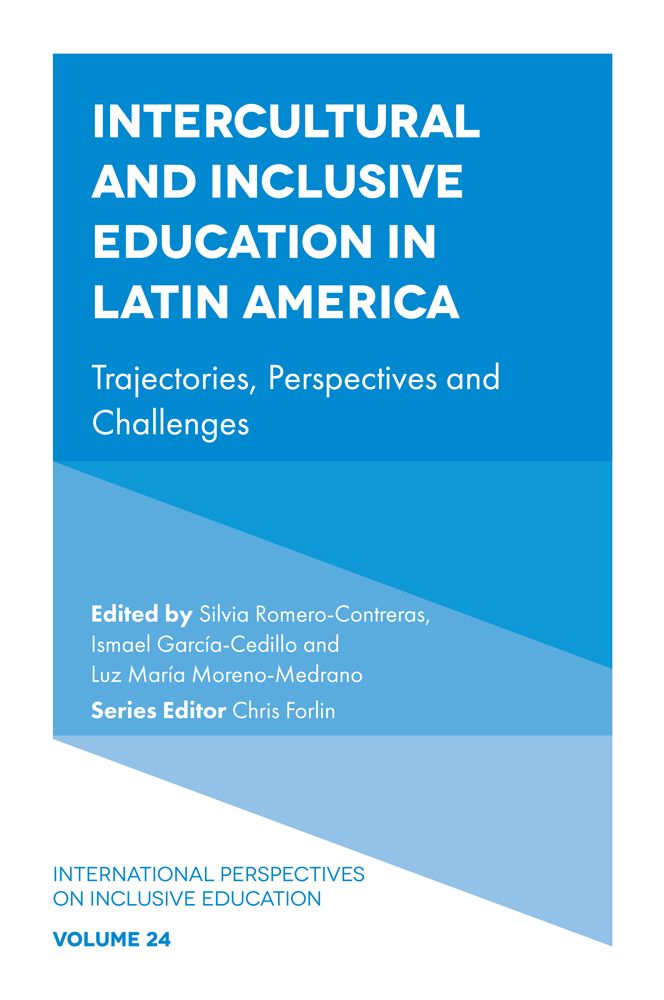

Intercultural and Inclusive Education in Latin America
Trajectories, Perspectives and Challenges

This book can be opened with

Note on our eBooks and Audiobooks: you can read our eBooks (ePUB or PDF) and listen to audiobooks on the free Emerald Books app on iOS, Android, and desktop. Or read and listen on Emerald's online reader (ePUB eBooks and audiobooks only). To purchase a digital book you will need to create an account if you don’t already have one. After purchasing you will receive instructions on how to get started.
- Description
- Contents
- About
Quality education is a human right and all individuals and peoples regardless of their social, ethnic, personal, economic, gender, or religion, should be able to participate and engage in productive and lifelong learning. This volume explores the ways in which intercultural and inclusive education have been addressed in Latin America through small, local, or nation-wide programs to improve peoples’ experiences regarding diversity, such as racism, classism, meritocracy, and redefines the priorities to advance on the quality of education for all.
Key international authors contribute chapters on the history, status, and challenges of intercultural and inclusive education in a specific country or region in Latin America. Intercultural and Inclusive Education in Latin America: Trajectories, Perspectives and Challenges focuses on the history and advances in public policies, teaching practices, educational programs, as well as new methodologies and theoretical perspectives to understand the Latin American context and offer culturally appropriate alternatives to respond to old and emerging socio-educational needs.
Providing a unique convergence of multiple perspectives, this collection incorporates diverse epistemologies, research approaches, and intervention practices, across a variety of educational and social contexts in the Latin American region.
Chapter 1. Context and socio-cultural determinants of inclusion and interculturality in Latin America; Ismael García-Cedillo and Silvia Romero-Contreras
- Chapter 2. Opportunities for people with special educational needs in higher education in Chile: an analysis of educational trajectories; Ernesto Treviño-Villarreal and Eugenia Victoriano Villouta Chapter 3. Inclusive education in Brazil: the potential of technology to facilitate inclusive practice; Dianne Chambers and Rodrigo Hübner Mendes
- Chapter 4. Education for all from the early years: inclusive experience in Chile; Paula Tapia Silva, Patricia Soto de la Cruz, and Yarela Muñoz López
- Chapter 5. Inclusive education in the Plurinational state of Bolivia: from decolonization to inclusion; Chris Forlin, Luis Adolfo Machicado Pizarro, and Gisselle Gallego
- Chapter 6. Training teachers for inclusive education in Colombia: From policy to practice; Gloria Calvo
- Chapter 7. Teacher training as a mediator of change towards inclusive education in Costa Rica; Lady Meléndez Rodríguez, Rocío Deliyore Vega, and Mario Segura Castillo
- Chapter 8. Inclusion of families in basic education in Mexico: policies, practices and cultures; Cristina Perales Franco
- Chapter 9. Teacher’s scientific explanation practices: Opportunities for equity; Valeria M. Cabello and David Geelan
- Chapter 10. Interculturality and educational inclusion in Brazil and Mexico: a comparative analysis; Stefano Claudio Sartorello and Alexandre Ferraz Herbetta
- Chapter 11. Interculturality in and out of the classroom: Indigenous voices and knowledge about equity; Laura Alicia Valdiviezo, Rukmini Becerra Lubies, and Dayna Andrea Moya Sepulveda
- Chapter 12. Inclusion and equity in higher education: the case of Ecuador, a plurinational and intercultural country; Pilar Samaniego-Santillán, Verónica Gabriela Maldonado-Garcés, and Mónica Delgado-Quilismal
- Chapter 13. The rural education model with Escuela Nueva and the Universidad en el Campo in Colombia; Diego Juárez Bolaños
- Chapter 14. School as a learning community: Critical interculturality and inclusion in action; Luz María Moreno-Medrano
- Chapter 15. The Implications of Epistemic Justice for Intercultural and Inclusive Education; Sylvia Schmelkes del Valle
Silvia Romero-Contreras is Professor at the Universidad Autónoma de San Luis Potosí, Mexico; former advisor to the National Project for Educational Integration in México and academic coordinator of the Inclusive Education Teacher Training Graduate Program in Paraguay.
Ismael García-Cedillo is Professor at the Universidad Autónoma de San Luis Potosí, Mexico. He directed the National Project for Educational Integration in México and the Inclusive Education Teacher Training Graduate Program in Paraguay.
Luz María Moreno-Medrano is the Director of the Research Institute for Educational Development (INIDE) at the Universidad Iberoamericana in Mexico City. She is the Mexican coordinator of the international project of Schools as Learning Communities.