
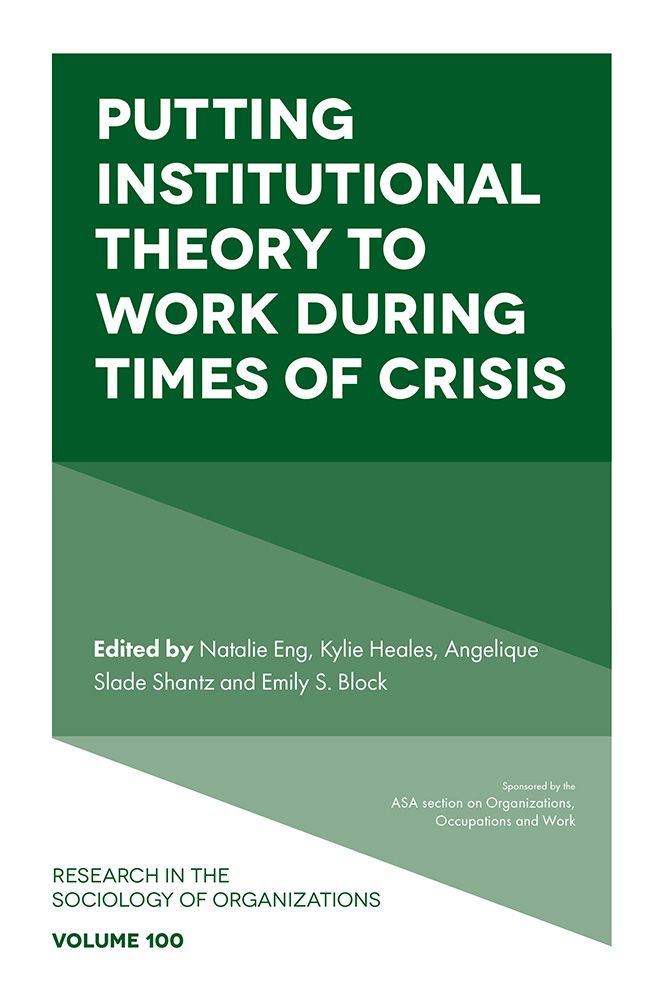
Putting Institutional Theory to Work During Times of Crisis

This book can be opened with

Note on our eBooks and Audiobooks: you can read our eBooks (ePUB or PDF) and listen to audiobooks on the free Emerald Books app on iOS, Android, and desktop. Or read and listen on Emerald's online reader (ePUB eBooks and audiobooks only). To purchase a digital book you will need to create an account if you don’t already have one. After purchasing you will receive instructions on how to get started.
- Description
- Contents
- About
Putting Institutional Theory to Work During Times of Crisis addresses a persistent challenge in management research: bridging the gap between rigorous theory and practical application. Despite the perceived complexity of institutional theory, this collection shows how it offers valuable insights for practitioners navigating organizational and societal crises.
Revisiting James D. Thompson's (1956) vision of administrative science as an applied field, the editors assert that institutional theory can guide decision-makers in understanding and responding to challenges from eroding democratic institutions to climate change. With papers divided into two sections, Section A foregrounds institutions themselves, examining the practical implications of institutional dynamics; and Section B focuses on activities within and around institutions, exploring the implications of extended institutional forces. Contributing authors identify relevant stakeholders, specify actionable strategies, and delineate appropriate contexts for application. By synthesizing seemingly disparate studies, the papers present a cohesive narrative about the practical value of institutional theory in addressing contemporary crises.
Illuminating the complex interplay between actors, practices, and institutional contexts, Putting Institutional Theory to Work During Times of Crisis provides a nuanced understanding of how change can be affected within structural constraints. This work demonstrates how institutional theory can fulfil its potential as both a rigorous academic pursuit and a valuable guide for real-world decision-making.
Introduction: Putting Institutional Theory to Work During Times of Crisis; Kylie Heales, Natalie Eng, Angelique Slade Shantz, and Emily S. Block
- Chapter 1. Bridging Theory and Practice in an Era of Crisis and Complexity: A Science Communication Approach to Academic-Practitioner Engagement; Prativa Baral and Jasmine Mah
- Section A
- Chapter 2. Regenerative Organizing as Institutional Repair; Brett Crawford, Madeline Toubiana, and Erica Coslor
- Chapter 3. Scaling Social Innovations – The Role of Institutional Infrastructure in “Mission Drift” at the Field Level; Andrea Wessendorf, Kamal Munir, and Royston Greenwood
- Chapter 4. Beyond Central Actors: Rethinking the Role of Peripheral Actors in Fields Facing Decline; Maggie M. Cascadden, Emily S. Block, and Viva Ona Bartkus
- Chapter 5. Transforming Via Mutability and Transposability: The Organizational Implications of Logics and Their Values; Bandita Deka Kalita and Joel Gehman
- Section B
- Chapter 6. Visualizing Institutions: Tweeting Images and Emotions in the Wake of the 2013 Boston Marathon Bombings; Christi Lockwood and Mary Ann Glynn
- Chapter 7. The Practical Significance of History: When and How History Can Be Used for Institutional Change; Natalie Eng, Laura Fey, and Hannah Schupfer
- Chapter 8. When Business as Usual Fails: The Case of Urban Agriculture in Detroit; Jocelyn Leitzinger and Robert David
- Chapter 9. Institutional Perspectives on Social Enterprise – Relevance for Policy in Democratizing Contexts; Nazik Beishenaly, Johanna Mair, and Emily S. Block
Natalie Eng is affiliated to the Strategy, Entrepreneurship, and Management Department at the University of Alberta, Canada.
Kylie Heales is an Assistant Professor in the Department of Management and Marketing at the Edwards School of Business, University of Saskatchewan.
Angelique Slade Shantz is an Associate Professor of Strategy, Entrepreneurship and Management at the Alberta School of Business, University of Alberta, and the Canada Research Chair in Social Entrepreneurship.
Emily S. Block is an Associate Professor of Strategy, Entrepreneurship and Management and the George Cormie Chair in Management at the Alberta School of Business, Canada.