
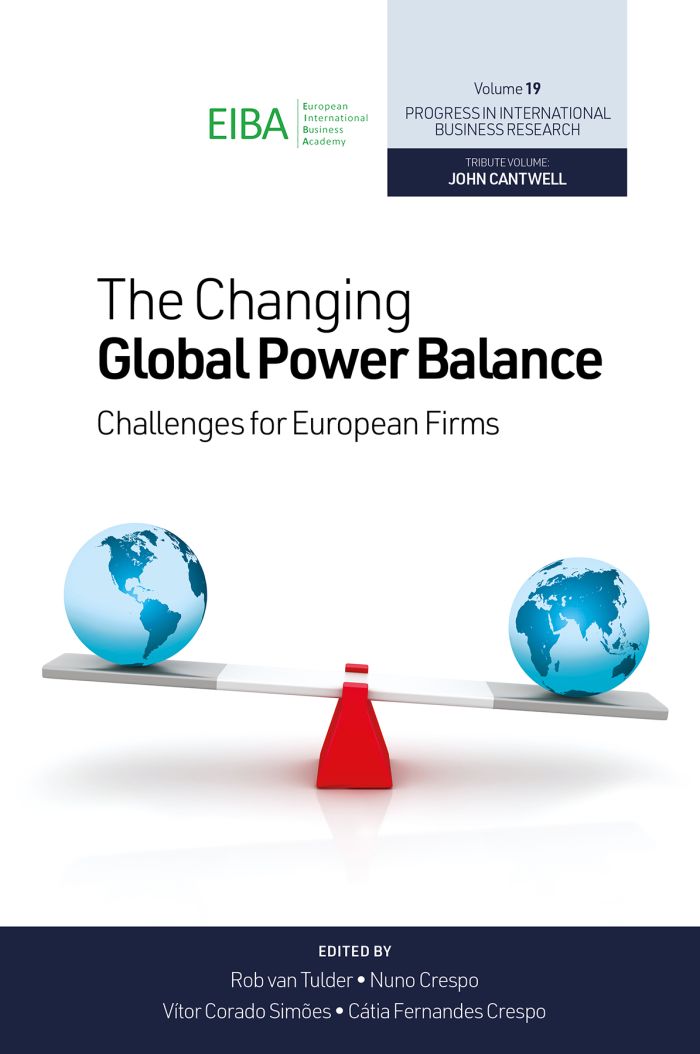

The Changing Global Power Balance
Challenges for European Firms

This book can be opened with

Note on our eBooks and Audiobooks: you can read our eBooks (ePUB or PDF) and listen to audiobooks on the free Emerald Books app on iOS, Android, and desktop. Or read and listen on Emerald's online reader (ePUB eBooks and audiobooks only). To purchase a digital book you will need to create an account if you don’t already have one. After purchasing you will receive instructions on how to get started.
- Description
- Contents
- About
The 2023 conference of the European International Business Academy (EIBA) was held in Lisbon, three decades after the previous EIBA Lisbon conference in 1993. Over this 30-year period, the international business environment changed dramatically, passing through phases of globalisation, increased nationalistic sentiments in a large number of countries, and a ‘cascade of crises’ or a ‘poly-crisis’. Currently, MNEs operate within a changing global power balance, with China and its allies challenging the hegemony of the U.S. and its allies. For European MNEs as well as for policy makers, the world economy is no longer characterized by a clear set of relatively stable enabling global conditions but rather by increased volatility, uncertainty, complexity and ambiguity (VUCA).
Volume 19 of the Progress in International Business Research (PIBR) series covers three key vectors: The changing global power balance in the world economy, how to deal with rapid changes in technology and innovation, and how to understand and assess the resulting challenges for Europe. A wide variety of perspectives are presented here, including a chapter from Elisa Ferreira, the European Commissioner for Cohesion and Reforms, who takes stock of the present situation and looks into the future from a European policy perspective. By choosing ‘innovation’ as a major area of focus, we pay tribute to one of the leading international business authors in that area – and a long-term EIBA member – John Cantwell.
Chapter 1. The Changing Global Power Balance: Challenges for European Firms – An Extended Essay; Vítor Corado Simões, Rob van Tulder, Nuno Fernandes Crespo, and Cátia Fernandes Crespo
- Part I: Ecosystems and International Cooperation for Innovation
- Chapter 2. An Evolutionary Approach to Technological Innovation and International Business: The Links from the Past to the Future; John Cantwell
- Chapter 3. Ecosystems of Innovation in a Multi-Paradox Era; Lucia Piscitello
- Chapter 4. Critical Raw Materials and MNE Strategies Under Paradigm Shift; Andrea Ascani, Simona Iammarino, and George Yunxiong Li
- Chapter 5. China Risk and Excess Returns: The Role of Firm Technological Capabilities; Anupama Phene and Yuxi Cheng
- Part II: Heading Towards De-Globalisation
- Chapter 6. The Changing Global Power Balance – Challenges for European Firms: Commentary; Peter Buckley
- Chapter 7. Does De-globalization Imply De-internationalization?; Gabriel R.G. Benito
- Part III: Economic Geography and European Policy Challenges
- Chapter 8. The Return of Economic Geography in a Fragmented World: Attracting and Anchoring Talent and Firms; Elisa Ferreira
- Chapter 9. An International Business Policy Perspective of the European Union’s Cohesion Investments; Ari Van Assche
- Part IV: War in Europe: Main Challenges
- Chapter 10. Internationalization as a Resource: Lessons from Ukrainian Company Response to War’s Crisis; Krzysztof Obloj and Roksolyana Voronovska
- Chapter 11. How Sustainable Conduct Impacts Companies’ Reactions to Sanctions? The International Survey; Stępień Beata and Szymon Truskolaski
- Chapter 12. Analyzing Consumer Responses to Warwashing Amidst the Russia-Ukraine Conflict: A Comparative Study of Portuguese and Danish Perspectives; Susana C. Silva, Paulo Duarte, and Benjamin Kanne
- Chapter 13. In the Shadow of the War: Reflection on IB-Related Challenges for Poland; Barbara Jankowska and Marta Götz
- Part V: Implications of Increasing Geopolitical Risks
- Chapter 14. Institutionalised Construal of Chinese Versus American Firms in the Semiconductor Industry: Path-Dependence and Business Narrative Fits; Tariq H. Malik
- Chapter 15. Diplomacy in a Challenging Geopolitical Landscape: Impact on Chinese Multinational Corporations; Diego Quer
- Chapter 16. Alone or Together: Chinese Overseas Lending Governance Structure Choices and the Role of Bilateral Relations; Constantin Lackinger
- Chapter 17. Geopolitical Risks: Differential Impacts on Domestic Firms and MNEs; Benedikt Zoller-Rydzek, Siyana Gurova, and Florian Keller
- Part VI: Relevance of Emerging Countries Issues
- Chapter 18. Impact Investment Firms and Institutionalization in Emerging Countries; Gilbert Kofi Adarkwah, Birgitte Grøgaard, and Sverre Tomassen
- Chapter 19. Beyond the Horizon: Exploring the Unknowns of Trademarks in Emerging Markets; Amy Linh Thuy Nguyen
Rob van Tulder is emeritus full Professor of International Business - Society Management at RSM Erasmus University Rotterdam (The Netherlands) and AIB and EIBA fellow.
Nuno Fernandes Crespo is Associate Professor at ISEG - Lisbon School of Economics and Management, University of Lisbon (Portugal). EIBA President (2023).
Vítor Corado Simões is a Professor at ISEG - Lisbon School of Economics and Management, University of Lisbon (Portugal). EIBA Fellow. EIBA President (1993).
Cátia Fernandes Crespo is currently Adjunct Professor at the School of Technology and Management of the Polytechnic of Leiria (Portugal).