
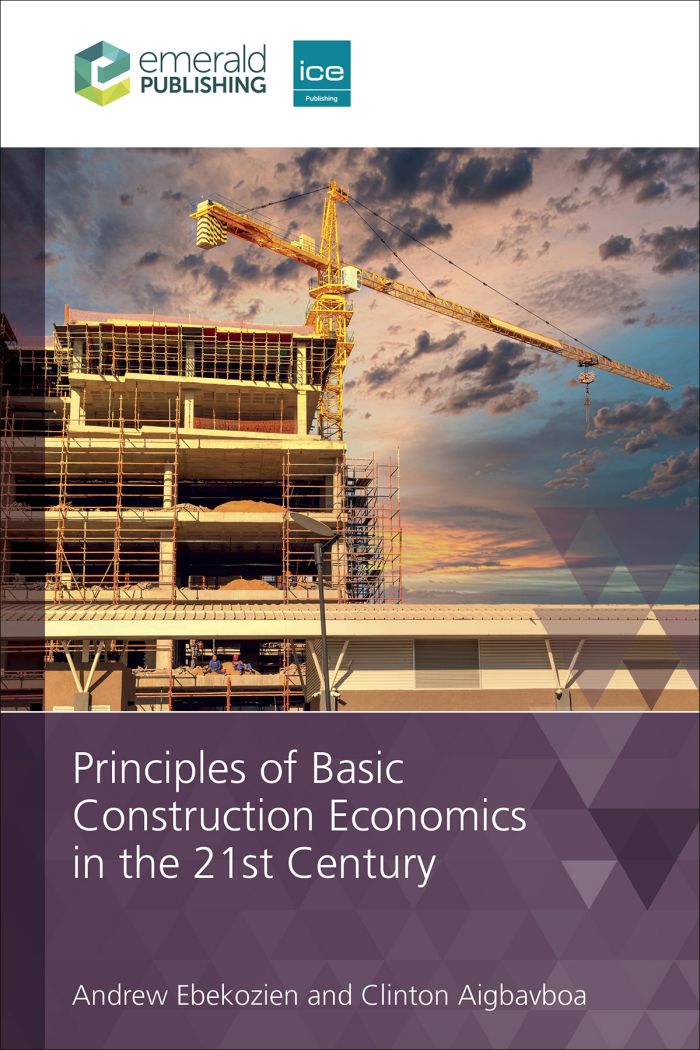

Principles of Basic Construction Economics in the 21st Century

This book can be opened with

Note on our eBooks and Audiobooks: you can read our eBooks (ePUB or PDF) and listen to audiobooks on the free Emerald Books app on iOS, Android, and desktop. Or read and listen on Emerald's online reader (ePUB eBooks and audiobooks only). To purchase a digital book you will need to create an account if you don’t already have one. After purchasing you will receive instructions on how to get started.
- Description
- Contents
- About
Principles of Basic Construction Economics in the 21st Century unravels and takes account of the widening and more sophisticated cost management and control services required by the discerning client in today’s construction industry. The book will effectively meet the needs of practitioners in the built environment discipline by providing the breadth of knowledge needed to make informed judgments on the many diverse matters within this subject and to achieve economical, sustainable construction.
The book reflects the essential aspects of construction economics required to meet the changing construction needs in the context of developing countries in the 21st century.
It covers
- the construction industry and economics and its relationship to the study of building costs
- the broad view of approximate estimating and design variables
- cost planning, control, and analysis of a construction project
- the nature of cost and cost-in-use.
In the construction industry, cost indices, property valuation, and the developer’s budget play a significant role achieving smart and sustainable construction in the 21st century. Principles of Basic Construction Economics in the 21st Century is essential reading not only for Quantity Surveying and Construction Economist practitioners and students but for all construction-related professionals such as architects, builders, estate surveyors, engineers, property managers, urban planners, and surveyors. The book also has the potential to support construction management and civil engineering courses that are desperately needed in developing economies.
Chapter 1. The Construction Industry and Economics
- Chapter 2. Approximate Estimating and Design Variables in the Construction Industry
- Chapter 3. Cost Planning, Control and Analysis of Construction Project
- Chapter 4. Life Cycle Costing for Building Projects
- Chapter 5. Cost Indices in the Construction Industry
- Chapter 6. Property Valuation and Developer’s Budget
- Chapter 7. Economics of Sustainable Construction
- Chapter 8. Economics of Smart Construction
Dr Andrew Ebekozien is a Senior Research Associate at the Department of Construction Management and Quantity Surveying, University of Johannesburg, South Africa. He is also a Lecturer at the Auchi Polytechnic, Auchi, Nigeria.
Prof Clinton Aigbavboa is the Director of the NRF/DSI Research Chair in Sustainable Construction Management and Leadership in the Built Environment and of the cidb Centre of Excellence at the University of Johannesburg, Johannesburg, South Africa.