
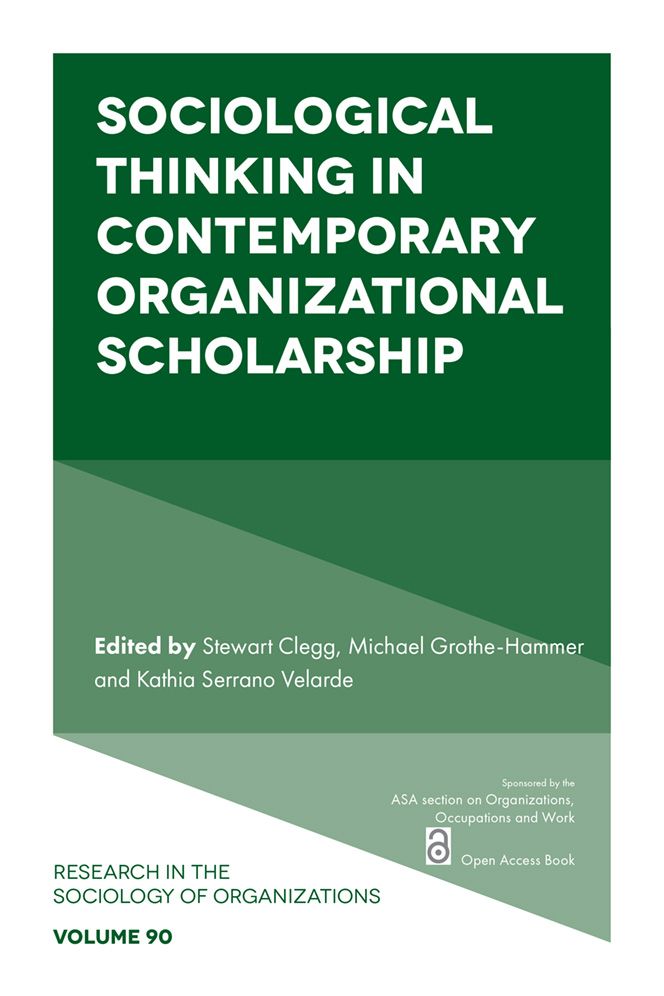

Sociological Thinking in Contemporary Organizational Scholarship

This book can be opened with

Note on our eBooks and Audiobooks: you can read our eBooks (ePUB or PDF) and listen to audiobooks on the free Emerald Books app on iOS, Android, and desktop. Or read and listen on Emerald's online reader (ePUB eBooks and audiobooks only). To purchase a digital book you will need to create an account if you don’t already have one. After purchasing you will receive instructions on how to get started.
- Description
- Contents
- About
- Open Access
The ebook edition of this title is Open Access and freely available to read online.
Though organizational scholarship traces its intellectual lineage from a diversity of sources, there is little doubt that in recent years a key divide has emerged amongst organization scholars and sociologists. For many, if not most, it has become unclear what role sociology is supposed to play in organization studies. Against this backdrop, the editors of Sociological Thinking in Contemporary Organizational Scholarship ask: what is “organizational sociology” today?
This pathbreaking volume explores the new boundaries of organizational sociology to identify, discuss and challenge sociology’s genuine contribution to organization studies. Mapping a community of scholars that transcends disciplinary limitations, chapters follow one simple epistemic logic: society happens in, between, across and around organizations.
Breathing fresh life into a once lively dialogue on the social nature, characteristics and consequences of the field, this is a valuable resource for navigating of the varied sociological scholarship we witness amongst today’s organization scholars.
Sociological Thinking in Contemporary Organizational Scholarship; Stewart Clegg, Michael Grothe-Hammer, and Kathia Serrano Velarde
- Part 1. The Place of Sociology in Organizational Scholarship
- Chapter 1. Revitalizing Organizational Theory Through a Problem-Oriented Sociology; Brayden G King
- Chapter 2. Organizational Sociology and Organization Studies: Past, Present, and Future; Leopold Ringel
- Chapter 3. Facing Up to the Present? Cultivating Political Judgement and a Sense of Reality in Contemporary Organizational Life; Thomas Lopdrup-Hjorth and Paul du Gay
- Part 2. Social Stratification In and Through Organizations
- Organizations Within Society: Organizational Perspectives on Status and Distinction
- Chapter 4. Status in Socio-Environmental Fields: Relationships, Evaluations, and Otherhood; Nadine Arnold and Fabien Foureault
- Chapter 5. Organizations as Carriers of Status and Class Dynamics: A Historical Ethnography of the Emergence of Bordeaux’s Cork Aristocracy; Grégoire Croidieu and Walter W. Powell
- Society Within Organizations: Organizational Perspectives on Social Integration and Marginalization
- Chapter 6. Organizations as Drivers of Social and Systemic Integration: Contradiction and Reconciliation Through Loose Demographic Coupling and Community Anchoring; Krystal Laryea and Christof Brandtner
- Chapter 7. Why Organization Studies Should Care More About Gender Exclusion and Inclusion in Sport Organizations; Lucy V. Piggott, Jorid Hovden, and Annelies Knoppers
- Part 3. Rediscovering Sociological Classics for Organization Studies
- Reflexivity and Control
- Chapter 8. Narrating the Disjunctions Produced by the Sociological Concept of Emotional Reflexivity in Organization Studies; Bruno Luiz Americo, Stewart Clegg, and Fagner Carniel
- Chapter 9. The Promise of Total Institutions in the Sociology of Organizations: Implications of Regimental and Monastic Obedience for Underlife; Mikaela Sundberg
- Organizing and Organization
- Chapter 10. Why Organization Sociologists Should Refer to Tarde and Simmel More Often; Barbara Czarniawska
- Chapter 11. Organization Systems and Their Social Environments: The Role of Functionally Differentiated Society and Face-to-Face Interaction Rituals; Werner Schirmer
Stewart Clegg is Emeritus Distinguished Professor of Management and Organization Studies at the University of Technology Sydney, Australia, as well as Professor of Project Management at the University of Sydney. He is widely acknowledged as one of the most significant contemporary theorists on both power relations and organization studies.
Michael Grothe-Hammer is Associate Professor in Sociology (Organization and Technology) at the Department of Sociology and Political Science of the Norwegian University of Science and Technology (NTNU), Norway. He is also President of the Research Committee on Sociology of Organizations of the International Sociological Association (ISA).
Kathia Serrano Velarde is Professor of Sociology at the Max-Weber-Institute of Sociology at Heidelberg University, Germany. She is also Vice-President of the Research Committee on Sociology of Organizations of the International Sociological Association (ISA).