
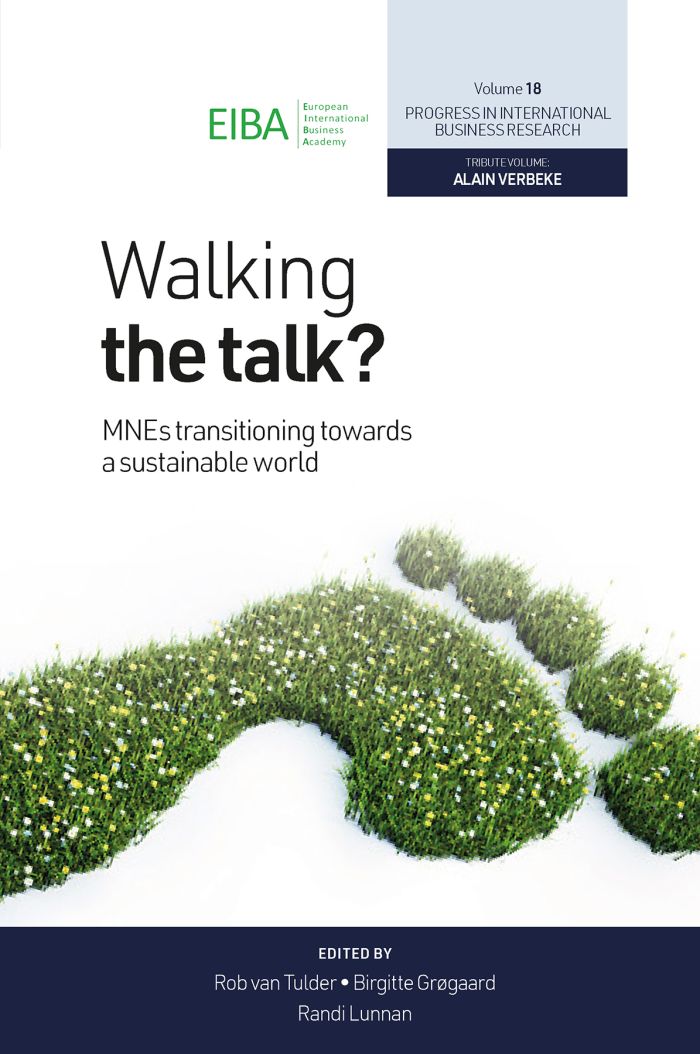

Walking the Talk?
MNEs Transitioning Towards a Sustainable World

This book can be opened with

Note on our eBooks and Audiobooks: you can read our eBooks (ePUB or PDF) and listen to audiobooks on the free Emerald Books app on iOS, Android, and desktop. Or read and listen on Emerald's online reader (ePUB eBooks and audiobooks only). To purchase a digital book you will need to create an account if you don’t already have one. After purchasing you will receive instructions on how to get started.
- Description
- Contents
- About
Across the globe, concerns escalate about the effects of greenhouse gas emissions on global climate conditions, implications on global trade from pandemics, and the destruction of ecosystems from the exploitation of limited and non-replaceable global resources. Politicians and businesses alike agree that something must be done, the question is what, how, when, and by whom? What should firms do to reduce their carbon footprint while continuing to secure jobs and profits? When should firms make decisions to transform their businesses given the uncertainty of markets as well as the lack of clear guidance from global institutions? In this volume we ask: Are we actually walking the talk?
This volume includes select contributions from the 2022 EIBA conference in Oslo, as well as a number of invited contributions. The book is a tribute to Professor Alain Verbeke who has contributed substantially to the theme of ‘walking the talk’ in the IB community. The chapters in this volume illustrate a broad spectre of research questions and ways to answer them within the IB community that provide evidence that many types of actors are taking – or can take - steps to actually “walk the talk”. The contributions also show, however, that MNEs face considerable challenges to make their ambitions real, which in turn presents a challenge for IB scholarship to develop relevant and robust analytical approaches to cover the transition problems that MNEs face.
Chapter 1. Introduction: Setting the Scene; Rob van Tulder, Birgitte Grøgaard, and Randi Lunnan
- Part I: Walking the Talk in International Business Studies
- Chapter 2. Evidence-Based International Business Scholarship; Alain Verbeke
- Chapter 3. Taking Wishes for Reality: The Neglected Role of Complementary Resources in the Choice of Foreign Market Entry, the Internationalization of Digital Ventures, and Catching-up by Emerging Market Firms; Jean-Francois Hennart
- Chapter 4. Distance, (Multi)regional Strategies, and Limitations to Bridge Distance; Thomas Hutzschenreuter
- Chapter 5. Governance for Sustainability: Alain Verbeke’s Contribution To International Business Scholarship and Practice; Liena Kano and Luciano Ciravegna
- Part II: Walking the Talk in Sustainability Issues
- Chapter 6. The Societal Responsibilities of Corporations in the 21st Century: Four Types of Challenges, Four Types of Strategies; Jacqueline Mees-Buss
- Chapter 7. Behind the Talk: Towards a Conceptual and Analytical Framework of Corporate Human Rights Reporting; Stefan Zagelmeyer
- Chapter 8. The European Union’s Cross-Border Adjustment Mechanism and its Implications for International Business; Viviana Pilato and Ari Van Assche
- Chapter 9. How Can Large International Financial Firms ‘Go Green’ and ‘Walk the Talk’?; John Holland
- Part III: Walking the Talk at the Interface with Government Policies
- Chapter 10. The Involvement of Firms in Chinese Foreign Aid Projects: A Data Overview and Research Agenda; Guus Hendricks
- Chapter 11. De-internationalization or Re-internationalization? The Role of Environmental Sustainability Orientation at Firm and Country-Level; Martina Barbaglia, Roberto Bianchini, Vincenzo Buttice, and Stefano Elia
- Chapter 12. Diffusion of Technologies: Delivering on the Promises of Battery Electric Vehicles; Alessandro Lampo and Susana C. Silva
- Chapter 13. Discussing Insights from the Carbon Performance Literature for IB: The Institutional Complexity of Climate Change Policy; Gunnar Leymann and Anna Kehl
- Part IV: Walking the Talk in International Value Chains
- Chapter 14. How Institutions Influence Firms’ Climate Change Strategies: Extending the Perspectives of International Business and Global Value Chains with Business Systems; Mohammad B. Rana and Matthew M.C. Allen
- Chapter 15. Come Closer! On Transaction Costs and Spatial Choices in a Circular Economy; Corina Fehlner
- Chapter 16. Disentangling the Effects of Circular Economy Principles on GVCs’ Activities, Configuration, and Governance; Christina Di Stefano, Stefano Elia, Paola Garrone, and Lucia Piscitello
- Chapter 17. The Role of Sustainability in Backshoring Decisions – A Conceptual Framework; Lise Lillebrygfjeld Halse
- Chapter 18. Corporate Social Responsibility, Irresponsibility, and Firms’ Financial Performance: Evidence from Emerging vs. Developed Countries; Stefano Elia, Gezim Hoxha, and Lucia Piscitello
- Chapter 19. The Role of NGOs in the Transition Towards More Sustainable and Innovative Agri-Food GVCs; Cyntia Vilasboas Calixto Casnici, Germano Glufke Reis, David Schulzmann, Marina Papanastassiou, and Jeremy Clegg
Rob van Tulder is full Professor of International Business-Society Management at RSM Erasmus University Rotterdam and Academic Director of the Partnerships Resource Centre.
Birgitte Grøgaard is a Professor of International Business and Strategy at the Department of Strategy and Entrepreneurship at BI Norwegian Business School in Oslo, Norway.
Randi Lunnan is a Professor of Strategy at the Department of Strategy and Entrepreneurship at BI Norwegian Business School in Oslo, Norway, and holds the Tom Wilhelmsen Chair of Ocean Business.