
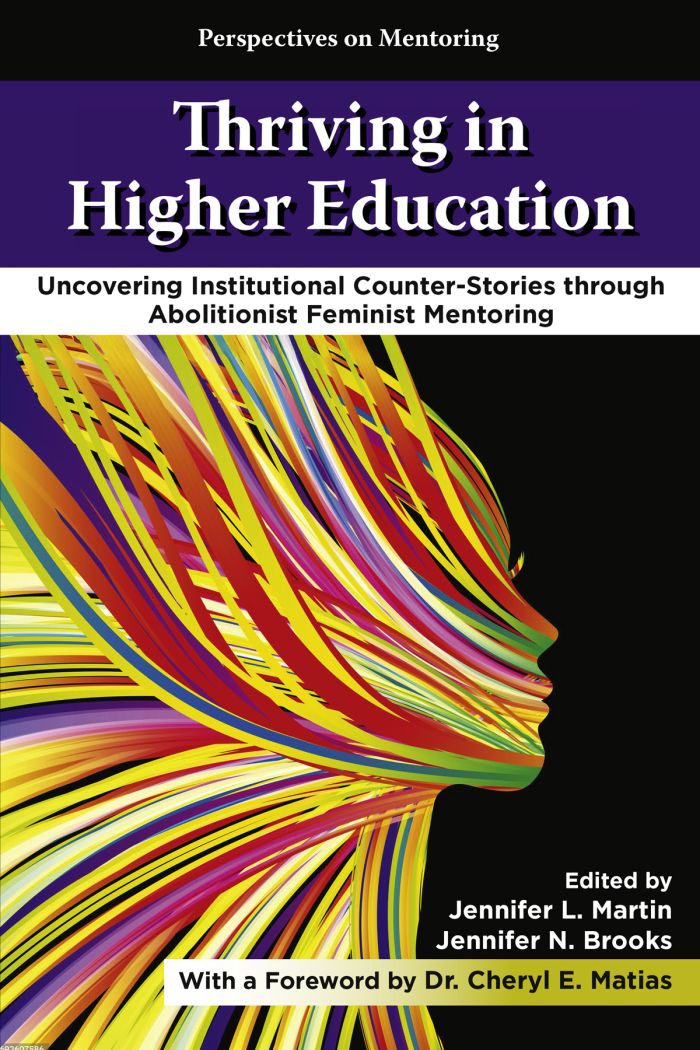
Thriving in Higher Education
Uncovering Institutional Counter-Stories through Abolitionist Feminist Mentoring

This book can be opened with

Note on our eBooks and Audiobooks: you can read our eBooks (ePUB or PDF) and listen to audiobooks on the free Emerald Books app on iOS, Android, and desktop. Or read and listen on Emerald's online reader (ePUB eBooks and audiobooks only). To purchase a digital book you will need to create an account if you don’t already have one. After purchasing you will receive instructions on how to get started.
- Description
- Contents
- About
Thriving in Higher Education: Uncovering Institutional Counter-Stories Through Abolitionist Feminist Mentoring shares personal narratives that highlight the critical role of mentoring in academic success—especially for women and people of color on the tenure track. Institutions often use mechanisms of control to shame those who challenge hegemonic norms and expectations. These shaming practices serve to silence and isolate victims, contributing to the hidden and ongoing nature of these mechanisms. In this book, scholars share experiences of microaggressions, racial battle fatigue, and institutional retaliation, revealing the hidden costs of advocating for justice and truth within academia.
These nineteen chapters, authored by multidisciplinary educators—some in collaboration with their mentors or mentees—serve as both guidebooks and cautionary tales necessary to navigate the potential perils of higher education through mentoring relationships. These brave counter-stories present tales of joy, resistance and solidarity for scholars deemed outsiders, troublemakers, boat-rockers, critical scholars, truth tellers, and the like.
While the work of dismantling institutional oppression is often costly—bringing stress, fear, and even trauma—this book stands as a beacon of hope. It offers readers not only validation and solidarity, but also practical strategies for building empowering mentoring relationships rooted in care, resistance, and community. Thriving in Higher Education is both a call to action and a testament to the resilience of those who dare to thrive in spaces not built for them.
Foreword - “Always here, but taken for granted”: The Dedication and Unappreciation of Overworked Femtors of Color; Cheryl E. Matias
- Chapter 1. I Wish I Woulda Known: Mentorship, Mobbing, and the Academy: Lessons in Power and Resistance; Jennifer L. Martin and Jennifer N. Brooks
- Chapter 2. Making Space in Narrow Rooms: The Role of Intersectional Mentoring on Program Completion; Jendayi Mbalia and Raquel Farmer-Hinton
- Chapter 3. The “Art” of Mentoring Otherwise: Troubling, Agitating and Flourishing in the Academy; Lindsey Abernathy, Stacie Warner, and Lucy E. Bailey
- Chapter 4. Performative Inclusion: Vignettes of Dehumanization, Resistance and Mentorship; Ahlam Rahal, Cynthia Bruce, Késa Munroe-Anderson, and Lynn Aylward
- Chapter 5. Centering Joy and Community in Doctoral Student Mentoring; Asia S. Thomas and Michelle Zoss
- Chapter 6. Mentoring for Freedom: Lessons from Doctoral Students of Color and the Mentor who Helped them Succeed; Lizette Aguilar, Franchesca Ho Sang, and Sherry L. Deckman
- Chapter 7. “Transformational Feminist Mentoring as Radical Love in Chicanx Studies”; Corina Benavides López
- Chapter 8. Protecting the Unprotected: The Power of Peer Mentorship in a Professional Counterspace for Black Women; Chenelle S. Boatswain
- Chapter 9. When We All We Got, Gatherings of Solidarity: Black Feminist Mentoring in Liberatory Research Teams; Taryrn T.C. Brown and Robin Phelps-Ward
- Chapter 10. ISOLATION: A Critical Race Perspective on Journeying Through Academia When Mentorship is Absent or Not Enough!; Frederick V. Jr. Engram
- Chapter 11. A Journey Through Black Femtoring and What the Academy Can Learn about Humanization; Marla Goins and K. Melchor Quick Hall
- Chapter 12. Critical Black Feminist Mentoring: Implications for Student and Faculty Success and Well-Being in Academic Spaces Post-COVID; Dyann C. Logwood and Sadaf Ali
- Chapter 13. Mentoring as Acts of Resistance and Reimagining: The Reflective Testimonios of Multiple Generations of Women Leaders in Higher Education; Katrina Struloeff, Kimberly Sterin, Karena Escalante, Sherri Manson, and Haley Rose Kowal
- Chapter 14. Swimming with the Sharks: Survival and Thriving with Academic Mentoring; Sun Y. Gu, April M. Jones, and Stephanie Anne Shelton
- Chapter 15. Thriving Through Counter-narratives of Hope, Love, and Joy: Reflections on Abolitionist Approaches to Queer/Feminist Mentorship; Trixie G. Smith and Matthew B. Cox
- Chapter 16. “We Are Each Other’s Bond": Abolitionist Feminism Peer Mentorship As Healing and Sustaining Praxis for Black Women Doctoral Students; Kiana Willis, Jaminque Adams, Bri’Ann Price, Laetitia Adelson, Brittney Kilgore, and Lastasia Ramsey
- Chapter 17. Sis, You Good? Mutual Mentorship as Care: Centering Well-being Among Black Women Scholars; Jhanae E. Wingfield, Laura Porterfield, and Lynnette Mawhinney
- Chapter 18. Mentorship Beyond Borders: Cultivating (Counter)Spaces of Wholeness for Faculty, Students, and Professionals from International Backgrounds; Yi Xuen Tay, Karren Gunalan, Milad Mohebali, and Eva Faith Sosoo
- Chapter 19. Critical Mentoring in the Hyphen: Reciprocal Connections Through a Shared Asian American Identity; Robin Brandehoff, Daranee Taychachaiwongse Teng, and Amie Ha
Jennifer L. Martin is an associate professor at the University of Illinois at Springfield.
Jennifer N. Brooks, a Ph.D. candidate in Curriculum & Instruction at the University of Illinois Chicago, is a scholar, educator, and literacy leader dedicated to racial equity and educational justice.