
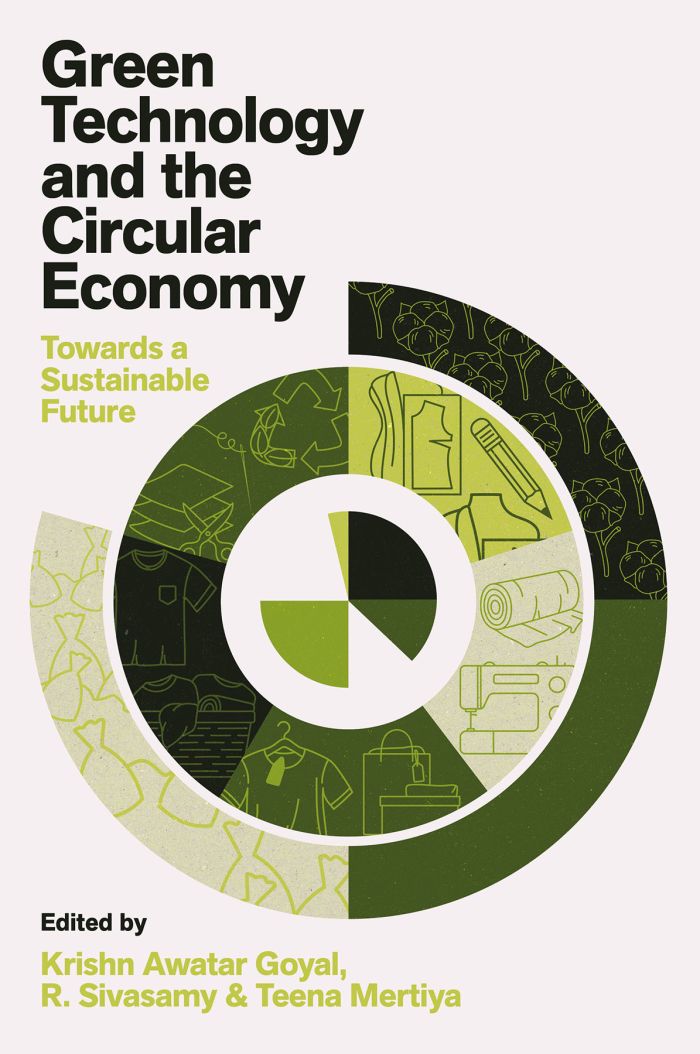
Green Technology and the Circular Economy
Towards a Sustainable Future

This book can be opened with

Note on our eBooks and Audiobooks: you can read our eBooks (ePUB or PDF) and listen to audiobooks on the free Emerald Books app on iOS, Android, and desktop. Or read and listen on Emerald's online reader (ePUB eBooks and audiobooks only). To purchase a digital book you will need to create an account if you don’t already have one. After purchasing you will receive instructions on how to get started.
- Description
- Contents
- About
Historically, companies have engaged in sustainable practices like recycling and refurbishing, but Green Technology and the Circular Economy: Towards a Sustainable Future provides modern, actionable strategies for reshaping operations. With these insights, businesses can minimize their environmental impact and maximize innovation in a rapidly evolving world.
Green Technology and the Circular Economy explores the transformative potential of the circular economy as a critical response to the global call for environmental stewardship. Delving into the principles of restorative and regenerative design, chapters advocate for reduced material consumption and the adoption of clean technologies. By emphasising the efficient reuse, recycling, and remanufacturing of products and materials, the authors highlight how the circular economy offers a sustainable alternative to the traditional linear economic model, driving resource efficiency and long-term sustainability. This edited collection also addresses the growing importance of sustainability in technology, particularly within the IT sector, where the challenges of electronic waste and carbon emissions from algorithmic training are becoming increasingly urgent. By introducing the concept of Green AI, the authors demonstrate how businesses can reduce their environmental footprint while still leveraging innovation through predictive modelling.
An essential read for academics and practitioners with a vested interest in innovation in green technology, smart cities, marine ecosystems and environmental issues.
Chapter 1. Green Technology and Circular Economy for Aquatic Waste Valorization: Public Awareness and Behavioural Intents in Aquatic Waste Management; Aparna Vajpayee, Deepak Kumar Swain, and Parag Sanghani
- Chapter 2. Blue Economy: Harnessing Sustainable Marine Potential for Future Prosperity; Meena Sharma
- Chapter 3. Environmental Impacts and Sustainability of Hydrogen Energy; Dev Kumar Mandal, Brijlal Mallik, Shivangi Kashyap, Vivek Hamal, and Krishnendu Ghosh -RETRACTED
- Chapter 4. Carving Technology-Driven Circular Economy for Sustainable Development in India: A Conceptual Framework; SN Singh and Vijayalakshmi Iyengar
- Chapter 5. Circular Economy: Trends, Challenges, and Sustainable Management Strategy of Mining Rare Earth Elements in India; Krishn Awatar Goyal, R. Sivasamy, Tomohiko Kobayashi, and Teena Mertiya
- Chapter 6. Going Green in Africa: Maximizing Artificial Intelligence Performance in Manufacturing Firms in Developing Economies; Timilehin Olasoji Olubiyi
- Chapter 7. Innovation and Sustainabity In The Cocoa Sector: The Example of a Swiss-Ghanian Start-up; Cornelia Caseau
- Chapter 8. Harnessing Indigenous Knowledge Systems for a Greener Future: Responsible Consumption, Sustainable Diet and Frugal Living Practices in Western Rajasthan; Pallavi Pathak and Kaveri Pathak
- Chapter 9. Sustainable Consumer Behaviour In the Green Cosmetics Market: A Research Agenda; Firdaus Bashir, Aswathy Prakash G, and Nikhil D Jonathan
- Chapter 10. The Paradox of Sustainable Living and Luxury Lifestyles: A Case Study on the Environmental Cost of Luxury Consumption; Rashmi Singh, Jaswinder Kumar, and Rajesh Ranjan
- Chapter 11. Impact of Circular Economy on Economic Growth and Environment: A Multi Country Study; Divya Verma and Vaishali
- Chapter 12. Effect of HRM Practices on Circular Economy of the Banking Sector; Arti Gaur and Kamal Preet Kaur
- Chapter 13. Global Policies and Green Regulations: Driving the Transition to a Sustainable Economy; Manoj Govindaraj, Chandramowleeswaran Gnanasekaran, G.M Shaju, and Jenifer Lawrence
- Chapter 14. Exploring Green AI Integration for Enhanced Crop Yield and Forest Management: A Sustainable Vision; Mohit Agrawal, Shraddha Singh, and Jinendra Kumar Jain
- Chapter 15. AI-Enabled Agro-Allied Trade Reorientation in Sri Lanka; Krishn Awatar Goyal, Athambawa Jahfer, Teena Mertiya, Sudha Bishnoi, and Rekha Verma
- Chapter 16. A Study to Analyze the Role of Green AI in Sustainable Practices of Indian Pharmaceutical Sector; Kshitiz Maharshi, Pooja Chaudhary, Surendra Bhadu, and Ramesh Kumar
- Chapter 17. The Role of Green Artificial Intelligence in Corporate Social Responsibility: An Examination of International Corporate Behaviour and Practices; S. K. Khatik, Rahul Joshi, Geetanjali Shrivastava, and Sanjit Dey
- Chapter 18. Challenges of Circular Economy in Steel Industry: A DEMATEL Approach; Pradeep Kumar and Milind Kumar Sharma
- Chapter 19. Strategies for Sustainable Energy Consumption: Towards a Greener Future; Rajeev Kumar
- Chapter 20. Green AI: Revolutionizing Smart City Infrastructure for Sustainability; Neeraj Mathur and Rashmi Mathur
Krishn Awatar Goyal is Professor of Business Finance and Economics at the Jai Narain Vyas University, Jodhpur, India.
R. Sivasamy is Professor of Statistics at the University of Botswana.
Teena Mertiya is Assistant Professor in the Department of Economic Administration and Financial Management, Govt. Bangur Postgraduate College, Pali, India.