
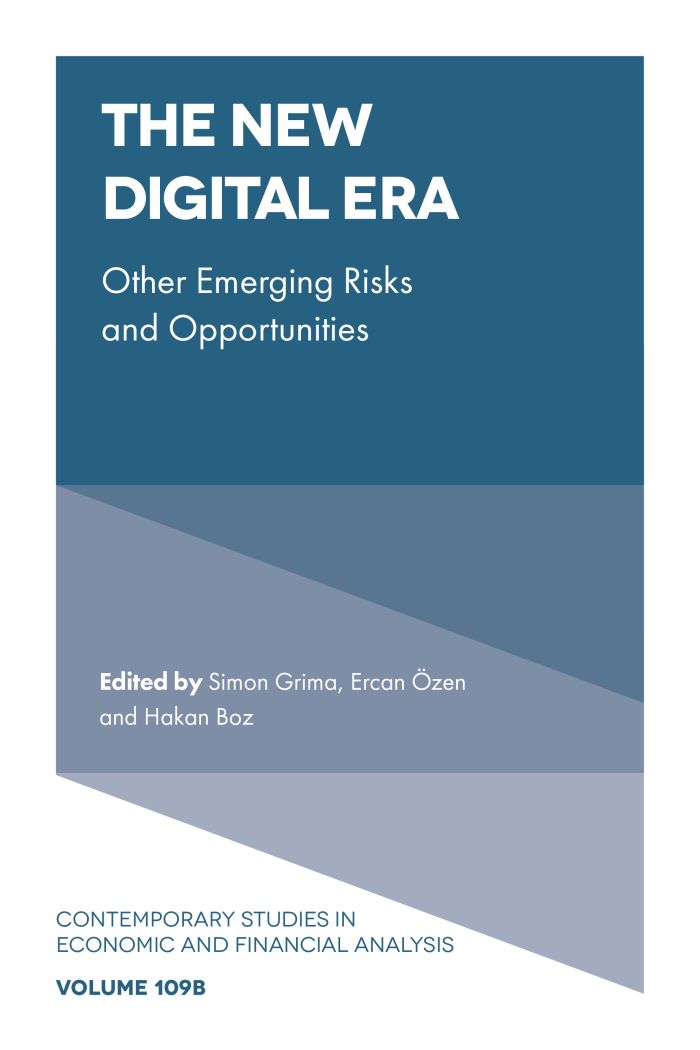

The New Digital Era
Other Emerging Risks and Opportunities

This book can be opened with

Note on our eBooks and Audiobooks: you can read our eBooks (ePUB or PDF) and listen to audiobooks on the free Emerald Books app on iOS, Android, and desktop. Or read and listen on Emerald's online reader (ePUB eBooks and audiobooks only). To purchase a digital book you will need to create an account if you don’t already have one. After purchasing you will receive instructions on how to get started.
- Description
- Contents
- About
The COVID-19 pandemic has led to further acceleration of digitalization in all areas. This caused significant changes in economic and social life. Through digitalization, the need for people in business life has decreased and has forced the traditional employment structure to change. During the pandemic period, some segments enjoyed the advantages of owning digital technologies, while others remained strangers to the new world because they were deprived of digital technologies, revealing the inequality of opportunity on an individual or social basis.
Although this rapid change produced positive results, it also brought about risks. To help mitigate such emerging risks, The New Digital Era’s two volumes vitally generate new information in order to determine the advantages and risks in which areas this digitalization, which has increased with the COVID-19 pandemic. The chapter authors highlight the new social and economic policies that are needed to balance the effects on social and economic life and prevent possible conflicts between individuals and societies
Contemporary Studies in Economic and Financial Analysis publishes a series of current and relevant themed volumes within the fields of economics and finance. Both disciplinary and interdisciplinary studies are welcome.
Other Emerging Risks and Opportunities
- Chapter 1. Achieving Financial Inclusion: Whatever it takes; Peterson K Ozili
- Chapter 2. Tourism Economic Policy, Covid -19 Restrictions, and Estimated Economic Impact the Industry; Maia Diakonidze
- Chapter 3. Impact of Crises on Capital Market Volatility: A Bibliometric Analysis; Adriana Anamaria Davidescua, Răzvan Gabriel Hapaub, and Eduard Mihai Mantac
- Chapter 4. Difficult Issues in Financial regulation for Financial Stability; Peterson K Ozili
- Chapter 5. Determinants of Intention and Investment Behavior of Youth In Kosovo: A Partial Least Squares Structural Equation Modeling Approach (Pls-Sem); Luan Vardari, Dafina Abdullahu, and Rinor Kurteshi
- Chapter 6. Defining and Analyzing the Epidemiology Results in Balkan for the Time Period of 2020 - An Overview; Hamdi Hoti, Edisona Kurhasku, and Arbër Hamdi Hoti
- Chapter 7. The Mediation Effect of Entrepreneurial Self-Efficacy in the Relationship between Entrepreneurial Passion and Leadership Styles; Diego Norena-Chavez, and Eleftherios Thalassinos
- Chapter 8. Bank Income Smoothing during the COVID-19 pandemic: Evidence from UK Banks; Peterson K Ozili
- Chapter 9. Assessment of Financial Reporting Quality: Theoretical Background; Lovinska Liudmyla and Kucheriava Maria
- Chapter 10. Probability of Default Estimation As A Credit Risk Parameter: A Markov Chain Approach Applied in Real Data; Vasileios Ouranos and Alexandra Livada.
Simon Grima is the the Deputy Dean of the Faculty of Economics, Management and Accountancy, Associate Professor and the Head of the Department of Insurance and Risk Management at the University of Malta. He is also a professor at the University of Latvia, Faculty of Business, Management and Economics, Latvia.
Ercan Özen is Associate Professor of Finance in the Department of Finance and Banking, the Head of the Finance and Banking Department, Deputy Dean in Faculty of Applied Sciences, University of Uşak, Turkey.
Hakan Boz is Associate Professor at Usak University’s School of Applied Sciences, Turkey.