
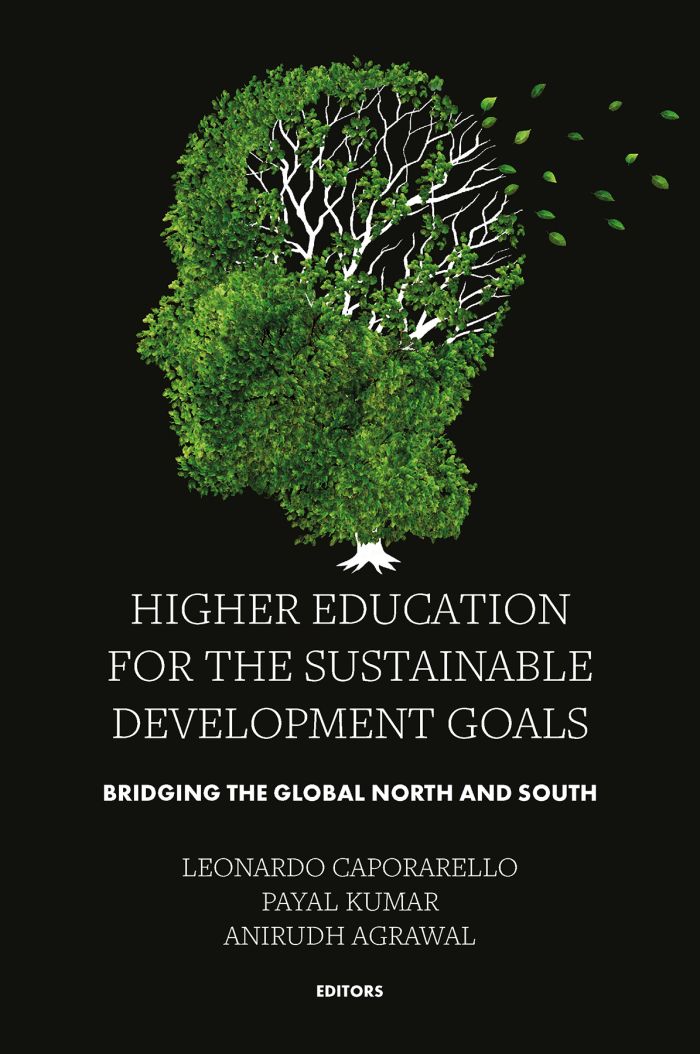

Higher Education for the Sustainable Development Goals
Bridging the Global North and South

This book can be opened with

Note on our eBooks and Audiobooks: you can read our eBooks (ePUB or PDF) and listen to audiobooks on the free Emerald Books app on iOS, Android, and desktop. Or read and listen on Emerald's online reader (ePUB eBooks and audiobooks only). To purchase a digital book you will need to create an account if you don’t already have one. After purchasing you will receive instructions on how to get started.
- Description
- Contents
- Reviews
- About
The Global North and Global South are in different stages of the journeys towards a sustainable future. The Global North is focusing on cutting carbon emissions and discussing “de-growth”, whilst large parts of the Global South are still struggling to move out of poverty, increasing their carbon emissions in many places. This division must be addressed through education, understanding the division and providing possible solutions. Higher Education Institutions (HEI) should take on a leadership role in shaping young minds through education and research to foster an enhanced perception of the variances in sustainability approaches of the Global North and Global South.
Presenting chapters from an international set of contributors, this collection provides practical insights that inform practice, focusing on two themes: the design of HEI curricula; and a specific focus on Global North and Global South divide in addressing social and political differences, and the role that HEIs can play in addressing the divide.
Higher Education for the Sustainable Development Goals is a must read for policymakers and researchers, learners, and management teams at HEIs.
Foreword; Mariam Kakkar
- Chapter 1. Research from the Global North and South on HEIs as a driver for SDGs; Payal Kumar, Leonardo Caporarello, and Anirudh Agrawal
- Theme one: GLOBAL HIGHER EDUCATION LANDSCAPE
- Chapter 2. How do higher education institutions manage biodiversity? Exploring the current state from universities in Global North and South; Remmer Sassen, Leyla Azizi, Ting-Yu Lin, Yu-Shan Lin, and Stella-Maria Yerokhin
- Chapter 3. Higher education and sustainable development: A literature analysis and conceptual overview; Elia Pizzolitto, Stefano Za, and Gianluca Antonucci
- Chapter 4. Higher education for sustainable development goals: Bridging the Global North and South; Rajeshwari Krishnamurthy and Garima Sahay
- Chapter 5. Higher education institutions as partners in multi-sector collaborative initiatives for integration of SDGs in tourism; Bengi Ertuna, Maria Dolores Alvarez, and Burcin Kalabay Hatipoglu
- Chapter 6. The role of shared leadership in realizing SDGs: An exploration of intra-country collaborative work between HEIs and public policy groups in Zambia; Chitalu Kabwe, Christine Phiri-Mushibwe, and Smita Tripathi
- Theme two: RETHINKING CURRICULUM AND LEARNING
- Chapter 7. Building sustainability leadership: Rethinking curriculum design and the role of the faculty; James Hunt, Lucy Turner, Scott N.Taylor and Danna Greenberg
- Chapter 8. Skill Integration in Higher Education: Curriculum for Sustainability; Supriya Pattanayak and Chhayabrita Maji
- Chapter 9. Experiential learning about sustainable development and the SDGs: Features, challenges, and experiences of a modular course in business education; André Martinuzzi, Angelo Spörk and Susanne Martinuzzi
- Chapter 10. Understanding the mediating role of peer feedback on team-based learning and career planning skills; Asad Abbas, Hossein Haruna, Anil Yasin Ar, and Danica Radovanović
HEIs are in a position to address Sustainable Development Goals and contribute to bridging the Global North and South. Access to quality education means empowering individuals with the knowledge, skills, and critical thinking abilities required to contribute both towards socio-economic development and to solving the significant global challenges we all currently face. Kudos to the editors of this book for seizing the opportunity to address key topics in this area.
This book's unique focus on Global North and Global South perspectives on the role that HEIs can play in addressing the Sustainable Development Goals makes it a must read for both policymakers and researchers.
Human activity has placed significant pressure on our planet’s resources, yet HEIs have failed to successfully harness our intellectual capacity to ensure a habitable future. HEI’s should play a pivotal role in helping create a future in which socioeconomic prosperity is shared across the globe on a healthy and sustainable planet. This can be achieved through innovation and the exploration of more just and sustainable futures. In this context, an evolution of HEI’s must occur bridging existing gaps between the Global North and South. A new formulation of HEI's must be designed to substantially contribute to this global mission and by accelerating innovation and producing much larger research, teaching, and real-world impact in critical areas that meet the urgent human and planetary crises now and into the future. This book enables a solid foundation for starting to address these critical issues.
Leonardo Caporarello is the Associate Dean for Online Learning Experiences and Professor of Leadership and Negotiation at SDA Bocconi School of Management, Italy. Leonardo is also the Rector's Delegate for Digital Learning at Bocconi University, Italy.
Payal Kumar is Principal Academic Advisor, Indian School of Hospitality, India. Formerly Payal was Professor & Chair HR/OB and Associate Dean, International Relations at BML Munjal University, India.
Anirudh Agrawal is an Associate Professor at O.P. Jindal Global University, India. Anirudh is also an active consultant for TVARIT Gmbh.