
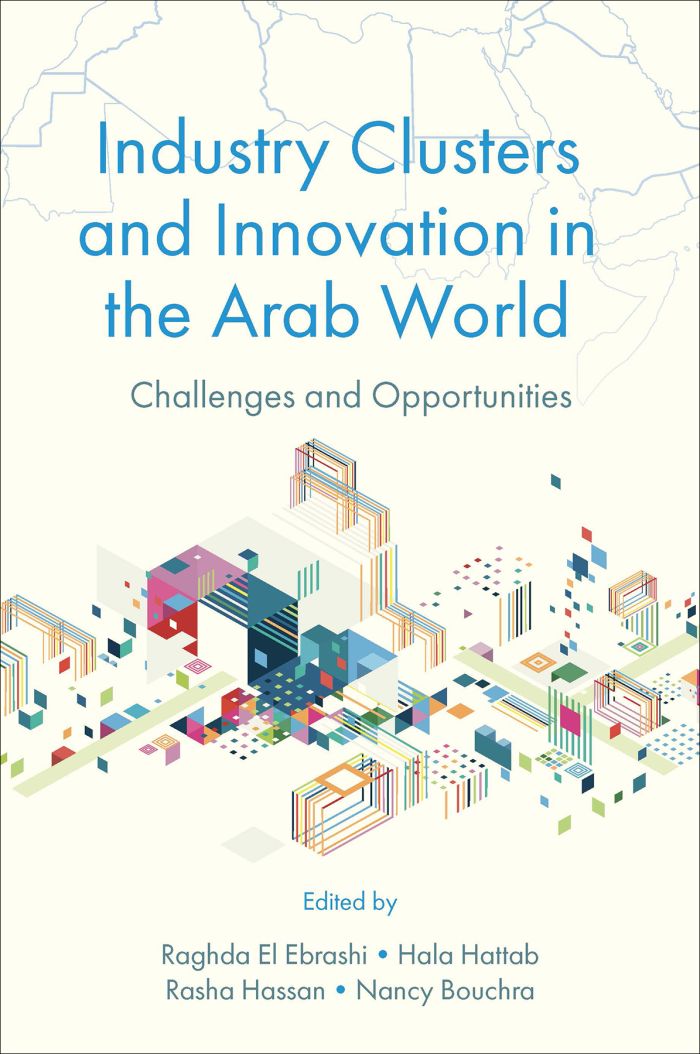

Industry Clusters and Innovation in the Arab World
Challenges and Opportunities

This book can be opened with

Note on our eBooks and Audiobooks: you can read our eBooks (ePUB or PDF) and listen to audiobooks on the free Emerald Books app on iOS, Android, and desktop. Or read and listen on Emerald's online reader (ePUB eBooks and audiobooks only). To purchase a digital book you will need to create an account if you don’t already have one. After purchasing you will receive instructions on how to get started.
- Description
- Contents
- About
Industry clusters promote innovation in the Arab World, through collaboration among businesses, research institutions, and governments. Benefits include the creation and sharing of knowledge, professional networking, access to spill-over knowledge, and specialized talent pools. These are the necessary elements to support the blossoming of innovation. In addition, clusters have the capacity to foster economic development in the region as a whole. They are key determinants in improving micro and small firms’ performance through company linkages and access to internationalization opportunities.
Industry Clusters and Innovation in the Arab World presents research and case studies in a range of Arabic-speaking countries, and proposes a series of reforms to build and promote industry clusters in the region. Challenges facing the establishment and the competitiveness of such clusters are also explored, and real-world applicable recommendations are provided. This break-through research highlights opportunities, and also macro-environmental threats. This is essential reading for researchers, policy-makers, and practitioners.
Chapter 1. Construction of the National Innovation System in Algeria and Economic Performances: In Search of Action Policies; Rédha Younes Bouacida
- Chapter 2. The Automotive Industry Cluster in Egypt: Cases of German Automotive Companies; Menatallah Darrag, Raghda El Ebrashi, Amira Aldibiki, and Salma Tosson
- Chapter 3. Knowledge Sharing Mechanisms and Challenges in a Governmental Driven Industry Cluster: A Saudi Arabian Case Study; Aliah Zafer
- Chapter 4. State-Business Relations, Public Policy, and Industrial Clusters Development in the Arab World; Mohamed Ismail Sabry
- Chapter 5. Application of Porter’s Diamond Model: A Case study of Tourism cluster in UAE; Nancy Bouchra and Rasha Hassan
- Chapter 6. Industrial clusters and the five drivers of regional productivity in Egypt; Enas Moustafa Mohamed Abousafi, Mohamed Abouelhassan Ali, and Jose Louis Iparraguirre
- Chapter 7. Role of Promotion Policies to Stimulate the Dynamics and Innovation of Clusters: The Case of Palestine; Suhail Sultan and Meine Pieter van Dijk
- Chapter 8. The Impact of Cluster Involvement on Supply Chain Sustainability Performance: Introducing the Sustainability/Involvement Index; Mona Ali Ali
- Chapter 9. Role of Universities as Knowledge Creators in a National Innovation System: An Open Innovation Paradigm; Rani Shahwan and Tabish Zaman
- Chapter 10. Formation of Agri-cluster on the priority of including Small Farms: Case from Egypt; Dina El Kayaly
- Chapter 11. Industrial Clusters: Ambassadors for Regional Development: Case Study of Agadir Agreement; Sameh Hammad
Raghda El Ebrashi is an Associate Professor of Strategic Management at the German University in Cairo (GUC), and the Head of the Management and Organization Department at the Faculty of Management Technology.
Hala Hattab is an Associate Professor of Entrepreneurship, and Head of Entrepreneurship and Business Unit at the Business Administration Department at the British University in Egypt.
Rasha Hassan is an Assistant Professor of Entrepreneurship and Innovation in the Faculty of Management Technology at the German University in Cairo (GUC).
Nancy Bouchra is an Assistant Professor of Strategy and Entrepreneurship at Amity University Dubai, and the Head of Industry Relations for Amity Business School.