
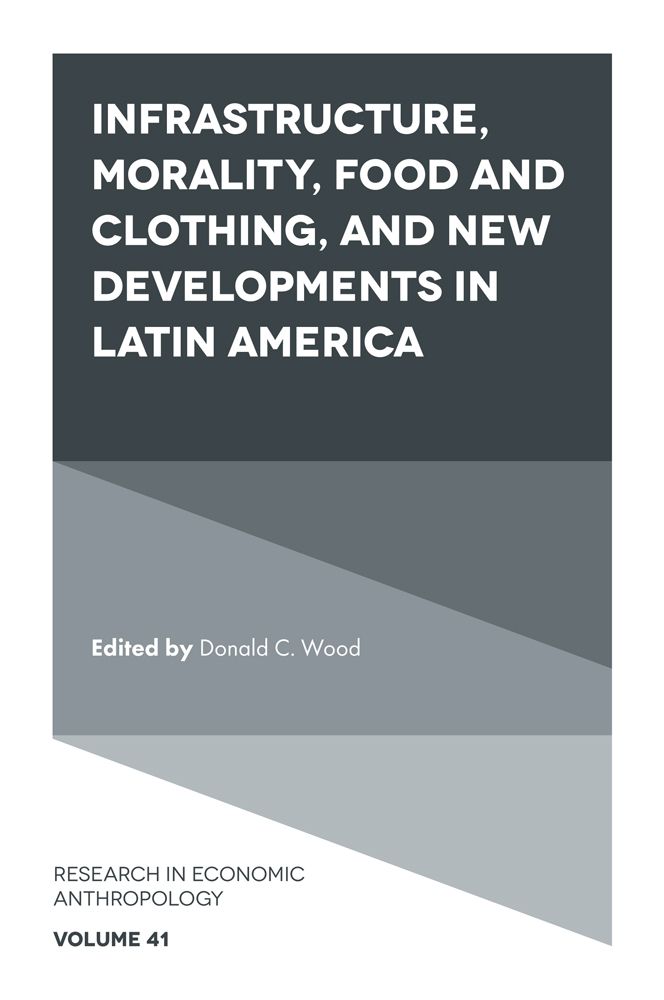

Infrastructure, Morality, Food and Clothing, and New Developments in Latin America

This book can be opened with

Note on our eBooks and Audiobooks: you can read our eBooks (ePUB or PDF) and listen to audiobooks on the free Emerald Books app on iOS, Android, and desktop. Or read and listen on Emerald's online reader (ePUB eBooks and audiobooks only). To purchase a digital book you will need to create an account if you don’t already have one. After purchasing you will receive instructions on how to get started.
- Description
- Contents
- About
Volume 41 of Research in Economic Anthropology explores a wide range of topics of interest to economic anthropology. The opening paper presents a novel approach to anthropological-economic infrastructural research in England, specifically London’s Thames Tideway Tunnel. The volume’s first section consists of four papers that are tied together by two common threads: the roles of money in social ties between people, and moral concerns regarding these and other roles and uses of money in society. The section covers commercial surrogate mothers in Russia, social welfare provision in Pakistan, the management of a communal fund within a school alumni association in South Korea, and a credit scheme’s impact on women in Nigeria.
Part two focuses on two basic necessities of human life—food and clothing - examining a New Zealand food security initiative that rescues “waste” food, modern transformations of a pre-owned clothing market in Hamburg, Germany, and Muslim fashion retail business in the same country’s capital city, Berlin.
Finally, the volume closes with a third section that fixes an anthropological lens on contemporary developments in Latin America, analyzing the larger fair trade movement and its particular manifestations and implications in Oaxaca, Mexico, the cost-effectiveness of the reintegration of ex-combatants in Colombia, and patron-client relations in Brazil and how these have been politically perceived and presented by domestic and foreign intellectuals and academics, respectively.
Introduction: Anthropological Investigations Into Infrastructure, Money, Community And Morality, Food And Clothing, And New Developments In Latin America; Donald C. Wood
- Paper 1. London’s “Super Sewer”: A Case Study For The Interdisciplinary Possibilities Of Anthropologists And Economists Investigating Infrastructure Together; Benjamin O.L. Bowles, Kate Bayliss, and Elisa Van Waeyenberge
- PART I MONEY, COMMUNITY AND MORALITY
- Paper 2. A Responsible Worker and A Caring Mother: Experiences of Russian Commercial Surrogates; Olga Doletskaya, Maria Denisova, and Oksana Dorofeeva
- Paper 3. God, Gift and Charity: The Case Of Zakat And Dasvandh In The Local Governance Of Social Welfare Provision In Pakistan; Muhammad Salman Khan
- Paper 4. Money for Belongingness: The Account Book and The Management of The Communal Fund of A High School Alumni Association In South Korea; You-Kyung Byun
- Paper 5. “Microcredit Schemes of Tension”: Women and The Economic Violence of Credit Mobilization in Ibadan, Nigeria; Olubukola Olayiwola
- PART II FOOD AND CLOTHING
- Paper 6. The Multiple and Changing Values of Rescued Food: Case Study Of A Food Security Initiative In Urban New Zealand; Jessica Mannette
- Paper 7. Digitalizing Local Markets: The Secondhand Market for Pre-Owned Clothing in Hamburg, Germany; Heike Derwanz
- Paper 8. Doing Difference: The Performance of Order in The Market for Islamic Fashion In Berlin; Robert Birnbauer
- PART III NEW DEVELOPMENTS IN LATIN AMERICA
- Paper 9. Rethinking Fair Trade: Narratives and Counter Narratives of Poverty and Partnerships; Sarah Lyon
- Paper 10. Assessing Cost-Effectiveness in Reintegrating Ex-Combatants in Colombia; Colleen Alena O'Brien
- Paper 11. A Tale of a Much Maligned But Persistent Cultural Pattern: Networks Of People Giving To Receive Something In Exchange; Sidney M. Greenfield
Donald C. Wood is Associate Professor in the Graduate School of Medicine, Akita University, Akita, Japan, where he has worked since completing a doctoral degree in cultural anthropology at the University of Tokyo in 2004.