
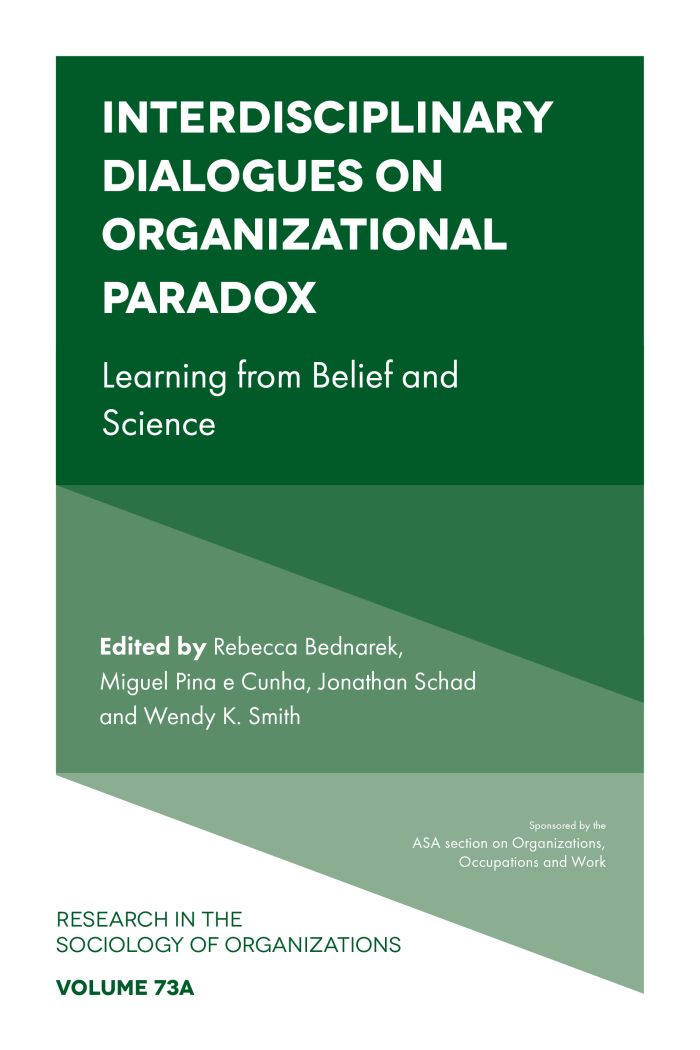

Interdisciplinary Dialogues on Organizational Paradox

Learning from Belief and Science

Rebecca Bednarek|Miguel Pina e Cunha|Jonathan Schad|Wendy K. Smith
Emerald
Emerald

This book can be opened with

Glassboxx eBooks and audiobooks can be opened on phones, tablets, iOS and Android devices

Hardback
9781801171847
08 July 2021
$122.99
eBook (ePub)
9781800434103
08 July 2021
$122.99
eBook (PDF)
9781801171830
08 July 2021
$122.99

Note on our eBooks and Audiobooks: you can read our eBooks (ePUB or PDF) and listen to audiobooks on the free Emerald Books app on iOS, Android, and desktop. Or read and listen on Emerald's online reader (ePUB eBooks and audiobooks only). To purchase a digital book you will need to create an account if you don’t already have one. After purchasing you will receive instructions on how to get started.

  • Description
  • Contents
  • About
Interdisciplinary Dialogues on Organizational Paradox is an innovative two-part volume that enriches our understanding about paradox; both deepening the theory and offering greater insight to address the grand challenges we face in the world today. Authors demonstrate how paradox theory benefits from interdisciplinary theorizing by reaching out to disciplines beyond organizational theory and exploring best practice in undertaking such research.

The 13 chapters in this double volume draw from four disciplinary realms: beliefs, physicality, expression, and social structure. Unique commentaries from thought leaders expand and assess the focal pieces of each volume.

Part A: Learning from Belief and Science, explores the realms of beliefs - from Ubuntu, Ying-Yang, Christian and Islamic philosophies - and physicality - from quantum mechanics, technology, to ecology - with reflective commentaries from Jean M. Bartunek and Mary Frohlich, and Andrew Van de Ven.

Introduction A.   The Value of Interdisciplinary Research to Advance Paradox in Organization Theory; Rebecca Bednarek, Miguel Pina e Cunha, Jonathan Schad, Wendy K. Smith  A1. Realm of Beliefs  Chapter 1. Paradox beyond East/West orthodoxy: The case of Ubuntu; Medhanie Gaim and Stewart Clegg  Chapter 2. The meta-perspective of Yin-Yang balancing: Salient implications for organizational management; Peter Ping Li.  Chapter 3. Where we might least expect to find it: Organizing paradoxes of Christian theology in a society of organizations; Mathew L. Sheep   Chapter 4. Crossing boundaries: Connecting religion and paradox for leadership and organization research; Ali Aslan Gümüsay  Commentary 1. Paradoxical dimensions of religious experience: a commentary; Jean M. Bartunek and Mary Frohlich  A2. Realm of Physical Systems  Chapter 5. Paradox and Quantum Mechanics – Implications for the Management of Organizational Paradox from a Quantum Approach; Eric Knight and Tobias Hahn  Chapter 6. Planetary Emergency and Paradox; Amanda Williams, Katrin Heucher and Gail Whiteman  Chapter 7. Digitally Induced Industry Paradoxes: Disruptive innovations of taxiwork and music streaming beyond organizational boundaries; David Tilson, Carsten Sørensen and Kalle Lyytinen  Commentary 2. Commentary: Strategies for Studying How Contradictions Unfold; Andrew Van de Ven  

    Rebecca Bednarek is an Associate Professor at Victoria University Wellington. She studies paradoxes and strategizing practices within science systems and financial markets and has written extensively about qualitative methods.

    Miguel Pina e Cunha is the Fundação Amélia de Mello Professor at Nova School of Business and Economics, Universidade Nova de Lisboa, Portugal. His work deals with three Ps of organizing: process, paradox, positivity.

    Jonathan Schad is Lecturer in Strategy and Organisation Theory at King’s Business School, King’s College London, UK. His research uses paradox theory to better understand the fundamental tensions contemporary organizations confront.

    Wendy K. Smith is Professor of Management at University of Delaware, USA. She studies paradoxes, exploring how leaders navigate strategic paradoxes such as tensions between exploration and exploitation or social missions and financial demands.