
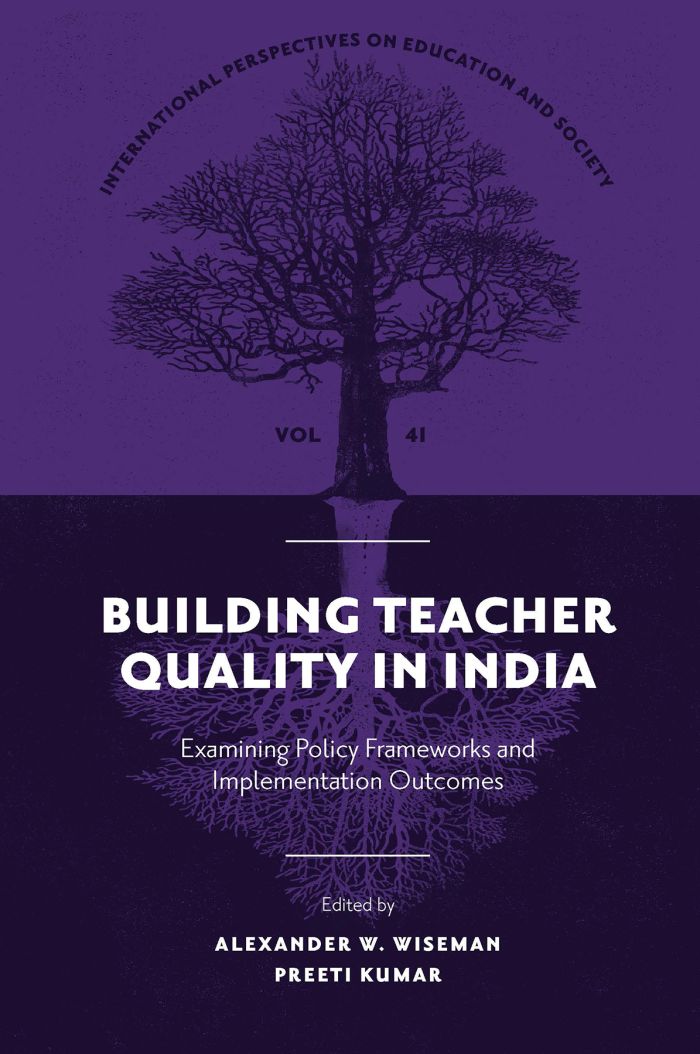
Building Teacher Quality in India

Examining Policy Frameworks and Implementation Outcomes

Alexander W. Wiseman|Preeti Kumar
Emerald
Emerald

This book can be opened with

Glassboxx eBooks and audiobooks can be opened on phones, tablets, iOS and Android devices

Hardback
9781800719040
04 August 2021
$138.99
eBook (PDF)
9781800719033
04 August 2021
$138.99
eBook (ePub)
9781800719057
04 August 2021
$138.99

Note on our eBooks and Audiobooks: you can read our eBooks (ePUB or PDF) and listen to audiobooks on the free Emerald Books app on iOS, Android, and desktop. Or read and listen on Emerald's online reader (ePUB eBooks and audiobooks only). To purchase a digital book you will need to create an account if you don’t already have one. After purchasing you will receive instructions on how to get started.

  • Description
  • Contents
  • About
In an era of educational globalization, teacher quality is heralded as a key factor to improve education quality worldwide. Since the 1980s, global, national, and local education policies and reforms have consistently focused on improving teacher quality in order to improve student learning outcomes. In India, which has one of the largest student populations and fastest growing economies in the world, the quality of teaching is blamed for the poor performance by Indian students on internationally-comparative assessments. As a result, Indian national policy documents and curriculum frameworks have repeatedly called for drastic improvements in teacher preparation and performance, but with few widespread results.

By identifying and analyzing various measures of teacher quality, and how teacher quality varies in India, this book provides an evidence-based framework for policymakers to further improve teacher quality in India. Building Teacher Quality in India provides suggestions for further research in order to augment educational practices in India, secure better student achievement, and improve the country's global standing.

This book is essential reading for education researchers and policymakers looking at teacher quality as a measure to improve student performance.

Chapter 1. The Promises and Challenges of Building Teacher Quality in India; Alexander W. Wiseman and Preeti Kumar Part 1. The State of Teacher Quality in India Chapter 2. Exploring Teacher Appraisal for Teacher Quality: Sojourn from Global Standards to Local Needs; Sudeshna Lahiri  Chapter 3. Perspectives on Teacher Quality in India: Unraveling the Inherent Complexities; Jyoti Bawane  Chapter 4. Teacher Educator Professionalism in India; Rajashree Srinivasan   Chapter 5. The Right to Education - Whose Learning Matters? The Unintended Lessons of Student Learning and Teacher Quality; Supriya Baily  Chapter 6. Preschool Teacher Quality in India; Reetu Chandra  Part 2. Measuring and Implementing Changes in Indian Teacher Quality  Chapter 7. Supportive Teacher Management Practices for Enhancing Teacher Quality: Analyzing Experiences from the Indian State of Karnataka; Puja Minni and Jyotsna Jha  Chapter 8. Teachers Within Neoliberal Educational Reforms: A Case Study of Delhi; Shreya Sandhu  Chapter 9. Moving Indian Teacher Education to Higher Education Institutions and Universities: Comparative Reflections from a Cross-National Study; Shamim C. Suryavanshi  Chapter 10. Modeling for Capacity: A Study of a Teacher Education Practice; Rohit Setty  Chapter 11. A Process of Teacher Performance Review for Continuous Improvement; Susan L. Hillman and Neha Chheda  Chapter 12. The Potential for Quality Education When Teachers Internalize an Affective Education Approach as a Base for Skill Development; Haein Shin, Radhika Iyengar, and Nirupam Bajpai

    Alexander W. Wiseman is Professor of Educational Leadership & Policy in the College of Education at Texas Tech University, USA. Dr. Wiseman conducts comparative educational research on educational policy, practice, and strategic decision-making using large-scale assessment data.

    Preeti Kumar is an independent researcher and educational consultant. Dr. Kumar's teaching expertise lies in the academics and inclusion for high incident special education students for K-12 grades, multicultural education, national and international policy studies, teacher quality, and gender studies.