
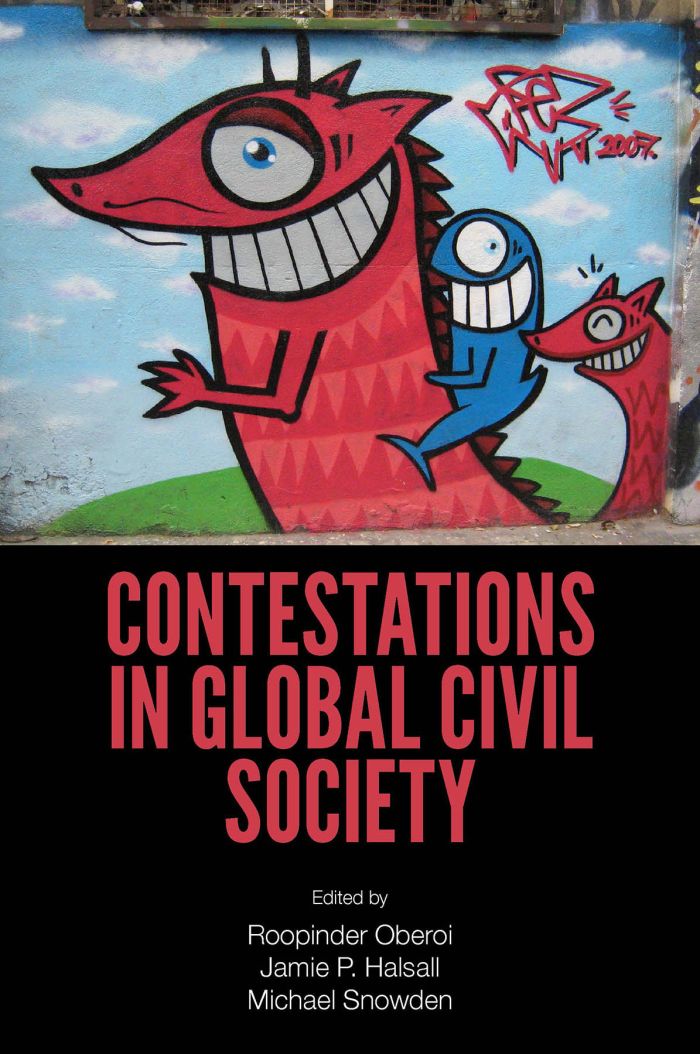


Contestations in Global Civil Society

This book can be opened with

Note on our eBooks and Audiobooks: you can read our eBooks (ePUB or PDF) and listen to audiobooks on the free Emerald Books app on iOS, Android, and desktop. Or read and listen on Emerald's online reader (ePUB eBooks and audiobooks only). To purchase a digital book you will need to create an account if you don’t already have one. After purchasing you will receive instructions on how to get started.
- Description
- Contents
- About
The concept of Global Civil Society as an ‘imagined global community’ is raising questions that challenge perceptions of a border-free, footloose, global community. The era of ‘hyper-individualism’, accompanied by the virtualization of the public sphere, is offering support for collective action and processes in the face of rising economic and social anxieties, such as inequality, poverty, terrorism, xenophobia, nuclear weapons, and environmental destruction. Global Civil Society is now equipping itself to negotiate with resurrected boundaries, calls for decelerating the flow of people, identity clashes and throwbacks to tribal politics.
Contestations in Global Civil Society examines the ways in which the global community is dealing with heightened destabilization, entering what has been dubbed an ‘Age of Fracture’, and takes a close look at contemporary shifts that accompany the resurrection of multiple normative civil society discourses such as political mobilization, polarization, responsibility, and participation.
What are the contestations within global civil society? What is our current perception of global civil society? How is it coping with the huge changes that are happening all around us? What will global civil society look like in the future?
Foreword. Rekha Saxana
- Chapter 1. Introduction: Global Civil Society; Roopinder Oberoi, Jamie P. Halsall, and Michael Snowden
- Chapter 2. Unselfishness and Resilience: Social Capital in the context of the pandemic of COVID-19; Ian G. Cook and Paresh Wankhade
- Chapter 3. Social Capital, Social Innovation and Social Enterprise: The Virtuous Circle; Roopinder Oberoi, Jamie P. Halsall, and Michael Snowden
- Chapter 4. Does Fifth Industrial Revolution Benefit or Trouble the Global Civil Society?; Cátia Miriam Costa, Enrique Martinez-Galán, and Francisco Leandro
- Chapter 5. Networked society and Governance: Algorithmic default?; Tom Cockburn
- Chapter 6. The end of neoliberalism? The response to COVID19: An Australian geopolitical perspective; Michael Lester and Marie dela Rama
- Chapter 7. Civil Society and Environmental Protection in Brazil: Two Steps Forward, One Step Back; Antônio Márcio Buainain and Junior Ruiz Garcia
- Chapter 8. Redefining Social Capital and Social Networks in Global Civil Society; Tom Cockburn
- Chapter 9. Role of Social Capital and Social Enterprise in China’s Poverty Relief; Sam Yuqing Li and Qingwen Xu
- Chapter 10. Conclusion: A Shifting Recognition of Global Civil Society?; Roopinder Oberoi, Jamie P. Halsall, and Michael Snowden
Roopinder Oberoi is Associate Professor in the Department of Political Science, KMC, University of Delhi. She did her MA, M.Phil and PhD in Political Science at the University of Delhi, and was awarded a Post-Doctorate Research Fellowship by the University Grant Commission, India.
Jamie P. Halsall is a Reader in Social Sciences in the School of Human and Health Sciences at the University of Huddersfield, UK. His research interests include communities, globalization, higher education, public and social policy.
Michael Snowden is a Senior Lecturer in Mentoring Studies in the School of Human and Health Sciences at the University of Huddersfield, UK. His research interests lie in the field of pedagogy, mentorship, social enterprise, curriculum enhancement, and learning.