
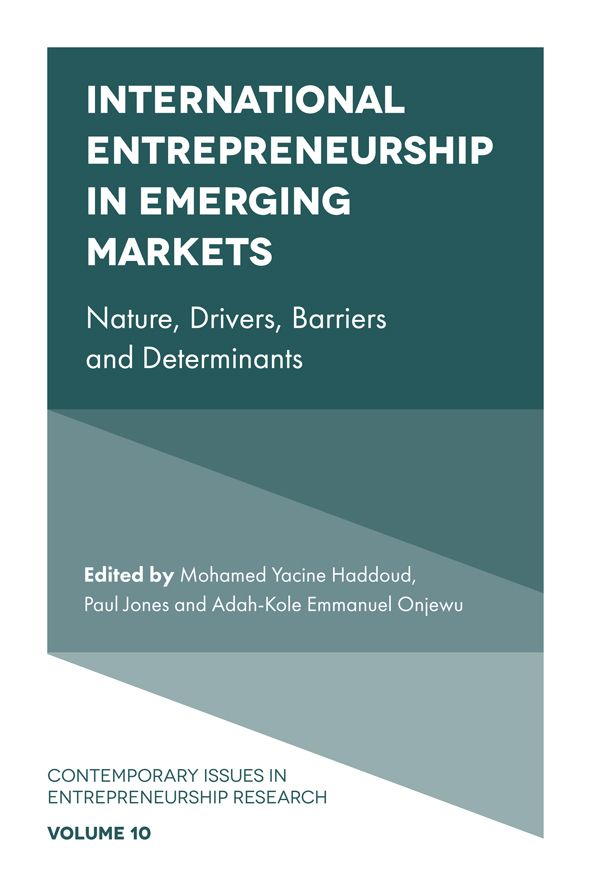
International Entrepreneurship in Emerging Markets

Nature, Drivers, Barriers and Determinants

Mohamed Yacine Haddoud|Paul Jones|Adah-Kole Emmanuel Onjewu
Emerald
Emerald

This book can be opened with

Glassboxx eBooks and audiobooks can be opened on phones, tablets, iOS and Android devices

Hardback
9781787695641
18 November 2019
$111.99
eBook (PDF)
9781787695634
18 November 2019
$111.99
eBook (ePub)
9781787695658
18 November 2019
$111.99

Note on our eBooks and Audiobooks: you can read our eBooks (ePUB or PDF) and listen to audiobooks on the free Emerald Books app on iOS, Android, and desktop. Or read and listen on Emerald's online reader (ePUB eBooks and audiobooks only). To purchase a digital book you will need to create an account if you don’t already have one. After purchasing you will receive instructions on how to get started.

  • Description
  • Contents
  • About
Among several themes in contemporary entrepreneurship, internationalisation generates extensive interest among scholars due to its exploration of dynamic activity within SMEs seeking market development and operational efficiency through foreign alliance and intelligence gathering opportunities. In the context of emerging markets, however, international entrepreneurship scholarship still lags behind first world evidence. With less developed avenues for finance and limited infrastructure support for product development and service delivery, an assessment of internationalisation within emerging contexts is required. 

International Entrepreneurship in Emerging Markets presents insights from Brazil, China, India, Pakistan, Sri Lanka and Turkey to enlighten scholars by unearthing the nature, drivers, barriers and determinants of entrepreneurship in emerging markets. It examines structural and environmental impediments to internalisation but demonstrates that these are far surpassed by the market opportunities and business readiness of SMEs in emerging environments. Readers of this tenth volume of the Contemporary Issues in Entrepreneurship Research series will find exclusive evidence from emerging countries, evidence that demonstrates the inclination of SMEs to revise products and, when appropriate, dissolve and recreate relationships in the face of market opportunity and uncertainty. Managers will learn that appropriating a range of attributes are more likely to achieve internationalisation. 

Capturing the true nature of value creation for international consumers and partners in an emerging market backdrop, this volume makes a significant contribution to the literature by mapping out the road to success within this diverse setting.

Introduction: A Primer on International Entrepreneurship in Emerging Markets; Mohamed Yacine Haddoud, Adah-Kole Emmanuel Onjewu and Paul JonesChapter 1. A Network Perspective on the Intermittent Internationalizing Experiences of Emerging Economy Entrepreneurial SMEs; Zubair Ali Shahid, Leonie Hallo  Chapter 2. Managerial Attributes and Collaborative Behaviours as Determinants of Export Propensity: Evidence from Turkish SMEs; Ali Kemal Celik, Mohamed Yacine Haddoud, Adah-Kole Onjewu, Paul Jones  Chapter 3. Assessing the Impact of Social Forces in International Opportunity Recognition: A Case Study of Brazilian Technology Firms; Nuno Arroteia, Khalid Hafeez  Chapter 4. Driving Business Exports in Emerging Markets: Business Clusters as a Policy Option for Internationalisation; Anthony Ayakwah, Ellis L.C. Osabutey, Isaac Sakyi Damoah  Chapter 5. Outward Internationalisation of Emerging Market Small & Medium Sized Enterprises: Contract Manufacturing Relationship with Developed Market Multinational Enterprise(s) and Capabilities Development; Ahmad Arslan, Sean Naughton, Abdollah Mohammadparast Tabas, Vesa Puhakka  Chapter 6. Trade Barriers and Assistance Requirements of South Asian Transnational Entrepreneurs; Shiv Chaudhry, Dave Crick, James M. Crick  Chapter 7. Barriers and Drivers of SME's Internationalisation in Emerging Markets: Study of Sri Lankan Youth Entrepreneurs; Gayathri Ranasinghe  Chapter 8. The CAGE around Internationalization of SMEs and the Role of Government; Paul Agu Igwe, Frederick Kanyembo

    Mohamed Yacine Haddoud is Lecturer in International Business Management at Plymouth Business School, Plymouth University, UK.  

    Paul Jones is Professor in Entrepreneurship & Innovation and Head of the Department of Businesses at the School of Management, Swansea University, UK. 

    Adah-Kole Emmanuel Onjewu is Lecturer in Business Strategy in the School of Strategy and Leadership, Coventry Business School, Coventry University, UK.