
Organizational Social Irresponsibility
Tools and Theoretical Insights

This book can be opened with

Note on our eBooks and Audiobooks: you can read our eBooks (ePUB or PDF) and listen to audiobooks on the free Emerald Books app on iOS, Android, and desktop. Or read and listen on Emerald's online reader (ePUB eBooks and audiobooks only). To purchase a digital book you will need to create an account if you don’t already have one. After purchasing you will receive instructions on how to get started.
- Description
- Contents
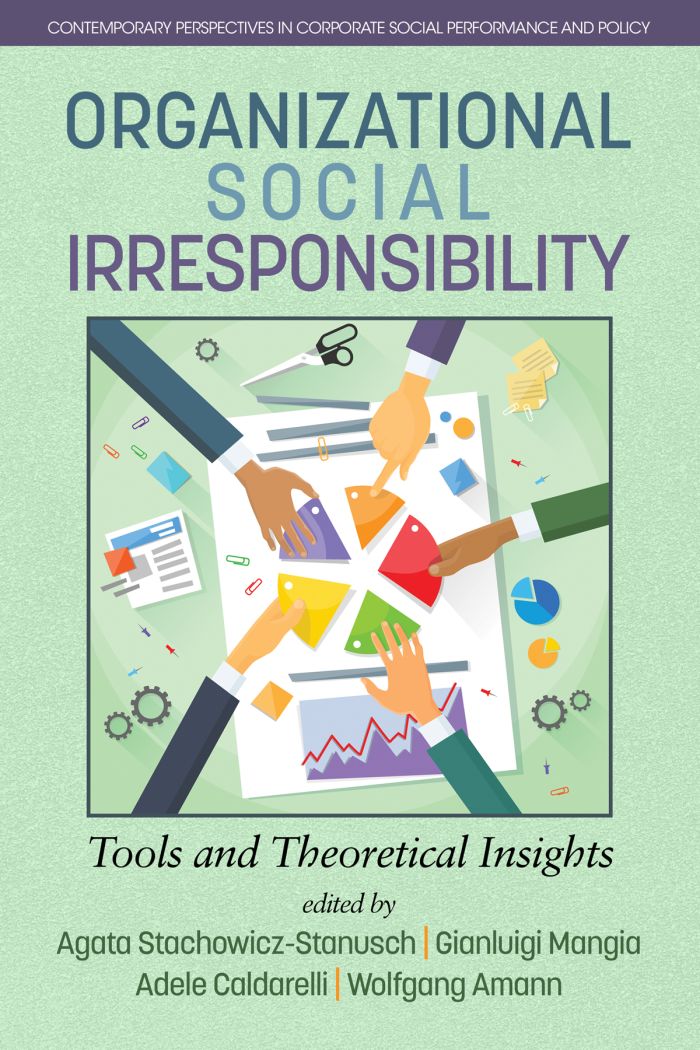
In the book Organizational Social Irresponsibility: tools and theoretical insights we focus both on theoretical and practical aspects of organizational social irresponsibility and hope to provide a contribution to the contemporary state of knowledge about its causes and results.
The book is written by a range of authors from all over the world. They provide us with examples of some irregularity in social organizational activity. There were included some theoretical and practical contributions into the topic of organizational social irresponsibility, from different sectors (e.g. pharmaceutical or manufacturing industry as well as public administration) and various organizational processes (such as marketing, training, innovation and knowledge management). We hope it will be a worthy inspiration for struggling with dark sides of organizational existence.
Acknowledgments.
- Part I. Organizational Social Irresponsibility: Practices and Experiences.
- Chapter 1. Organizational Social Irresponsibility: Theoretical Frontiers and Practical; Agata Stachowicz-Stanusch, Gianluigi Mangia, Adele Caldarelli, and Wolfgang Amann.
- Chapter 2. Why Illegal and Questionable Pharmaceutical Marketing Practices Hurt Stakeholders; Michaeline Skiba.
- Chapter 3. Public Management Reforms and the Oxymoron of Training Proceduralization; Denita Cepiku, Maurizio Decastri, Alessandro Hinna, and Sandro Mameli.
- Chapter 4. Not Everything That Glitters is Gold: The Dark Side of Leadership and Rewards; Mariacristina Bonti, Vincenzo Cavaliere, and Sara Lombardi.
- Part II. The Thousand Faces of the Dark Side of Business.
- Chapter 5. The Dark Side of Being too Good in Organizational Settings; Irene Nikandrou and Irene Tsachouridi.
- Chapter 6. The Dark Side of the Gift in Organizations: When Gift-Giving Becomes Bribery and Corruption; Guglielmo Faldetta.
- Chapter 7. The Dark Side of Ethics in Finance: Empirical Evidences From the Italian Market; Giovanni Landi and Andrea Tomo.
- Chapter 8. The Dark Side of the Entrepreneur: The Alignment of Dreams and Business Idea Through Education; Rocco Agrifoglio, Paola Briganti, Concetta Metallo, and Lorenzo Mercurio.
- Chapter 9. Conducting Business Through Corrupt Means: Studying the Black Arts of Management; Duane Windsor.
- Part III. Social, Cultural, and Institutional Dimensions.
- Chapter 10. Exploring the Nexus Between Organizational Crimes and the Dark Side of Behavior: Strategies for Prevention and Mitigation; Radha R. Sharma and Anishya O. Madan.
- Chapter 11. Mechanisms of the Embedding of Extortion Racket Systems: The Case of Cosa Nostra; Martin Neumann, Giovanni Frazzica, and Valentina Punzo.
- Chapter 12. The Dark Side of Creativity and Innovation in Organizations; Agnieszka Wojtczuk-Turek.
- Chapter 13. Kerr Had It Right: What Is the Folly of the Reward? Diane H. Parente, James F. Fairbank, and Randy C. Brown.
- About the Editors.
- About the Contributors.