
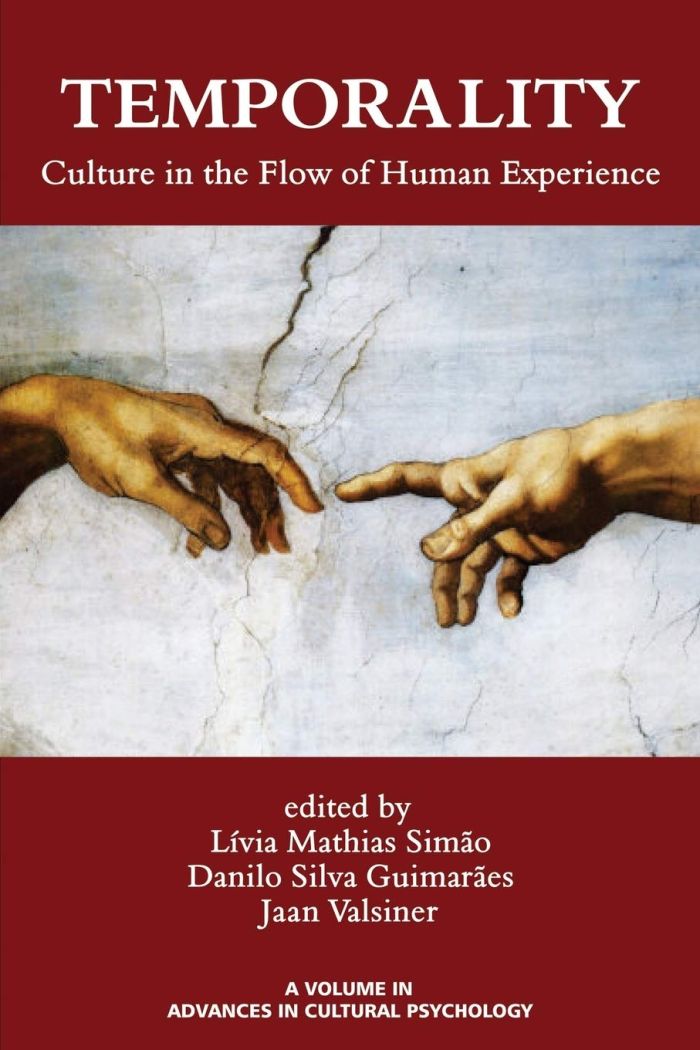
Temporality
Culture in the Flow of Human Experience

This book can be opened with

Note on our eBooks and Audiobooks: you can read our eBooks (ePUB or PDF) and listen to audiobooks on the free Emerald Books app on iOS, Android, and desktop. Or read and listen on Emerald's online reader (ePUB eBooks and audiobooks only). To purchase a digital book you will need to create an account if you don’t already have one. After purchasing you will receive instructions on how to get started.
- Description
- Contents
This book comes as part of a broader project the first editor is developing in collaboration with the other two, aiming critically to articulate the central philosophical issue of time and temporality with Cultural Psychology and related areas in its frontier. Similarly to the previous milestone in this effort—Otherness in Question: Labyrinths of the Self, published in this same series, the present one we also invited international cast of authors to bring their perspectives about a possible dialogue between a central philosophical issue and the core subject of their respective research domains. The book interests to researchers, scholars, professionals and students in Psychology and its areas of frontier.
Introduction: Time—Not Always the Same, Lívia Mathias Simão.
- Part I: Emporality and Its Boundaries.
- Chapter 1. Temporality and the Necessity of Culture in Psychology, Hroar Kemple.
- Chapter 2. Defining a Temporal Mereotopology, Giuseppina Marsico.
- Chapter 3. Temporality and the Boundary Between Present and Future, Emily Abbey.
- Chapter 4. Unaccomplished Trajectories: Shadows From the Past in the Present and Future, Vivian Pontes and Ana Cecília Bastos.
- Part II: Living Temporality.
- Chapter 5. Living and Observing: Two Modes of Understanding Time, Carlos Cornejo and Himmbler Olivares.
- Chapter 6. When Is Now: Measuring How We Perceive Instants in Time, André Cravo and Hamilton Haddad.
- Part III: Temporality and Lifetime.
- Chapter 7. Duration and Experience: The Temporality of Development, Dankert Vedeler.
- Chapter 8. Temporality, Lifetime, and the Afterdeath: Case Studies From Hospice Patients, Meike Watzlawik.
- Chapter 9. Times of Illness and Illness of Time, Maria Francesca Freda, Raffaele De Luca Picione, and Maria Luisa Martino.
- Part IV: Temporalities of the Self.
- Chapter 10. Heidegger, Temporality, and Dialogical Self Theory, Basia Ellis and Henderikus Stam.
- Chapter 11. On Time and Temporality From a Clinic and Psychoanalytic Point of View, Nelson Coelho Jr. Chapter 12.Temporality: Expectation and Futurity in Physiotherapy Patients, Larissa Laskovski and Lívia Mathias Simão.
- Chapter 13. Time or Not Time in Mind: What Is Temporality? Ruggero Ruggieri and Anna Gorrese.
- Part V: Collective-Personal Temporalities.
- Chapter 14. Living With the Belief in Cyclical Time: Collective and Personal Constructions of Hindus, Nandita Chaudhary.
- Chapter 15. Temporality as Reciprocity of Activities: Articulating the Cyclical and the Irreversible in Personal Symbolic Transformations, Danilo Guimarães.
- Chapter 16. Repetition, Duration and Persistence: Temporality in the Performing Arts, Juliano Sampaio and Lívia Simão.
- Chapter 17. Black God, White Devil, and Behind the Sun: Destinies in Modern Brazilian Cinema, Renato Tardivo.
- Part VI: Temporality and Its Future Challenges for Psychology.
- Chapter 18. Temporality and the Challenge to Genetic Cultural Psychology, Cor Baerveldt.
- Chapter 19. Temporality and Generalization in Psychology: Time as Context, Luca Tateo.
- Chapter 20. The Temporality of Tradition: Some Horizons for the Semiotic-Cultural Constructivism in Psychology, Lívia Simão.
- About the Authors.