
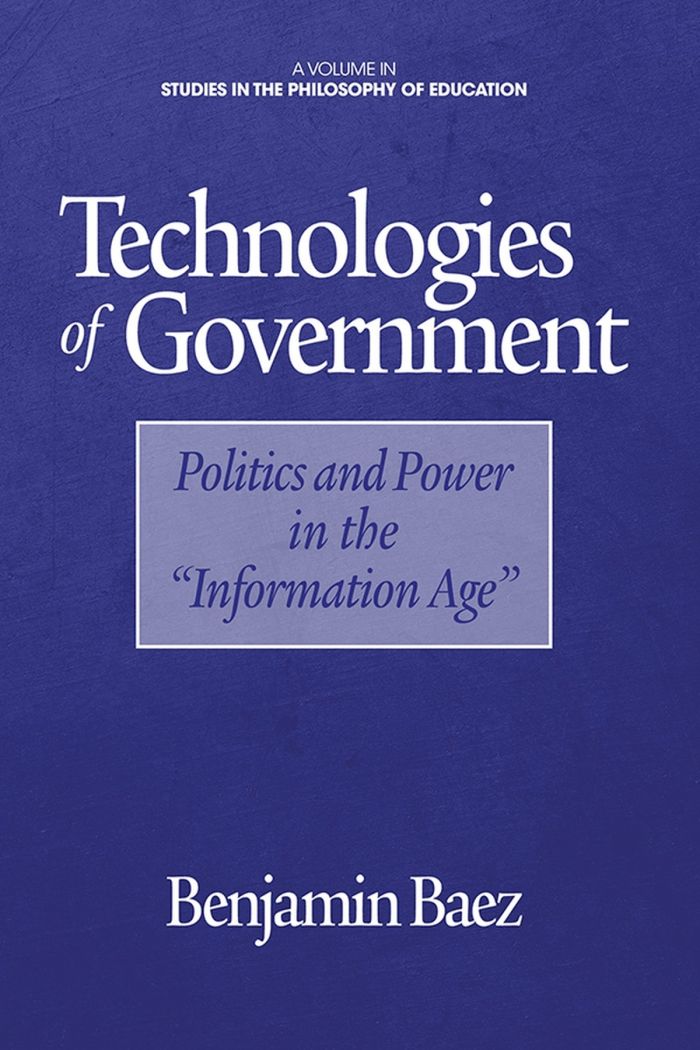
Technologies of Government
Politics and Power in the "Information Age"

This book can be opened with

Note on our eBooks and Audiobooks: you can read our eBooks (ePUB or PDF) and listen to audiobooks on the free Emerald Books app on iOS, Android, and desktop. Or read and listen on Emerald's online reader (ePUB eBooks and audiobooks only). To purchase a digital book you will need to create an account if you don’t already have one. After purchasing you will receive instructions on how to get started.
- Description
- Contents
In this book, Baez examines a series of governmental “technologies” that he believes strongly characterize our present. The technologies that he addresses in this book are information, statistics, databases, economy, and accountability. He offers arguments about the role these technologies play in contemporary politics. Specifically, Baez analyzes these technologies in terms of (the sometimes oppositional) rationalities for rendering reality thinkable, and, consequently, governable. These technologies bear on the field of education, but also exceed it. So, while issues in education frame many of the arguments in this book, the book’s also has usefulness to those outside of field of education.
Specifically, Baez concludes that the governmental technologies listed above all are coopted by neoliberal rationalities rendering our lives thinkable and governable through an array of devices for the management of risk, using the model of the economy, and heavily investing in the uses of information, statistics, databases, and oversight mechanisms associated with accountability. Baez leaves readers with more questions than they might have had prior to reading the book, so that they may re-imagine their own present and future and thus their own forms of self-government.
Foreword.
- Preface.
- Chapter 1. Govern-Mentalities.
- Chapter 2. Info-Notions.
- Chapter 3. Statistics.
- Chapter 4. Database.
- Chapter 5. Economy.
- Chapter 6. Accountability.
- References
- About the Author.