
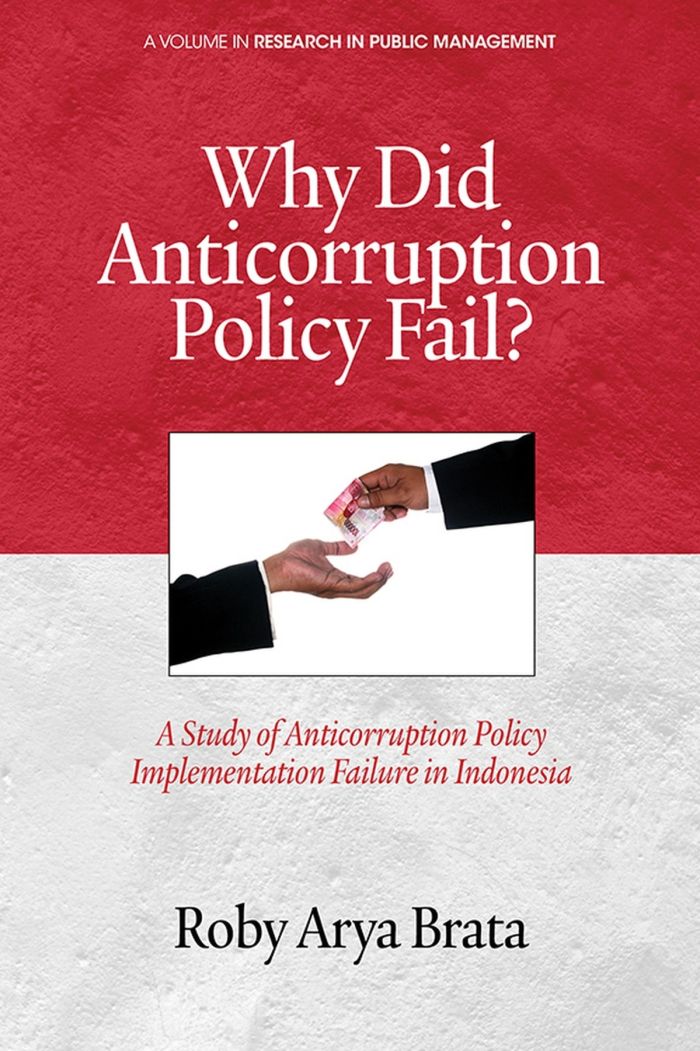
Why Did Anticorruption Policy Fail? a Study of Anticorruption Policy Implementation Failure in Indonesia

This book can be opened with

Note on our eBooks and Audiobooks: you can read our eBooks (ePUB or PDF) and listen to audiobooks on the free Emerald Books app on iOS, Android, and desktop. Or read and listen on Emerald's online reader (ePUB eBooks and audiobooks only). To purchase a digital book you will need to create an account if you don’t already have one. After purchasing you will receive instructions on how to get started.
- Description
- Contents
This book examines the cases of implementation failure of the Indonesian Anticorruption Law 1971 of the authoritarian New Order regime, and of the Anticorruption Law 1999 of the democratic Reform Order regime. It investigates to what extent and for what reasons the implementation of these Laws failed to attain the policy objectives of eradicating corruption in the public sector under the two different political systems.
The book concludes that combating corruption in a developing country undergoing political transition from an authoritarian to a democratic political system is problematic and difficult. When corruption has systematically infected and distorted the institutional structures and processes of the government, in particular the law enforcement mechanisms, implementing anticorruption laws is expected to be suboptimal and subsequently fail. To overcome this problem, the factors contributing to the policy implementation failure must be eliminated.
Foreword.
- Preface.
- Acknowledgments.
- Chapter 1. Introduction.
- Chapter 2. Explaining Anticorruption Implementation Failure.
- Chapter 3. Evaluation Methodology.
- Chapter 4. Anticorruption Implementation Failure Under the Authoritarian New Order Regime.
- Chapter 5. Anticorruption Implementation Failure Under the Democratic Reform Order Regime.
- Chapter 6. Comparing the Anticorruption Implementation Failure Under Both Regimes.
- Chapter 7. Conclusions and Policy Recommendations.
- A. Recovery Rate of the State Assets Losses from All High Prosecution Offices in Indonesia (January to December 2001).
- B. Monetary Outputs of the Courts' Decisions on Corruption Cases (January–November 2005).
- C. Monetary Outputs of the Legal Appeal-Related Courts' Decisions on Corruption Cases (January–December 2002).
- D. Investigation of Corruption Cases by All High Prosecution Offices in Indonesia (January–December 2001).
- E. Investigation of Corruption Cases by All High Prosecution Offices in Indonesia (January–December 2002).
- F. Investigation of Corruption Cases by All High Prosecution Offices in Indonesia (January–December 2003).
- G. Investigation of Corruption Cases by All High Prosecution Offices in Indonesia (January–December 2004).
- H. Investigation of Corruption Cases by All High Prosecution Offices in Indonesia (January–December 2005).
- References.
- Glossary.
- About the Author.