
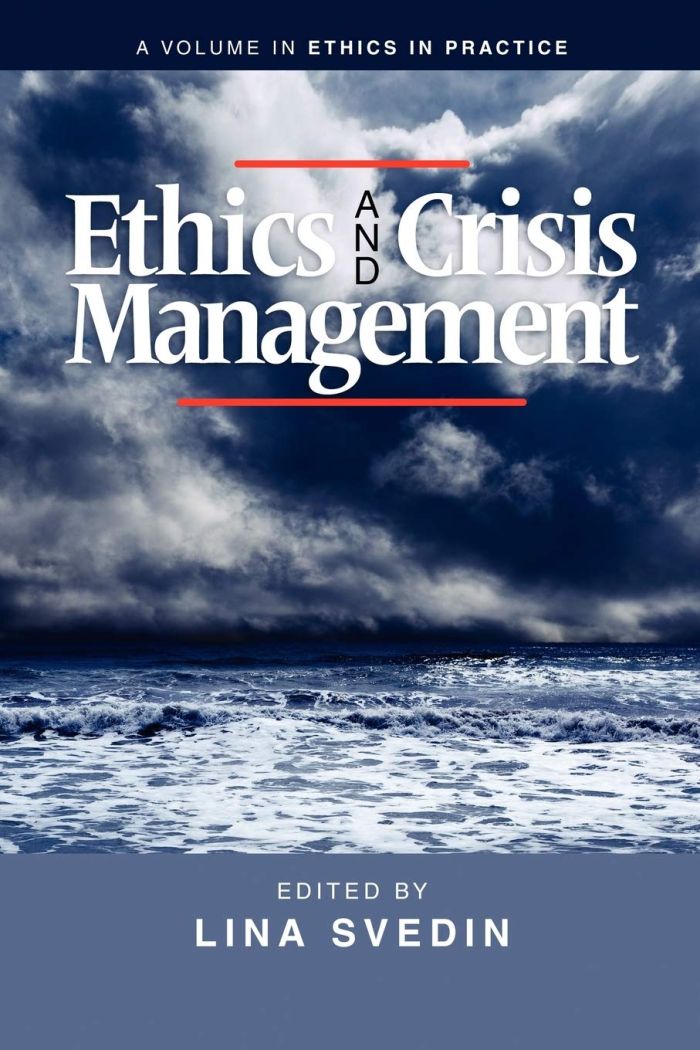
Ethics and Crisis Management

This book can be opened with

Note on our eBooks and Audiobooks: you can read our eBooks (ePUB or PDF) and listen to audiobooks on the free Emerald Books app on iOS, Android, and desktop. Or read and listen on Emerald's online reader (ePUB eBooks and audiobooks only). To purchase a digital book you will need to create an account if you don’t already have one. After purchasing you will receive instructions on how to get started.
- Description
- Contents
The daily process of public service provision and administration is filled with value judgments and value trade-offs, and the safeguarding of just and fair processes is key to the public’s trust in governing institutions. In crises, public decision-makers face complex ethical judgments under great uncertainty, timepressure, and heightened public scrutiny. A lack of attention to the ethical dimensions of crises has lead decision-makers to long-shadow crises that never reach closure. Furthermore, crises triggered by unethical conduct by public officials steadily feed people’s cynicism about politicians and bureaucracy. The fact that decision-makers often are judged on how they dealt with ethical issues in crises further underlines the importance of this topic.
Little scholarly attention had been paid to how ethics play into and are dealt with in situations when they matters most – in crises. In order to improve government performance we need to analyze the ethical dilemmas and normative challenges that face practitioners in crises. This book meets this challenge by presenting a public policy framework for analyzing the ethical dilemmas in crises and introduces ten empirical chapters written by prominent public administration and crisis management scholars. The cases reviewed include Abu Ghraib, the 9/11 Commission, the 2008 Financial Crisis and the Memorial Hospital Tragedy during Hurricane Katrina. Building off the empirical focus on inherent ethical challenges in crises and actor ethics in evaluation and judgment, the concluding chapter outlines important lessons about criteria for crisis decision-making and strategies, the poisoned apple of bureaucratic discretion, and the nature of post-crisis evaluations.
The book is geared toward students, scholars, and practitioners concerned with public management, public sector ethics, public policy, crisis management, and the implication of these factors on business and corporate crisis management.
Foreword; Mary C. Gentile.
- Preface.
- Acknowledgements.
- Chapter 1. Introduction; Lina Svedin.
- Chapter 2. Inherent Ethical Challenges in Bureaucratic Crisis Management: The Swedish Experience with the 2004 Tsunami Disaster; Pär Daléus and Dan Hansén.
- Chapter 3. Value Conflicts in Foreign Policy Crises: How the United States and the U.K. Wrestled with the Ethical Dilemma of Going to War in Iraq; Fredrik Bynander.
- Chapter 4. International Humanitarian Assistance: Legitimate Intervention or Illegitimate Interference? Lieuwe Zijlstra, Andrej Zwitter, and Liesbet Heyse.
- Chapter 5. Drowning in Discretion: Crisis Management Ethics and the Problem of Aporia; Arjen Boin and Paul Nieuwenburg.
- Chapter 6. The Ethical Dilemmas of Straddling the Public–Private Divide in Economic Crises; Lina Svedin.
- Chapter 7. Chasing Evil, Defending Atrocities: Blame Avoidance and Prisoner Abuse During the War in Iraq; Sanneke Kuipers, Kasia Kochanska, and Annika Brändström.
- Chapter 8. Communication in Crises of Public Diplomacy: The Quest for Ethical Capital; Eva-Karin Olsson.
- Chapter 9. The Politics-Administration Dichotomy and the Failure of Symmetrical Responsibility Doctrines; Helena Wockelberg.
- Chapter 10. The Purpose, Functions, and Ethical Dimensions of Postcrisis Investigations: The Case of the 9/11 Commission; Charles F. Parker.
- Chapter 11. Uncertainty, Accountability, and the Conduct of Postcrisis Inquiries; Daniel Nohrstedt.
- Chapter 12. Conclusions; Lina Svedin.
- About the Editor.
- Contributors List.