
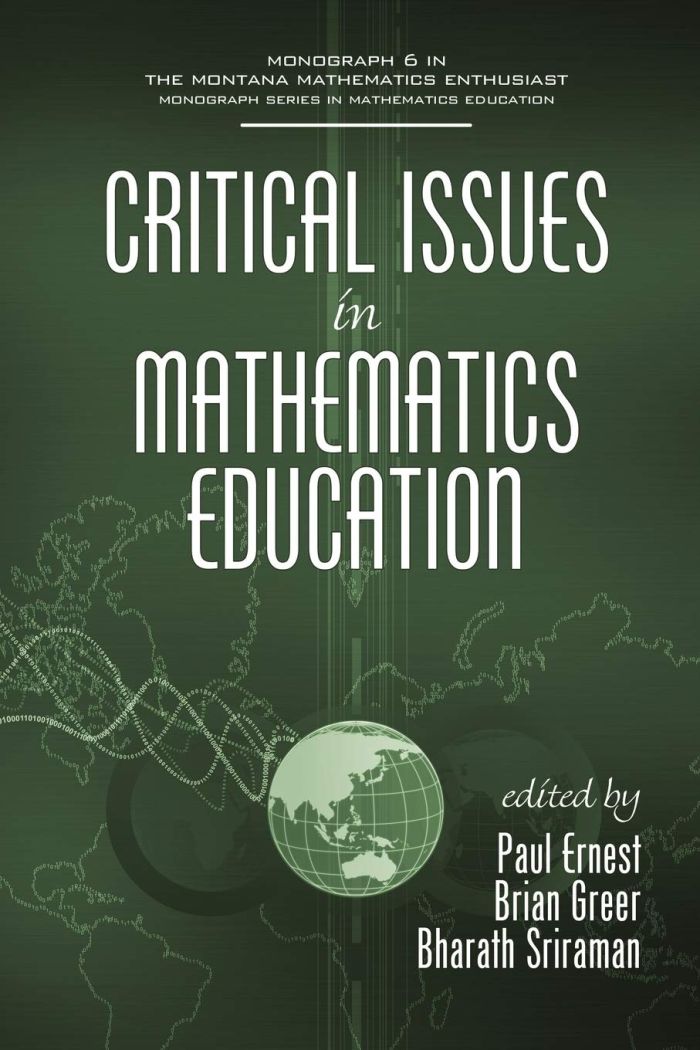
Critical Issues In Mathematics Education

This book can be opened with

Note on our eBooks and Audiobooks: you can read our eBooks (ePUB or PDF) and listen to audiobooks on the free Emerald Books app on iOS, Android, and desktop. Or read and listen on Emerald's online reader (ePUB eBooks and audiobooks only). To purchase a digital book you will need to create an account if you don’t already have one. After purchasing you will receive instructions on how to get started.
- Description
- Contents
The word "critical" in the title of this collection has three meanings, all of which are relevant. One meaning, as applied to a situation or problem, is "at a point of crisis". A second meaning is "expressing adverse or disapproving comments or judgments". A third is related to the verb "to critique", meaning "to analyze the merits and faults of". The authors contributing to this book pose challenging questions, from multiple perspectives, about the roles of mathematics in society and the implications for education. Traditional reasons for teaching mathematics include: preparing a new generation of mathematics researchers and a cadre of technically competent users of mathematics; training students to think logically; and because mathematics is as much part of cultural heritage as literature or music. These reasons remain valid, though open to critique, but a deeper analysis is required that recognizes the roles of mathematics in framing many aspects of contemporary society, that will connect mathematics education to the lived experiences of students, their communities, and society in general, and that acknowledges the global ethical responsibilities of mathematicians and mathematics educators.
The book is organized in four sections (1) Mathematics education: For what and why? (2) Globalization and cultural diversity, (3) Mathematics, education, and society and (4) Social justice in, and through, mathematics education
The chapters address fundamental issues such as the relevance of school mathematics in people's lives; creating a sense of agency for the field of mathematics education, and redefining the relationship between mathematics as discipline, mathematics as school subject and mathematics as part of people's lives.
Section I. Mathematics Education: For What and Why?
- Chapter 1. What is Mathematics Education For? Brian Greer
- Chapter 2. Ethical Responsibility and the "What" and "Why" of Mathematics Education in a Global Context; Bill Atweh
- Chapter 3. The Demathematising Effect of Technology: Calling for Critical Competence; Uwe Gellert & Eva Jablonka
- Chapter 4. Mathematical Literacy: Issues of Engagement from the South African Experience of Curriculum Implementation; Mellony Graven & Hamsa Venkat
- Chapter 5. The Purpose of School Mathematics: Perspectives of Colombian Mathematics Teachers; Cecilia Agudelo-Valderrama
- Chapter 6. Teaching Mathematics With and For Creativity: An Intercultural Perspective; Roza Leikin
- Chapter 7. Whose Mathematics Education? Mathematical Discourses as Cultural Matricide? Fiona Walls
- Chapter 8. The Tension Between What Mathematics Education Should Be For and What It Is Actually For; Alexandre Pais
- Chapter 9. Mathematics Education: For Whom? Monica Mesquita
- Section II. Globalization and Cultural Diversity
- Chapter 10. Mathematics Education Ideologies and Globalization; Paul Ernest
- Chapter 11. What is This Thing Called Social Justice and What Does It Have to Do With Us in the Context of Globalization; Bill Atweh
- Chapter 12. Defrosting and Re-Frosting the Ideology of Pure Mathematics: An Infusion of Eastern-Western Perspectives on Conceptualizing a Socially Just Mathematics Education; Bal Chandra Luitel & Peter Charles Taylor
- Chapter 13. Mathematics Education and the Brazilian Landless Movement; Gelsa Knijnik
- Chapter 14. Kerala Mathematics and Its Possible Transmission to Europe; Dennis Almeida & George Gheverghese Joseph
- Chapter 15. The Philosophy of Mathematics, Values, and Kerala Mathematics; Paul Ernest
- Section III. Mathematics, Education, and Society
- Chapter 16. Classroom Research: Impact and Long Term Effect Versus Justice, Liberation and Empowerment? Paul Ernest
- Chapter 17. Values and the Social Responsibility of Mathematics; Simon Goodchild
- Chapter 18. What Has Power Got to Do With Mathematics Education? Paola Valero
- Chapter 19. Formatting Power of "Mathematics in a Package": A Challenge for Social Theorising? Ole Skovsmose
- Chapter 20. What is Mathematics About? Ole Skovsmose and Keiko Yasukawa
- Chapter 21. Applied Mathematics as Social Contract; Philip Davis
- Chapter 22. Mathematics and Curriculum Integration: Challenging the Hierarchy of School Knowledge; De Freitas
- Section IV. Social Justice In, and Through, Mathematics Education
- Chapter 23. Social Justice and Mathematics Education: Issues, Dilemmas, Excellence and Equity; Bharath Sriraman and Olof Steinhorsdottir
- Chapter 24. Social Justice and Mathematics: Rethinking the Nature and Purposes of School Mathematics; Kurt Stemhagen
- Chapter 25. Possibilities and Challenges in Teaching Mathematics for Social Justice; Eric (Rico) Gutstein
- Chapter 26. Math Education and Social Justice: Gatekeepers, Politics, and Teacher Agency; Peter Applebaum & Erica Davila
- Chapter 27. On Methodologies of Research Into Gender and Other Equity Questions; Jeff Evans
- Chapter 28. The Privilege of Pedagogical Capital: A Framework for Understanding Scholastic Success in Mathematics; Carol V. Livingston
- Chapter 29. Pupils of African Heritage, Mathematics Education, and Social Justice; Kwame E. Glevey
- Chapter 30. Researching, and Learning Mathematics at the Margin: From "Shelter" to School; Renuka Vithal