
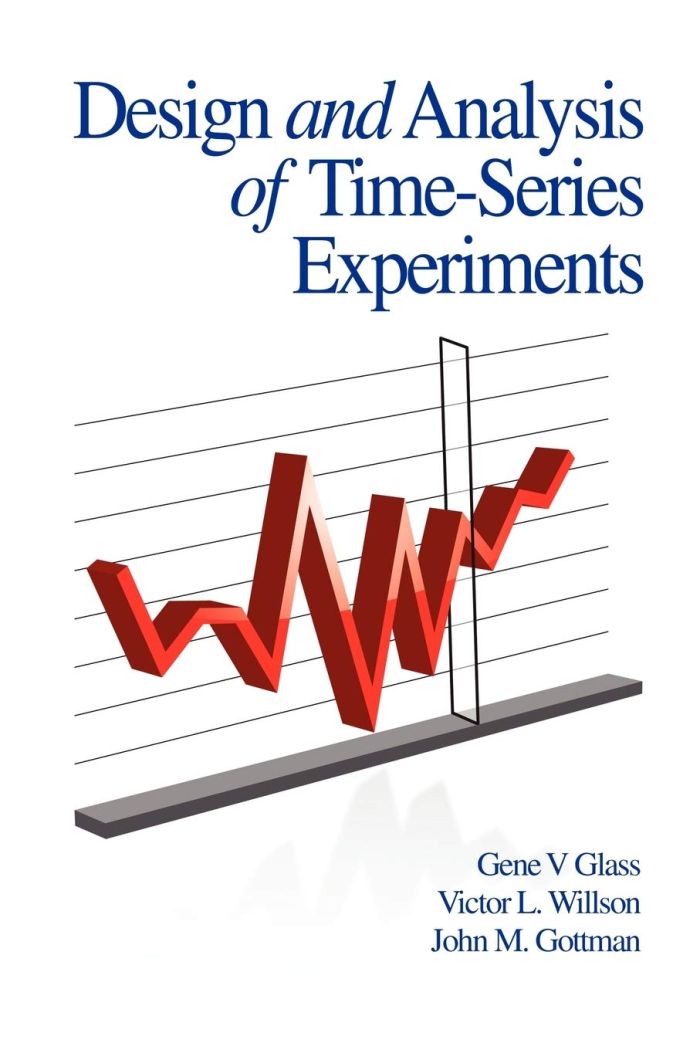
Design and Analysis of Time-Series Experiments

This book can be opened with

Note on our eBooks and Audiobooks: you can read our eBooks (ePUB or PDF) and listen to audiobooks on the free Emerald Books app on iOS, Android, and desktop. Or read and listen on Emerald's online reader (ePUB eBooks and audiobooks only). To purchase a digital book you will need to create an account if you don’t already have one. After purchasing you will receive instructions on how to get started.
- Description
- Contents
Hailed as a landmark in the development of experimental methods when it appeared in 1975, Design and Analysis of Time-Series Experiments is available again after several years of being out of print.
Gene V Glass, Victor L. Willson and John M. Gottman have carried forward the design and analysis of perhaps the most powerful and useful quasi-experimental design identified by their mentors in the classic Campbell & Stanley text Experimental and Quasi-experimental Design for Research (1966). In an era when governments seek to resolve questions of experimental validity by fiat and the label 'Scientifically Based Research' is appropriated for only certain privileged experimental designs, nothing could be more appropriate than to bring back the classic text that challenges doctrinaire opinions of proper causal analysis.
Glass, Willson & Gottman introduce and illustrate an armamentarium of interrupted time-series experimental designs that offer some of the most powerful tools for discovering and validating causal relationships in social and education policy analysis. Drawing on the ground-breaking statistical analytic tools of Box & Jenkins, the authors extend the comprehensive autoregressive-integrated-moving-averages (ARIMA) model to accommodate significance testing and estimation of the effects of interventions into real world time-series. Designs and full statistical analyses are richly illustrated with actual examples from education, behavioral psychology, and sociology.
About The Authors.
- Introduction To The Republication.
- Chapter 1. Time-Series Experiments And The Investigation Of Causal Claims
- Chapter 2. Variations On The Basic Time-Series Experimental Design
- Chapter 3. Interventions And Intervention Effects
- Chapter 4. Sources Of Invalidity In Time-Series Experiments.
- Chapter 5. Outline Of Time-Series Analysis.
- Chapter 6. Estimating And Testing Intervention Effects.
- Chapter 7. Estimating And Testing Intervention Effects In The General Arima (P, D, Q) Model.
- Chapter 8. Concomitant Variation In Time-Series Experiments.
- Chapter 9. Special Topics In The Analysis Of Time-Series Experiments.
- Appendix A. Special Analysis Of Time-Series
- Appendix B. Data Lists
- Appendix C. Linear Model And Least-Squares Theory
- References
- Subject Index
- Author Index