
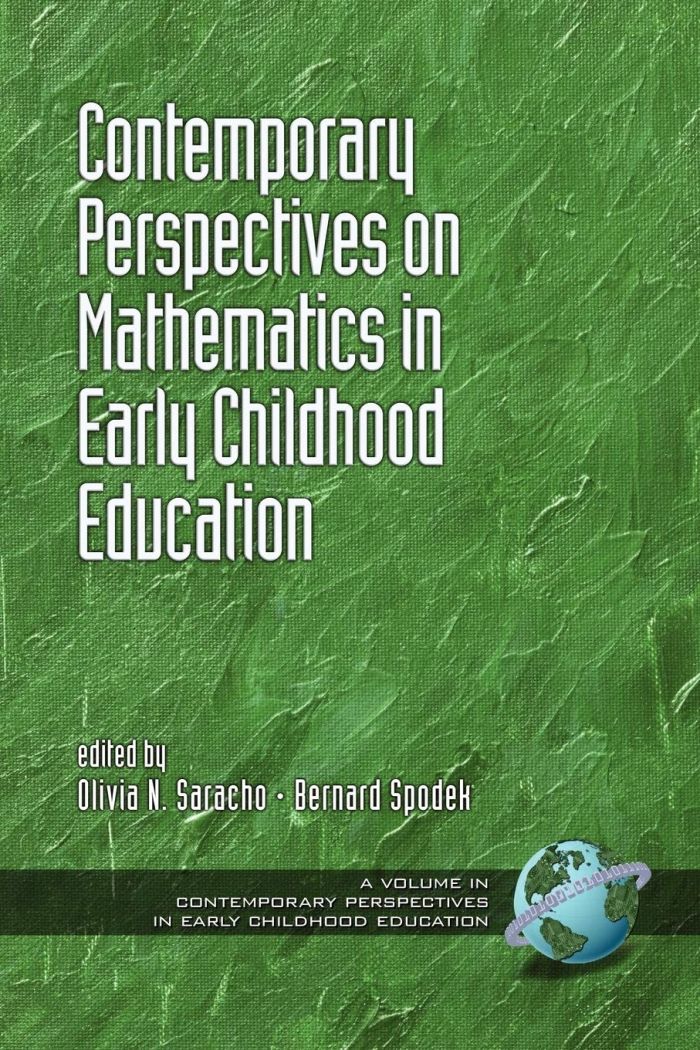
Contemporary Perspectives on Mathematics in Early Childhood Education

This book can be opened with

Note on our eBooks and Audiobooks: you can read our eBooks (ePUB or PDF) and listen to audiobooks on the free Emerald Books app on iOS, Android, and desktop. Or read and listen on Emerald's online reader (ePUB eBooks and audiobooks only). To purchase a digital book you will need to create an account if you don’t already have one. After purchasing you will receive instructions on how to get started.
- Description
- Contents
This volume provides a comprehensive critical analysis of the research in mathematics education for young children. The researchers who conducted the critical analysis focused on the relationship between (1) mathematics learning in the early years and domain specific approaches to cognitive development, (2) the children’s social learning and their developing understanding of math, and (3) the children’s learning in a natural context and their understanding of mathematics concepts. The work of these scholars can help guide those researchers who are interested in pursuing studies in early childhood mathematics in a specific area of study. This volume will facilitate the research conducted by both novice and expert researchers. The volume has accomplished its major goals, which consists of critically analyzing important research in a specific area that would be most useful in advancing the field and provide recommendations for both researchers and educators.
Introduction: Trends in Early Childhood Mathematics Research; Olivia N. Saracho and Bernard Spodek.
- Chapter 1. History of Mathematics in Early Childhood Education; Olivia N. Saracho and Bernard Spodek.
- Chapter 2. Rethinking the Starting Point for Mathematics Learning; Catherine Sophian.
- Chapter 3. Knowing the Mathematics in Early Childhood Mathematics; Herbert P. Ginsburg and Barbrina Ertle.
- Chapter 4. Mathematics in Early Childhood; Julie Sarama and Douglas H. Clements.
- Chapter 5. Mathematics Learning and Teaching in the Early Years; Ann Anderson, Jim Anderson, and Carolyn Thauberge.
- Chapter 6. Development of Children's Mathematical Thinking in Early School Years; Jennifer M. Young-Loveridge.
- Chapter 7. Development of Mathematical Reasoning among Young Children: How Do Children Understand Area and Length? William M. Bart, Masamichi Yuzawa, and Miki Yuzawa.
- Chapter 8. The Impact of Method on Assessing Young Children's Everyday Mathematical Experiences; Jonathan Tudge, LinLin Li, and Tiffany Kinney Stanley.
- Chapter 9. An Examination of the Role of Statistical Investigation in Supporting the Development of Young Children's Statistical Reasoning; Aisley Leavy.
- Chapter 10. Research on Spatial Skills and Block Building in Girls and Boys: The Relationship to Later Mathematics Learning; Joanne Kersh, Beth M. Casey, and Jessica Mercer Young.
- Chapter 11. Sociocultural Influences on Young Children's Mathematical Knowledge; Prentice Starkey and Alice Klein.
- Chapter 12. Guidance of Numeracy Development in Early Childhood; Maureen Vandermaas-Peeler.
- Chapter 13. Do Parents Count?: The Socialization of Children's Numeracy; Joann P. Benigno and Shari Ellis.
- Chapter 14. Research Perspectives in Early Childhood Mathematics; Olivia N. Saracho and Bernard Spodek.
- About the Contributors.