
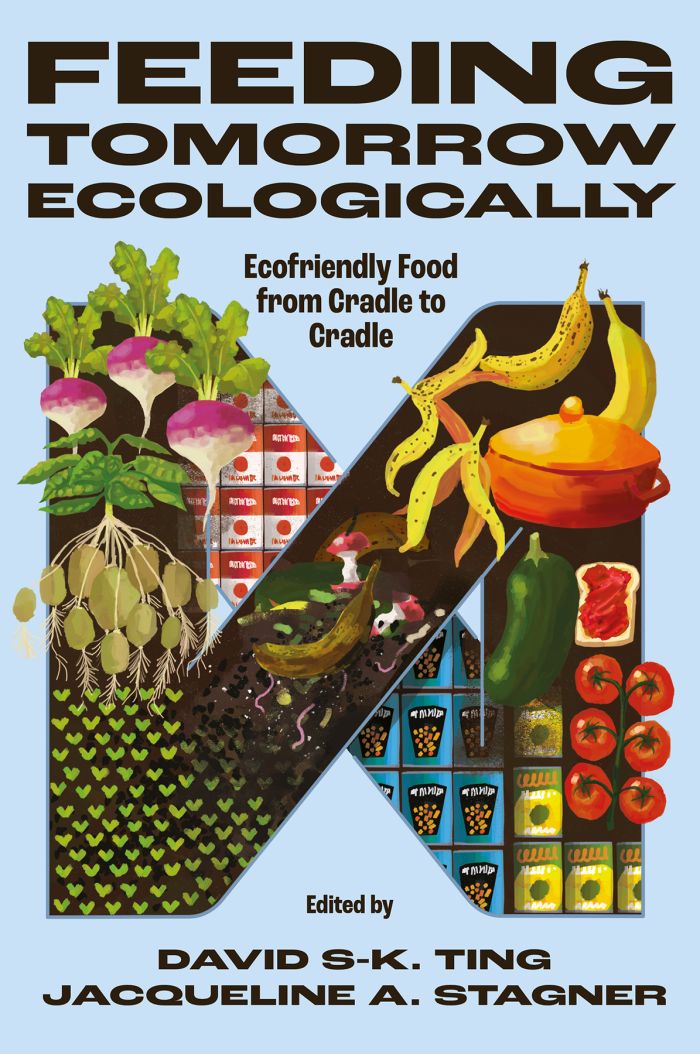

Feeding Tomorrow Ecologically
Ecofriendly Food from Cradle to Cradle

This book can be opened with

Note on our eBooks and Audiobooks: you can read our eBooks (ePUB or PDF) and listen to audiobooks on the free Emerald Books app on iOS, Android, and desktop. Or read and listen on Emerald's online reader (ePUB eBooks and audiobooks only). To purchase a digital book you will need to create an account if you don’t already have one. After purchasing you will receive instructions on how to get started.
- Description
- Contents
- About
Reports from the United Nations indicate that the Sustainable Development Goals (SDGs) are not meeting their targets, at least not according to the proposed timeline. Despite this, the world produces enough food to feed everyone. The crucial task remains to ensure equitable food distribution to those in need and reduce global food wastage.
Feeding Tomorrow Ecologically: Ecofriendly Food from Cradle to Cradle serves to support the top three SDGs: No Poverty, Zero Hunger, and Good Health and Well-Being. In this edited collection, authors delve into multifaceted aspects of global food systems. They examine the pivotal role of engineering throughout the food supply chain, from production to waste management, and its potential in fostering sustainable food security. Additionally, contributors investigate the evolution and perception of eco-friendly agriculture, focusing on adoption rates and attitudes, as well as diverse topics such as soil management, water reclamation, and policy. Through these varied perspectives, the chapters provide a comprehensive overview of challenges and innovations in shaping the future of food production and sustainability.
This edited collection brings together experts from farming, engineering, health sciences, policy, and other fields to provide insights into sustaining future populations with nourishing food. Scholars and professionals across various disciplines, including engineers, economists, scientists, sociologists, and marine conservationists, benefit from this work, which holds deep implications for food and economic systems.
Chapter 1. Engineering’s Role as a Partner in the Food Supply Chain: From Farm to Plate and Beyond; Graham T. Reader
- Chapter 2. Application of Biochar as a Soil Amendment for Ameliorating Soil Properties; Yulin Hu and Quan He
- Chapter 3. Water Reclamation Technologies for a Sustainable Agri-Food System: The Water-Oriented Living Lab of ‘La Axarquia’ (Spain); Antonia María Lorenzo López, Alfonso Expósito, and Julio Berbel
- Chapter 4. Sustainable Farming to Achieve Future-Proof Food Security; Mohammad Shokati Amghani, Valiollah Sarani, Moslem Savari, and Hamed Sheykhi
- Chapter 5. The Evolution of Feeding Concepts and Technologies: Past, Present, and Future; Esraa E. Ammar, Abubakr S. Sallam, Shrouk Ekramy, Nouran A. EL-Shershaby, and Xiaobo Zou
- Chapter 6. Policy Formulation and Implementation for Sustainable Food Systems; Beth-Anne Schuelke-Leech
- Chapter 7. Harmony by Design: Fostering the Green Engineering Revolution for Sustainable Agriculture; Abhishek Anand, Monika Jain, Bishal Mukherjee, Suman Dutta, and Manish Kumar Naskar
- Chapter 8. The Permaculture Alternative and Its Potential for Addressing Global Food Scarcity; Timothy C. Leech
- Chapter 9. Toxicity in the Green Growth Transition in Africa: Reality versus Utopia; Nyong Princely Awazi
- Chapter 10. Analyzing the Circular Economy of the EU Countries: Evidence on Environmental and Sustainable Development Perspectives; Fazıl Gökgöz and Engin Yalçin
David S-K. Ting is the founder of the Turbulence & Energy Laboratory. He is a professor in the Department of Mechanical, Automotive, and Materials Engineering at the University of Windsor, Canada.
Jacqueline A. Stagner is the Undergraduate Programs Coordinator in the Faculty of Engineering at the University of Windsor, Canada.