
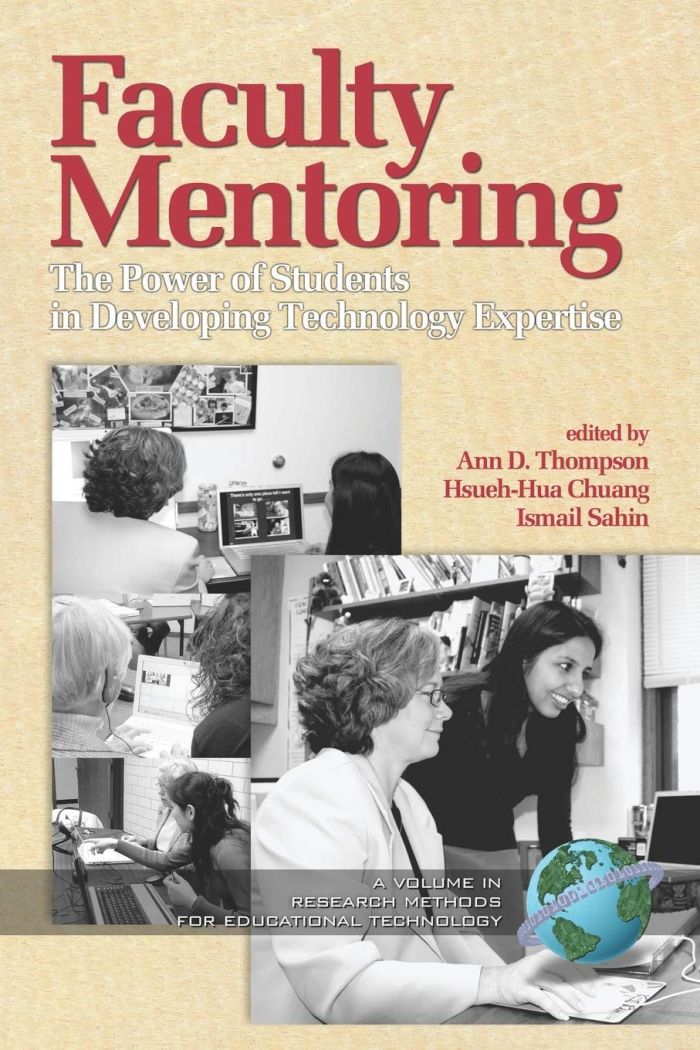
Faculty Mentoring
The Power of Students in Developing Technology Expertise

This book can be opened with

Note on our eBooks and Audiobooks: you can read our eBooks (ePUB or PDF) and listen to audiobooks on the free Emerald Books app on iOS, Android, and desktop. Or read and listen on Emerald's online reader (ePUB eBooks and audiobooks only). To purchase a digital book you will need to create an account if you don’t already have one. After purchasing you will receive instructions on how to get started.
- Description
- Contents
The purpose of this book is to describe the approach and process involved in a program designed to assist faculty in acquiring technology skills and to apply these skills in constructing meaningful learning-centered applications. Most educators will agree that the challenge of developing faculty technology expertise is a major and crucial one for colleges and universities. As early as 1988 it became apparent that teachers were not prepared to use new technologies coming into their classrooms (OTA, 1988).
This book is intended for educators who are working to lead the meaningful integration of technology into higher education and K–12 environments. The detailed stories provide useful knowledge and background for K–12 educators, higher education educators, and trainers in business and industry who are faced with the challenge of helping people learn to use technology effectively.
Series Editor's Preface.
- Preface; Ann Thompson.
- Chapter 1. History of the Faculty Technology Mentoring Program; Ann Thompson.
- Chapter 2. Role of the Faculty Mentoring Program in the Adoption and Diffusion of Instructional Technology: The Theoretical Perspective; Ismail Sahin.
- Chapter 3. Faculty Technology Mentoring Programs: Major Trends in the Literature; Hsueh-Hua Chuang and Denise Schmidt.
- Chapter 4. A Senior Faculty Member Approaches Technology; Denise Lindstrom and Geoff Abelson.
- Chapter 5. Making Connections: An International Student's Perspective; Hsueh-Hua Chuang.
- Chapter 6. Designing an On-line Learning Environment: Experts Learning Together; Qian Li.
- Chapter 7. Understanding and Addressing a Faculty Member's Concerns in the Technology Integration Process; Sonmez Pamuk.
- Chapter 8. Technology Mentoring through the Eyes of K–5 Practitioners; Comfort Kouadio.
- Chapter 9. Mentor Me This! Technology Mentoring in a Secondary School; Jeannette Babcock and Mary Ohaver Moermond.
- Chapter 10. Learing to Mentor: A Student's Perspective; Natalie Johnson.
- Chapter 11. Lessons Learned; Ann Thompson.
- Epilogue.