
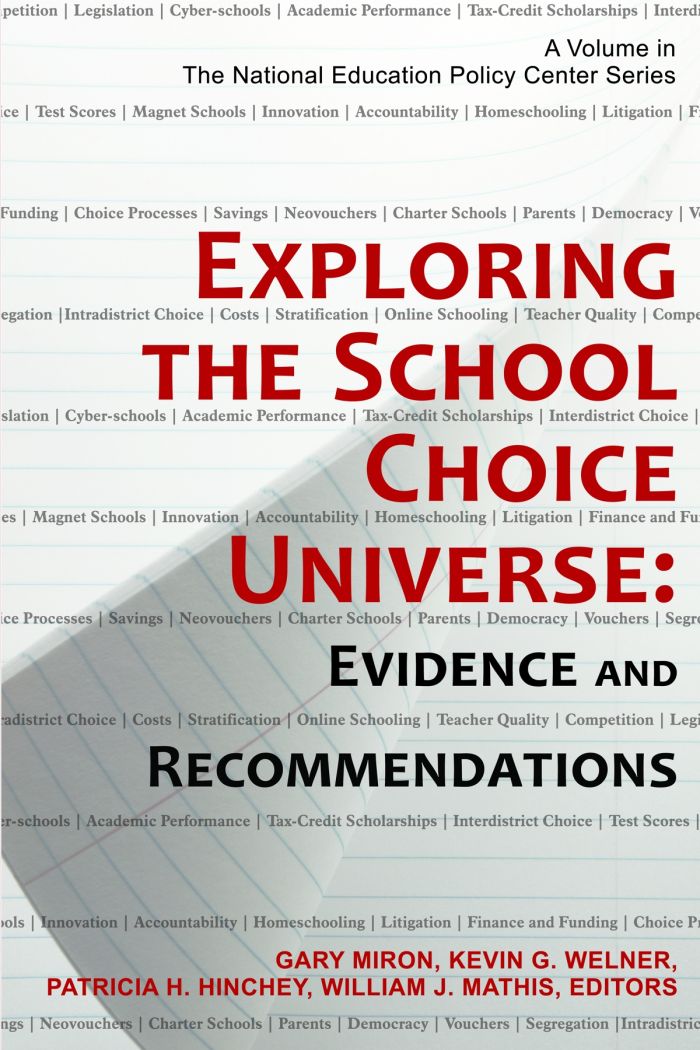
Exploring the School Choice Universe
Evidence and Recommendations

This book can be opened with

Note on our eBooks and Audiobooks: you can read our eBooks (ePUB or PDF) and listen to audiobooks on the free Emerald Books app on iOS, Android, and desktop. Or read and listen on Emerald's online reader (ePUB eBooks and audiobooks only). To purchase a digital book you will need to create an account if you don’t already have one. After purchasing you will receive instructions on how to get started.
- Description
- Contents
Exploring the School Choice Universe: Evidence and Recommendations gives readers a comprehensive, complete picture of choice policies and issues. In doing so, it offers cross-cutting insights that are obscured when one looks only at single issue or a single approach to choice. The book examines choice in its various forms: charter schools, home schooling, online schooling, voucher plans that allow students to use taxpayer funds to attend private schools, tuition tax credit plans that provide a public subsidy for private school tuition, and magnet schools and other forms of public school intra- and interdistrict choice. It brings together some of the top researchers in the field, presenting a comprehensive overview of the best current knowledge of these important policies.
The questions addressed in Exploring the School Choice Universe are of most importance to researchers and policy makers. What do choice programs actually do? What forms do they take? Who participates, and why? What are the funding implications? What are the results of different forms of school choice on outcomes that matter, like student performance, segregation, and competition effects? Do they affect teachers’ working conditions? Do they drive innovation?
The contents of this book offer reason to believe that choice policies can further some educational goals. But they also suggest many reasons for caution. If choice policies are to be evidence-based, a re-examination is in order. The information, insights and recommendations facilitate a more nuanced understanding of school choice and provide the basis for designing sensible school choice reforms that can pursue a range of desirable outcomes.
Introduction, Gary Miron and Kevin G. Welner.
- Chapter 1. Negotiating Public and Private: Philosophical Frameworks for School Choice, Terri S. Wilson.
- Chapter 2. How Legislation and Litigation Shape School Choice, Julie F. Mead.
- Chapter 3. Who Chooses Schools, and Why? The Characteristics and Motivations of Families who Actively Choose Schools, Natalie Lacireno-Paquet and Charleen Brantley.
- Chapter 4. School Choice and Accountability, Gregg Garn and Casey Cobb.
- Chapter 5. Funding Formulas, School Choice, and Inherent Incentives, Clive R. Belfield.
- Chapter 6. Teacher Qualifications and Work Environments Across School Choice Types, Marisa Cannata.
- Chapter 7. Educational Innovation and Diversification in School Choice Plans, Christopher Lubienksi.
- Chapter 8. School Choice and Segregation by Race, Ethnicity, Class, and Achievement, Roslyn Arlin Mickelson, Martha Cecilia Bottia, and Stephanie Southworth.
- Chapter 9. The Competitive Effect of School Choice Policies on Public School Performance, David Arsen and Yongmei Ni.
- Chapter 10. The Impact Of School Choice Reforms On Student Achievement, Gary Miron and Jessica L. Urschel.
- Conclusions and Recommendations, William J. Mathis and Patricia H. Hinchey.