
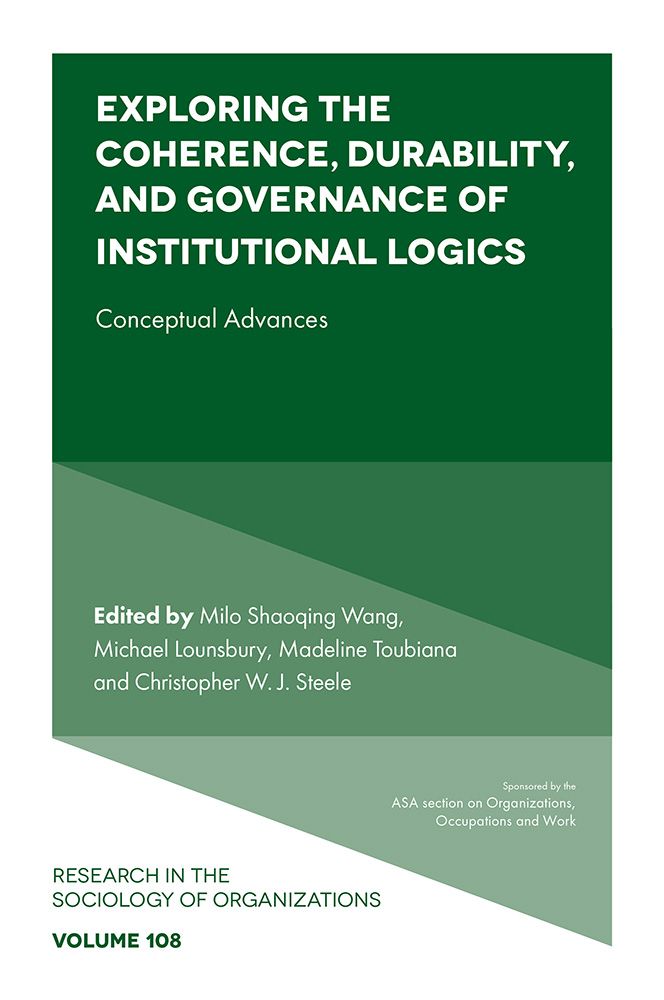
Exploring the Coherence, Durability, and Governance of Institutional Logics
Conceptual Advances

This book can be opened with

Note on our eBooks and Audiobooks: you can read our eBooks (ePUB or PDF) and listen to audiobooks on the free Emerald Books app on iOS, Android, and desktop. Or read and listen on Emerald's online reader (ePUB eBooks and audiobooks only). To purchase a digital book you will need to create an account if you don’t already have one. After purchasing you will receive instructions on how to get started.
- Description
- Contents
- About
This volume contains an Open Access chapter.
Institutional logics have become a foundational framework for understanding how meaning and practice shape organizational and societal life. This volume examines institutional logics as structured yet evolving formations, focusing on how they cohere, persist and are governed across diverse settings.
Bringing together new conceptual contributions, Exploring the Coherence, Durability, and Governance of Institutional Logics: Conceptual Advances maps multifaceted views of how institutional logics take form and are sustained in practice. The papers engage with questions of how values and practices align to produce recognizable configurations, how field‑level actors and governance arrangements influence the maintenance or disruption of logics, and how digital environments, stigmatization processes and organizational mechanisms shape patterns of stability and change. Contributors introduce frameworks for analyzing institutional competence, identifying critical linchpin actors, understanding the generative properties of logics and assessing coherence through configurational and methodological approaches.
Advancing a clearer understanding of how institutional logics operate as dynamic yet ordered social constructs, this volume provides a foundation for future research on institutional processes and organizational change.
Institutional Logics as Phenomena: Advancing the Study of Coherence, Durability, and Governance; Milo Shaoqing Wang, Michael Lounsbury, Madeline Toubiana, and Christopher W. J. Steele OPEN ACCESS
- Chapter 1. Levels, Axes, Quadrants, and Fractals: Theorizing Institutionalization and Deinstitutionalization for Multi-Level Causal Analysis and Measurement; Eleanor R. Anderson and Jeannette A. Colyvas
- Chapter 2. Theorizing the Character of Institutional Logics: Insights from the Generative Logic of Hospital Medicine, 1996-2016; Christopher W. J. Steele, Vanessa Pouthier, and William Ocasio
- Chapter 3. Constructing Coherence of Emerging Logics: A Configurational Approach to Coherence; Chuqiao Zhou
- Chapter 4. Stigmatization as Governance: Maintaining the Coherence of Institutional Logics; Lin Dong
- Chapter 5. Institutional Linchpins; Chirag Kasbekar
- Chapter 6. The (Il)Logics of Social Media; Lee C. Jarvis and Catherine Berrington
- Chapter 7. Toward the Study of Institutional Competence: A Conceptual Framework; Kym Chappell, Henry Shi, and Tracey Dodd
- Chapter 8. Methodology in Institutional Analysis: The Operationalization and Theorization of Institutional Logics; Tammar B. Zilber
Milo Shaoqing Wang is an Assistant Professor in the Department of Management and Entrepreneurship at Arizona State University’s W. P. Carey School of Business, USA, where he is also an affiliated faculty at the Center for AI and Data Analytics for Business and Society.
Michael Lounsbury is a Professor, the A.F (Chip) Collins Chair, and Chair of the Strategy, Entrepreneurship and Management Department at the University of Alberta School of Business, Canada, where he is also the Academic Director of the eHUB entrepreneurship centre. He is also a Professor of Business Strategy & Entrepreneurship (Part-Time) at the Australian National University College of Business and Economics.
Madeline Toubiana is Professor of Strategy and Organization and the Desmarais Chair of entrepreneurship at University of Ottawa, Canada.
Christopher W. J. Steele is an Associate Professor of Strategy, Entrepreneurship, and Management and Eric Geddes Professor of Business at the University of Alberta, Canada.