
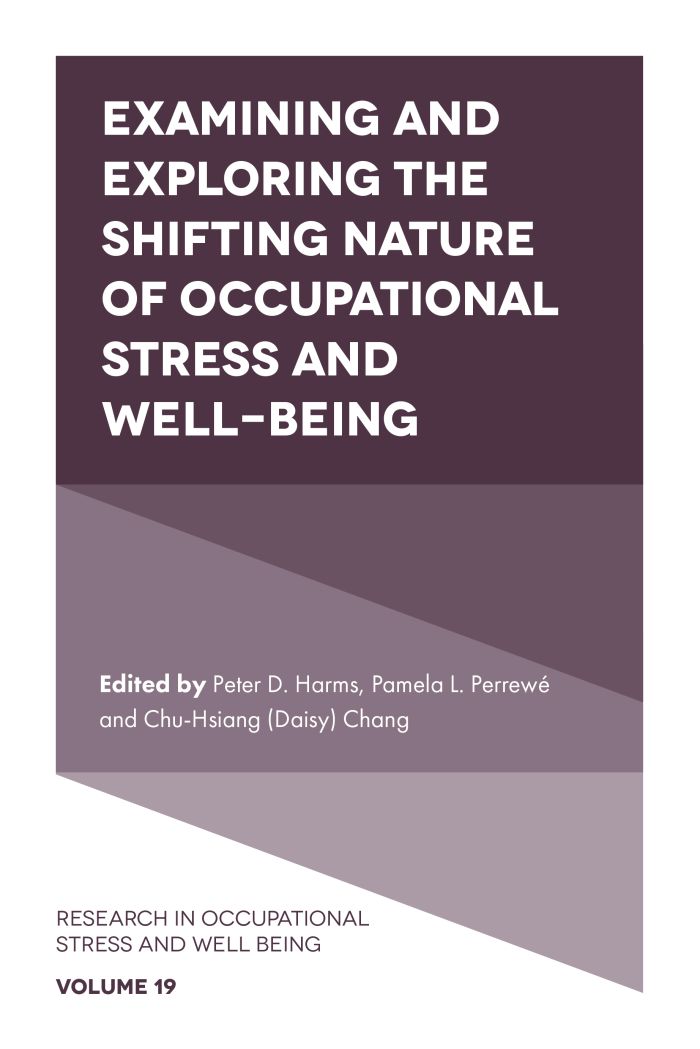

Examining and Exploring the Shifting Nature of Occupational Stress and Well-Being

This book can be opened with

Note on our eBooks and Audiobooks: you can read our eBooks (ePUB or PDF) and listen to audiobooks on the free Emerald Books app on iOS, Android, and desktop. Or read and listen on Emerald's online reader (ePUB eBooks and audiobooks only). To purchase a digital book you will need to create an account if you don’t already have one. After purchasing you will receive instructions on how to get started.
- Description
- Contents
- About
Volume 19 of Research in Occupational Stress and Well-Being explores and enhances our understanding of how stress and well-being at work can change over time. Much of the prior literature in occupational stress and well-being is designed to look at antecedents of stress and well-being, treating them as dependent variables. Although these models implicitly acknowledge the dynamic nature of stress and well-being, they are often assessed at a single time point and treated as a static end-state.
This volume moves beyond this approach by explicitly examining stress and well-being as a dynamic phenomenon by examining changes in stress and well-being that happen developmentally, because of intentional interventions on the part of organizations, in response to job role or job status transitions, or which examine the ways in which changes in stress and well-being is conceptualized and assessed.
Chapter 1. The Purpose and Work Stress Model: Contextualizing the Role of Purpose on and Following Stressful Work Experiences; Patrick L. Hill, Rachel D. Best, and M. Teresa Cardador Chapter 2. Adaptive and Proactive Coping in the Process of Developing Resilience; Clodagh Butler, Deirdre O’Shea, and Donald Truxillo Chapter 3. The Role of Crucibles as Developmental Experiences in Organizations; Paul B. Lester Chapter 4. The Role of Velocity in Occupational Stress Across the Career Span; Jenna A. Van Fossen, Chu-Hsiang Chang, and Russell E. Johnson Chapter 5. Shifting Nature of Occupational Well-Being: Examining Inconsistent Findings from Generational Research Using a Lifespan Perspective; Youjeong Huh and Michael T. Ford Chapter 6. Handling Time in Occupational Stress and Well-Being Research: Considerations, Examples, and Recommendations; Rachel S. Rauvola, Cort W. Rudolph, and Hannes Zacher Chapter 7. Experience Sampling Methodology: Conceptual and Technological Advances for Understanding and Assessing Variability in Well-Being Research; Stuti Thapa, Louis Tay, and Daphne Hou Chapter 8. Modeling Occupational Stress and Well-Being as a Dynamic Phenomenon: It’s About Time; Kristin Lee Sotak and Barry Friedman Chapter 9. Examining the Dynamic Nature of Worker Subjective Well-Being: The Application of Idiographic Approaches; Rachel M. Saef, Emorie Beck, and Joshua J. Jackson
Peter D. Harms is currently the Morrissette Faculty Fellow in Leadership and Ethics for the Culverhouse College of Business at the University of Alabama.
Pamela L. Perrewé is the Robert O. Lawton Distinguished Professor, the Haywood and Betty Taylor Eminent Scholar of Business Administration and Distinguished Research Professor at Florida State University.
Chu-Hsiang (Daisy) Chang is a Professor at the Department of Psychology of Michigan State University.