
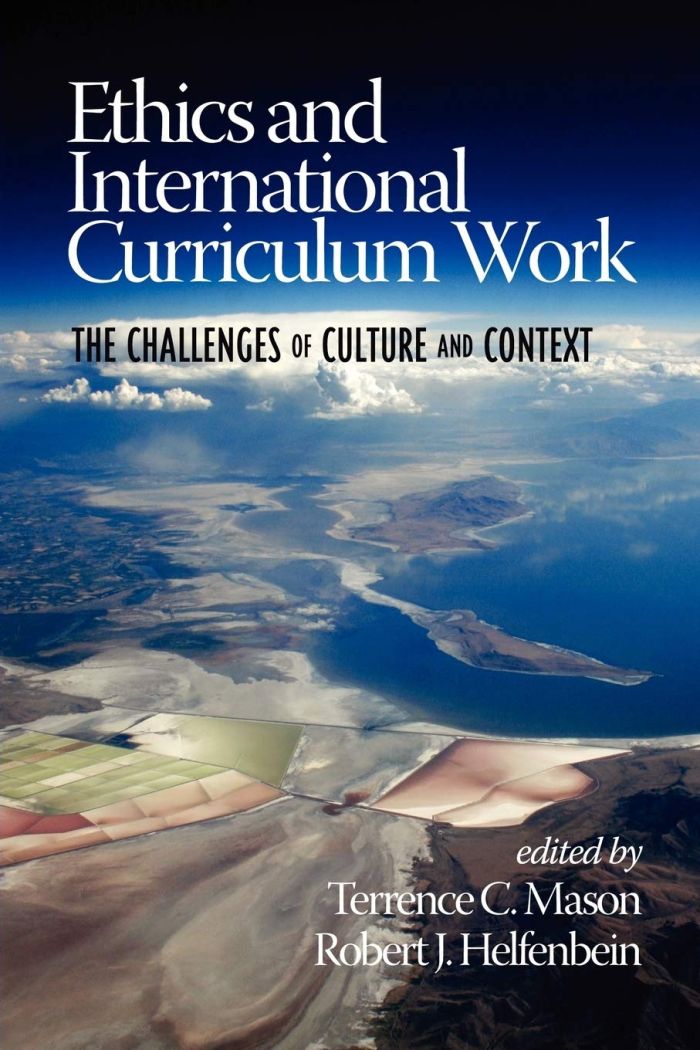
Ethics and International Curriculum Work
The Challenges of Culture and Context

This book can be opened with

Note on our eBooks and Audiobooks: you can read our eBooks (ePUB or PDF) and listen to audiobooks on the free Emerald Books app on iOS, Android, and desktop. Or read and listen on Emerald's online reader (ePUB eBooks and audiobooks only). To purchase a digital book you will need to create an account if you don’t already have one. After purchasing you will receive instructions on how to get started.
- Description
- Contents
The widely cited, though highly contested, idea that “the world is flat” (Friedman, 2004) carries with it a call for education to provide a leveling effect across continents and cultures Students in Skokie or in Skopje, as the theory goes, are expected to experience a school curriculum that shares certain common elements, goals, and purposes. Such a globalized view is not, however, without its complications. This book addresses some of the issues that arise when the transmigration of educational ideas occurs, with a particular eye toward the ethical dilemmas that curriculum workers face in international contexts.
The authors who have contributed to this volume explore, through case examples and critical reflection, what happens when ideas that are drawn from one set of cultural norms and experiences is introduced into other cultural contexts. In many cases these are the stories of “donors” and “hosts,” of structured inequities of power and influence, of disparities in material resources, and, as expressed in one of the cases, the dynamics of the “colonizer” and the “colonized.” A recurrent theme concerns the challenges faced by educators working internationally to reconcile their own ethical predispositions toward equity and cultural responsiveness with certain tacit assumptions about the appropriateness or value of curriculum practices brought from the “developed” world for teachers and students in the “developing” world. How these dilemmas are navigated forms the content of this collection of reports from the field written by those who engage in this complex and important work.
While the content of this volume is situated at the intersection between the field of curriculum studies and comparative education, it is fundamentally a book about curriculum. Most of the authors come from various disciplinary backgrounds with specializations in curriculum development in content areas such as social studies, geography, or mathematics. As “outsiders looking in” on the field of international education and with thoughtful reflections grounded in practice, the authors provide a new set of insights into the challenges of international curriculum work. Finally, since many of the questions raised by the work included here are ethical in nature, the book begins and ends with analyses that link the practical realities presented in the cases with contemporary philosophical thought. This, then, can be seen as the primary contribution of the book to the educational literature as it offers a careful and well-articulated synthesis of theory and practice in the field of international curriculum work. This publication would make an important contribution to courses in curriculum theory and practice, comparative and international education, and international development outside of the field of education.
Acknowledgements.
- Book Editors Introduction: Ethics, International Curriculum Work, and the Practice of Freedom; Robert Helfenbein and Terrence C. Mason
- Preface: Mutuality or Monopoly: Reflections on the Ethics of International Curriculum Work; J. Gregory Keller.
- Section I. Curriculum for Democratic Citizenship
- Chapter 1. Ethics and Democracy Education Across Borders: The Case of Civitas International; Terrence C. Mason.
- Chapter 2. Deliberating Across Ethical Terrain; Patricia Avery and Carolyn Pereira.
- Chapter 3. From Transmission and Influence to Dialogue and Understanding: Rooting International Curriculum Work in Democratic Ethics; Doyle Stevick.
- Chapter 4. Curriculum Development Collaboration between Colonizer and Colonized: Contradictions and Possibilities for Democratic Education; Steven Camicia and Alfredo Bayon.
- Section II. Ethics, Teaching, and Teacher Education
- Chapter 5. A New Set of Questions: The Ethics of Taking Space Seriously in Macedonia; Robert Helfenbein.
- Chapter 6. Ethics, Dissensus, and Traveling Without Moving: Using Videoconferencing to Facilitate Dialogue between Preservice Teachers in Two Nations; Walter Gershon.
- Section III. Transnational Curriculum Theory and Practice.
- Chapter 7. From Text to Pretext: An Ethical Turn in Curriculum Work; Jean-Francois Maheux, Dalene Swanson and Steven Khan.
- Chapter 8. Ethical Dimensions of a Global Curriculum and Professional Development Program: Reflections on a Project in India; William Gaudelli.
- Chapter 9. "I Saw It With My Own Eyes": The Knowledge-Construction Process in International Educator Exchanges; Anatoli Rapoport.
- Afterword: Philosophical Resources for International Curriculum Work; Barry Bull, Indiana University-Bloomington.