
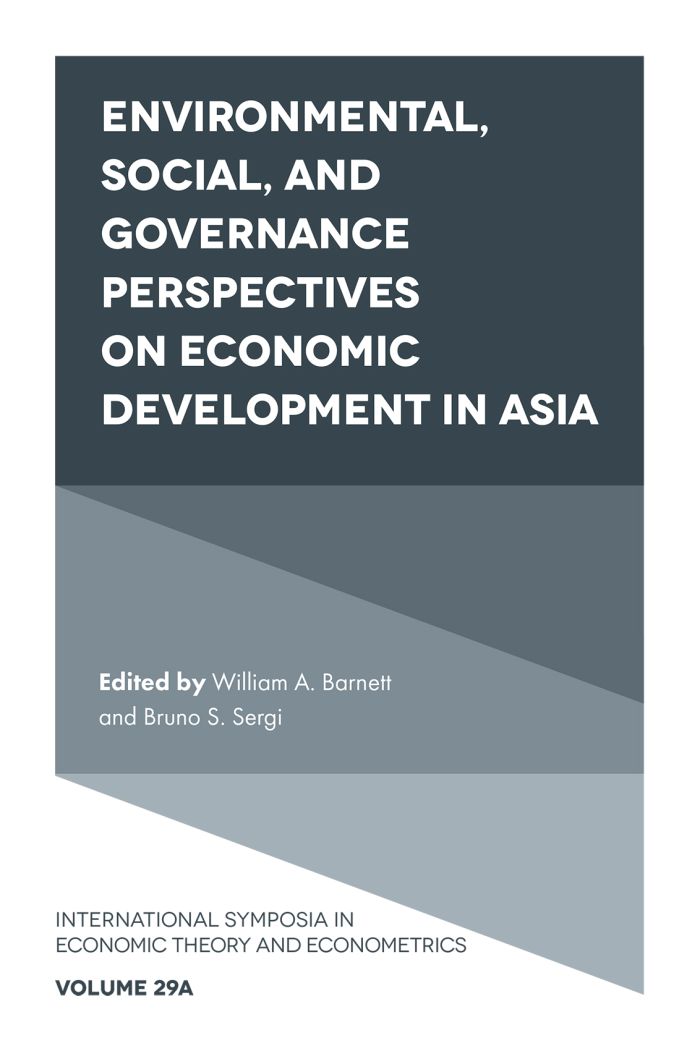

Environmental, Social, and Governance Perspectives on Economic Development in Asia

This book can be opened with

Note on our eBooks and Audiobooks: you can read our eBooks (ePUB or PDF) and listen to audiobooks on the free Emerald Books app on iOS, Android, and desktop. Or read and listen on Emerald's online reader (ePUB eBooks and audiobooks only). To purchase a digital book you will need to create an account if you don’t already have one. After purchasing you will receive instructions on how to get started.
- Description
- Contents
- About
This volume of the International Symposia in Economic Theory and Econometrics explores the latest economic and financial developments in Asia. Chapters cover a range of topics such as the impact machine learning models have on forecasting, the levels and effects of financial literacy of farmers in Thailand, as well as the need to prioritise increasing employee engagement for sustainability. These peer-reviewed papers touch on a variety of timely, interdisciplinary subjects such as corporate social responsibility and the effects of public policy.
Environmental, Social, and Governance Perspectives on Economic Development in Asia also includes empirical studies in financial economics and public governance. For example, one chapter considers the influence of green supply chain integration and environmental uncertainty on performance in Indonesia, while another empirically studies Banking Development and Household Welfare in Thailand.
Together, ISETE 29 volume A, is a crucial resource of current, cutting-edge research for any scholar of international finance and economics.
Chapter 1. The Neo-Fisherianism to Escape Zero Lower Bound; Siddhartha Chattopadhyay
- Chapter 2. Do Machine Learning Models hold the key to better Money Demand Forecasting?; Taniya Ghosh and Sakshi Agarwal
- Chapter 3. The Role of Money in the Monetary Policy: A New Keynesian and New Monetarist Perspective; Masudul Hasan Adil, Neeraj R. Hatekar, and Taniya Ghosh
- Chapter 4. Return and Volatility Linkages between Bitcoin, Gold price and Oil price: Evidence from Diagonal BEKK-GARCH Model; Surachai Chancharat and Julaluk Butda
- Chapter 5. Sin Stock Proportion and Investment Manager Education Background in Indonesian Equity Funds; Taufik Faturohman, Karina Agri Widjaya, Yulianti, and Kurnia Fajar Afgani
- Chapter 6. Banking Development and Household Welfare in Thailand: Evidence from a Panel Survey; Kanokporn Intharak, Surachai Chancharat, and Jakkrich Jearviriyaboonya
- Chapter 7. Financial literacy: Does it improve well-being? A Case Study of Farmers in Khon Kaen, Thailand; Natchaya Thongrak, Surachai Chancharat, and Ploypailin Kijkasiwat
- Chapter 8. The Interlinkages and Diversification Opportunities among Emerging Bond Markets: BRIC and BRICS Comparison; Adefemi A. Obalade, Tsepang Moeti, Vijen Moodley, Yusuf Randeree, and Paul-Francois Muzindutsi
- Chapter 9. Inflation Volatility in Indonesia Using ARIMA Model: Before and During Covid-19; Setyo Tri Wahyudi, Rihana Sofie Nabella, and Kartika Sari
- Chapter 10. Education and Socialization Investment Galleries to Improve Capital Market Inclusion; Dito Rinaldo and Vina Anggilia Puspita
- Chapter 11. Relationship Between Income Smoothing and Earnings Announcement; Agustin Palupi
William A. Barnett is the Oswald Distinguished Professor of Macroeconomics at the University of Kansas, USA. He is also the Director of the Center for Financial Stability in New York City, Founder and First President of the Society for Economic Measurement, and editor of the Cambridge University Press journal, Macroeconomic Dynamics.
Bruno S. Sergi is an instructor on the Economics of Emerging Markets and the Political Economy of Russia and China at Harvard University, and an Associate of the Harvard’s Davis Center for Russian and Eurasian Studies and the Harvard Ukrainian Research Institute. He is the co-director of the Lab for Entrepreneurship and Development (LEAD), a social science research lab based in Cambridge, MA that aims to generate and share knowledge about entrepreneurship, development, and sustainability.