
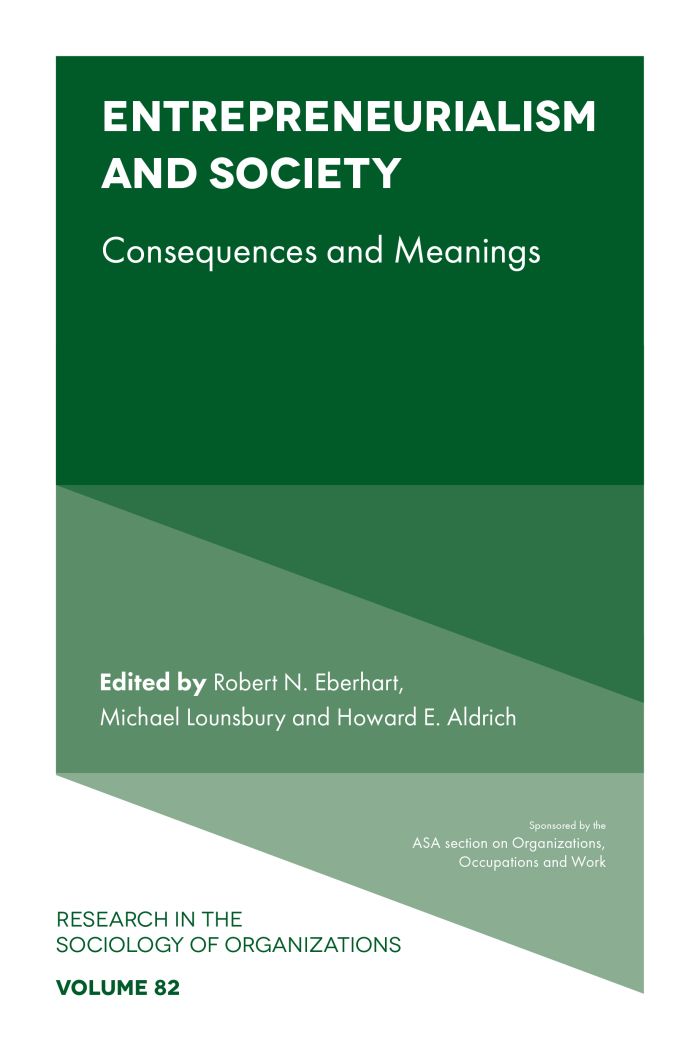


Entrepreneurialism and Society
Consequences and Meanings

This book can be opened with

Note on our eBooks and Audiobooks: you can read our eBooks (ePUB or PDF) and listen to audiobooks on the free Emerald Books app on iOS, Android, and desktop. Or read and listen on Emerald's online reader (ePUB eBooks and audiobooks only). To purchase a digital book you will need to create an account if you don’t already have one. After purchasing you will receive instructions on how to get started.
- Description
- Contents
- Reviews
- About
The second of two volumes bringing together researchers from an array of disciplines including sociology, organization theory, strategy, and organizational behaviour, Entrepreneurialism and Society: Consequences and Meanings addresses the question of how entrepreneurship has transformed from an organizing activity into an ideology that is changing society.
The authors investigate how the transformed meanings of entrepreneurship are causal in new social phenomenon such as organizational misconduct and driving inequality, but also how it may offer a promise to resolve those issues.
Examining into the role of organizations in society, Entrepreneurialism and Society invigorates academic research by developing new perspectives on how entrepreneurs and their organizations shape our social world.
Introduction – "Reversing Entrepreneurship’s Arrow”: The Metaphor’s Model and Research Implications; P. Deveraux Jennings, Timothy R. Hannigan, and Jennifer E. Jennings
- Chapter 1. Towards an Untrepreneurial Economy? The Entrepreneurship Industry and the Rise of the Veblenian Entrepreneur; Rasmus Koss Hartmann, Andre Spicer, and Anders Dahl Krabbe
- Chapter 2. Revisiting the Relationship Between Income Equality and Entrepreneurship: A Social Trust Perspective; Ryan Coles, Shon R. Hiatt, and Wesley D. Sine
- Chapter 3. Rethinking Social Capital: Entrepreneurial Ecosystems as Contested Communities; Banu Ozkazanc-Pan
- Chapter 4. Social Entrepreneurship and the Common Good; Helen M. Haugh and Bob Doherty
- Chapter 5. How Do Founding Teams Form? Towards a Behavioral Theory of Founding Team Formation; David R. Clough and Balagopal Vissa
- Chapter 6. Enacting (New) Possibilities of Living: Entrepreneurship and Affirmation; Dillon Berjani, Karen Verduijn, and Elco van Burg
- Chapter 7. Entrepreneurship Education in Post-Soviet Higher Education Systems: Moving into or Resisting Global Entrepreneurial Culture; Pavel Sorokin, Isak Froumin, and Svetlana Chernenko
The two volumes are a tour de force that serve to crystallize a novel way of conceptualizing the interplay between society and entrepreneurship. They have led to a sea change in scholarship on entrepreneurship and will inspire new and exciting research for years to come.
Entrepreneurship has morphed from “what startups and small businesses do” into a pervasive ideology. From Shark Tank to university curricula, entrepreneurship is everywhere now. How did everyone become an LLC, ready to toss an elevator pitch at a moment’s notice? The articles in these volumes examine the societal impact of entrepreneurialism -- what happens when the process of starting a business becomes a set of values and a how-to guide for appropriate action far beyond the context of startups. They reflect an engaging mix of disciplines and methods taking on a vital problem.
Entrepreneurship has been the rage for several decades, escaping serious scrutiny of its ramifications for those who experience its second and third-order consequences. The authors remedy that omission, deftly revealing the many societal costs and limitations that stem from worshipping at the altar of entrepreneurship.
Robert N. Eberhart is the Associate Director of Research of the entrepreneurship and society project at Stanford University Graduate School of Business. He is also a visiting professor at Kobe University, and at Oxford’s Space Science Initiative.
Michael Lounsbury is a Professor at the Alberta School of Business and adjunct in the Department of Sociology at the University of Alberta, Canada. He is also the Director of the eHUB entrepreneurship centre.
Howard E. Aldrich is Kenan Professor of Sociology and Adjunct Professor of Business at the University of North Carolina, Chapel Hill, USA. He is a fellow of Sidney Sussex College, Cambridge University, and an Affiliate in the Strategy Department at Duke University.