
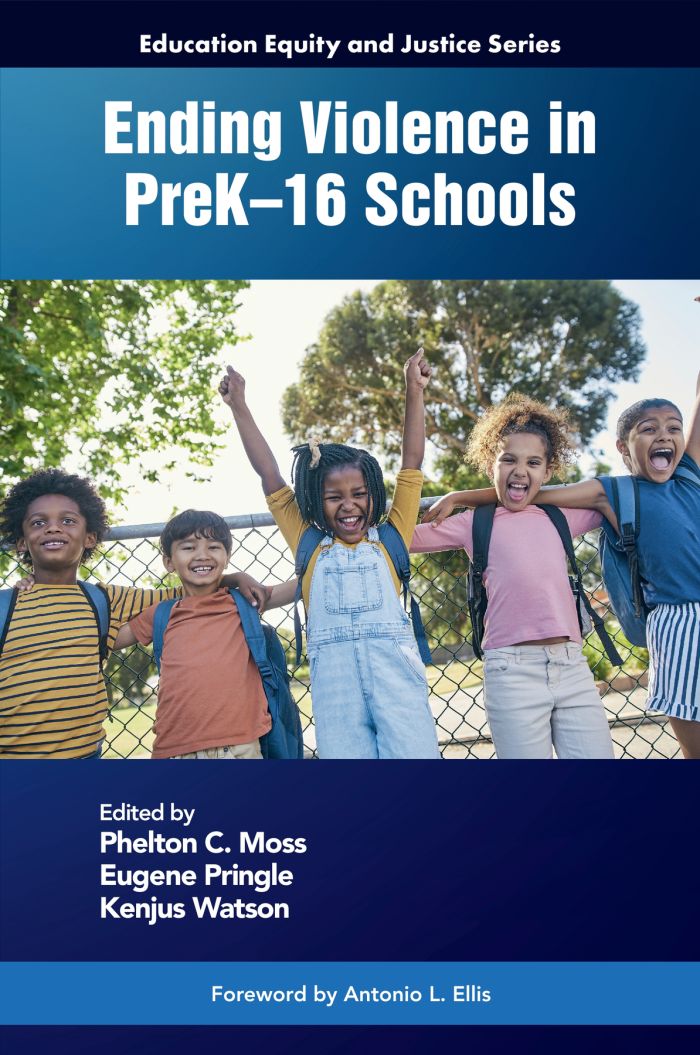
Ending Violence in PreK–16 Schools

This book can be opened with

Note on our eBooks and Audiobooks: you can read our eBooks (ePUB or PDF) and listen to audiobooks on the free Emerald Books app on iOS, Android, and desktop. Or read and listen on Emerald's online reader (ePUB eBooks and audiobooks only). To purchase a digital book you will need to create an account if you don’t already have one. After purchasing you will receive instructions on how to get started.
- Description
- Contents
- Reviews
- About
Ending Violence in PreK–16 Schools provides a comprehensive examination of the complex issues surrounding violence prevention and intervention in educational settings, focusing on promoting equity, justice, and safety for all students.
The book explores innovative strategies, research findings, case studies, and best practices related to ending violence in schools from preschool through higher education. With insights, analyses, and practical recommendations for addressing the complex challenges of violence in educational settings, this book offers interdisciplinary perspectives and diverse methodological approaches which contribute to a deeper understanding of the issues at hand and offer actionable solutions for promoting equity and justice in schools.
Ending Violence in PreK–16 Schools will provide valuable insights and resources for educators, researchers, policymakers, and practitioners working to create safer, more inclusive learning environments for all students.
Part I. Unmasking Structural Inequities and Systemic Violence
- Chapter 1. Suspension is Never an Intervention: Addressing Systemic Inequalities in School Discipline through Robust MTSS Practices; Delarious Stewart, Frederick O. Hill, Tanisha W. Smith, and Brandon Harris
- Chapter 2. Systemic Inequities and Disparities in School Discipline Practices; Katherine Graves, Meagan Meredith, Denise Dennis, and Ambra L. Green
- Chapter 3. The School-to-Graveyard Pipeline: How Schools Create Vulnerability to Violence through Mental Health Neglect, Anti-Blackness, and Discipline; Tonya Strozier
- Chapter 4. The Violent Effects of the “Invisible Tax” on Black Students in K–12 Schools; Dia L. Jones
- Chapter 5. An Autoethnographic Account of Gun Violence and Its Impact on Teachers in K–12 Schools; Brandon S. Best
- Part II. Cultivating Safe and Supportive School Climates
- Chapter 6. A Community Effort: Enhancing Student Safety with D.C.'s Safe Passage Program; Phillip Copeland and Kathryn E. Wiley
- Chapter 7. Creating Safe Havens: Supporting Mental Health to End School Violence; Allison N. Oliver and Christine D. Lewis
- Chapter 8. Linking School Violence to Mental Health Challenges in PreK–12 Students; Timothy Traylor
- Chapter 9. The Impact of Intentional Lesson Planning and Culturally Responsive Care on Reducing Physical Violence in Middle School Classrooms; Eddie Vanderhorst
- Chapter 10. Finding Wonder Women & Men: Non-academic Trainings in Teacher Education Programs; Erica M. Barnett-Southworth, Aubrie Faust, and Ashley Streeter
- Part III. Resistance Pedagogies and Transformative Justice
- Chapter 11. Addressing Dating and Domestic Violence in PreK–16 Schools: Issues and Best Practices; Laura Finley
- Chapter 12. From Harm to Healing: Cultivating Liberatory Learning and Psychological Safety in Title I Classrooms through Culturally Relevant and Asset-Based Practices; Brianna Nargiso Newton
- Chapter 13 . A Social Worker’s Role in Interrupting Harm and Ending Violence in PreK–16 Schools; Niani Smith
This powerful, justice-driven collection challenges the systemic roots of violence in educational spaces, urging readers to move beyond reactive solutions and toward transformative change. Through critical analysis, personal narrative, and practical strategies, the authors illuminate how racism, ableism, and institutional neglect fuel harm in PreK–16 schools. At the same time, they offer hope, showcasing culturally responsive pedagogy, community-based programs, and mental health-centered approaches that foster healing and belonging. This book is essential reading for educators, policymakers, and advocates seeking to create learning environments where students and educators are not only safe, but affirmed, empowered, and free to thrive.
As a licensed social worker committed to equity and trauma-informed care, I found this collection both validating and transformative. It speaks to the daily realities we witness, students navigating schools that often replicate the very systems of harm they’re meant to challenge. What sets this volume apart is its refusal to separate school violence from systemic oppression. It offers practical, culturally grounded strategies that center healing, mental health, and restorative justice. This is not just a book, it’s a vital resource for anyone working at the intersection of education, mental health, and community care. I will return to it again and again.
As parents, we send our children to school hoping they’ll be safe, supported, and seen. This collection opened our eyes to the invisible harms so many students face and gave us hope that change is possible. It doesn’t just describe the problems; it offers real solutions grounded in love, justice, and accountability. We are especially grateful for the voices of educators and advocates who affirm the experiences of families like ours. Every parent, teacher, and policymaker should read this book. It’s a powerful reminder that safe schools aren’t built on punishment, they’re built on care, community, and courageous action.
As a special education teacher, school safety means more than locked doors, it means creating environments where all students feel emotionally secure and supported. This powerful collection redefines safety through equity, care, and inclusion. It’s an essential guide for educators working to protect and empower every student, especially those most marginalized.
Phelton C. Moss is an Assistant Professor at Virginia Commonwealth University School of Education, USA.
Eugene Pringle is a senior professorial lecturer at American University School of Education, USA.
Kenjus Watson is an Assistant Professor at American University School of Education, USA.