
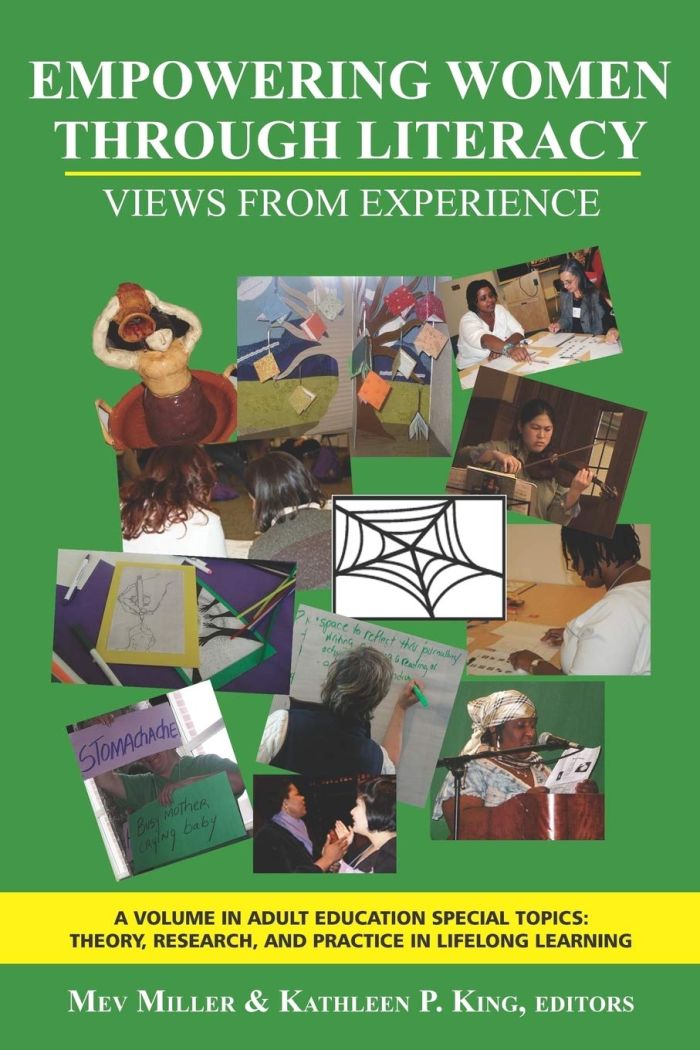
Empowering Women Through Literacy
Views from Experience

This book can be opened with

Note on our eBooks and Audiobooks: you can read our eBooks (ePUB or PDF) and listen to audiobooks on the free Emerald Books app on iOS, Android, and desktop. Or read and listen on Emerald's online reader (ePUB eBooks and audiobooks only). To purchase a digital book you will need to create an account if you don’t already have one. After purchasing you will receive instructions on how to get started.
- Description
- Contents
This unique volume of writings by educators in the field working with women's literacy reveals the many ways in which addressing women's empowerment through literacy continues to impact lives. Not only are teachers and learners in adult basic education (ABE), literacy and English language learning (ELL) classes affected, but also those who value and support women’s learning and equity, and education for social change.
Revelations--
More than half of the 3.6 million students in adult basic/literacy education (ABE) programs across the U.S. are women (Sticht, 2001). Research outlines many barriers for women pursuing basic education and literacy, and recommends using woman-positive approaches (Sheared, 1994). However, there exists little research on how educational systems and policies, instructional materials, and pedagogical practices best support the literacy and educational achievement of women literacy learners. Writings and curriculum by individual educators outline and describe innovative activities/ programs focused specifically on the needs of women learners (Cuban & Hayes, 1996; Hayes & Flannery, 2000; Miller & Alexander, 2004; Young & Padilla, 1990). In recent years, educators have been developing innovative curriculum to address such issues as trauma and violence (e.g., Take on the Challenge), work-readiness (e.g. Ready for Work), or women's issues in general (Making Connection).
New Directions--
Empowering Women through Literacy: Voices from Experience is the first comprehensive collection of writing from the field by everyday educators who experience the joys and challenges, creativity and barriers to acknowledge or integrate innovative solutions to support women's learning needs in adult basic education and literacy settings.
Mirroring the power of community-based and grassroots organizations, this volume has had a remarkable history. It has emerged from five years of work by WE LEARN (Women Expanding Literacy Education Action Resource Network) to address the needs of literacy educators and students alike through the organization. The vibrant collective of the WE LEARN network provides consistent visibility for women’s literacy issues, creates connections among educators and activists, supports selfefficacy among learners, encourages new research relevant to women in ABE, and develops and distributes women-focused literacy materials and curriculum resources. It continues to be the only national U.S. organization directly addressing issues of adult women's literacy and the educational needs of women in ABE.
We know you will enjoy this volume that provides an opportunity to hear from 47 contributors from around the world who reflect on their experiences with critical topics of adult literacy practices; how to empower women through literacy and current research based practice. From Belize to Australia, Brazil to Germany, and USA to Turkey, the voices of women engaged in empowerment are awaiting you through these pages. Literacy can change lives, how can we better reach those who desire this empowerment? Join us we explore the breadth of vision and knowledge captured within this groundbreaking volume.
Dedication and Acknowledgements.
- Introduction; Mev Miller and Kathleen P. King.
- Section I: Reflections.
- Chapter 1. Enriching Lives; Geraldine Cannon Becker.
- Chapter 2. Finding Common Ground: Fostering Positive Relationships Among Women in the Literacy Classroom; Karen L. Milheim.
- Chapter 3. The Literacy of Being; Denise DiMarzio.
- Chapter 4. An Ongoing Journey; Beatrice Arndtell.
- Chapter 5. Becoming a Lady of Letters: For Cherie; Cindy Childress.
- Chapter 6. The Right to Write: Teaching Creative Writing to Women Inmates; Dominique T. Chlup.
- Chapter 7. But How Can I Teach Her If She Can’t Get Her Bum on the Seat?; Jenny Horsman.
- Chapter 8. Frustrated; Laura Holland.
- Section II: Learning Communities.
- Chapter 9. No Obstacle for Learning: A Learner’s Story of Overcoming; Ana Bertha Diaz.
- Chapter 10. Dear Mary; Lorna Rivera.
- Chapter 11. A Cradle in the Classroom: Creating a Positive Learning Environment for Student Mothers; Tanya M. Spilovoy.
- Chapter 12. Telling Our Truths; Tzivia Gover.
- Chapter 13. Laugh Listen, Leave the Door Open: Working with Teen Women in Adult Programs; Stacie Evans.
- Chapter 14. It Has Been a Pleasure; Sharon L. Shoemaker.
- Chapter 15. Fabella and Fiona Find Liberating Literacy: A Teacher’s Visual Reflection on Women and Literacy; Sally S. Gabb.
- Chapter 16. Reading Against the Odds: African American Women, Literacy and Transformation; Jaye Jones.
- Chapter 17. Courage, Choice, Change: Gestalt Therapy Techniques Within the Adult Literacy Classroom; Cheryl Reid.
- Chapter 18. Portraits and Possibilities: Empowerment Through Literacy; Elite Ben-Yosef.
- Chapter 19. Cultivating Intimacy in the Classroom at the King County Jail; Kit Gruver.
- Chapter 20. Women Creating Change: The Center for Immigrant Families’ English Literacy Project; Ujju Aggarwal, Priscilla González, Donna Nevel, and Perla Placencia.
- Chapter 21. Two Voices; Maura Donnelly.
- Chapter 22. Women and Continued Education in Belize; Jane Elizabeth Bennett.
- Section III: Learners and Learning.
- Chapter 23. Breaking the Spell of Dyslexia: A Retrospective Dialogue Between Student and Teacher; Gail Wood Miller and Susan Makinen.
- Chapter 24. The “Power” of Mutual Mentoring and Coaching: Walking Alongside One Another on the Learning Journey; Kathleen P. King.
- Chapter 25. Fancy Footwork: Australian Women Write from Experience and Reflection; Delia Bradshaw and Lynne Matheson.
- Chapter 26. The Push and Pull of Peers on Women Learners; Heidi Silver-Pacuilla, Edie Lantz-Leppertz, and Laura Porfirio.
- Chapter 27. We Learn: Working on Fertile Edges; Mev Miller.
- Section IV: Explorations of Practice.
- Chapter 28. Landscape of Academe; Lorna Rivera.
- Chapter 29. School Phobias: Personal Stories of Fear and Adult Education Practices That Help; Lisa Robertson.
- Chapter 30. The Experience of Grieving, Trauma, and Violence: The Forgotten Adult Learner; Özlem Zabigi.
- Chapter 31. A Difference of Degree: A Case Study of Iresa Stubblefield-Jones; Carrie J. Boden.
- Chapter 32. Making a Beach: Women, Community, and Democracy at the Open Book; Dianne Ramdeholl, Stacie Evans, and John Gordon.
- Chapter 33. Parallels in the Marginalization of ABE Women Educators and Women Literacy Learners; Sandra D. Bridwell.
- Chapter 34. Empowering Women Through Voice: Low-Income Mothers Speak About Work, [Non]Education, Poverty, Welfare Reform; Mary V. Alfred.
- Chapter 35. Breaking Free: The Power of Experiential Learning as it Impacts the Development of Self-Efficacy in Incarcerated Female Adult Learners; Dawn E. Addy.
- Chapter 36. Out of the Stands and Onto the Field: Participants, Engagement, and Empowerment of Women Literacy Learners Using Web 2.0 and New Media; Kathleen P. King.
- Chapter 37. Transformation is the Way: A Study About Forum Theater and Critical Literacy with Brazilian Immigrants in an ESOL Class in New England; Maria Tereza Schaedler.
- Chapter 38. Simplemente Mujer: A Literacy Project By, With, and for Women; Gabriele I. E. Strohschen.
- Chapter 39. Voices from the Earth: Pottery and English Experience for Hispanic Farm Worker Women, Orleans County, New York; Linda Redfield Shakoor and Deborah Wilson.
- Meet the Contributors.