
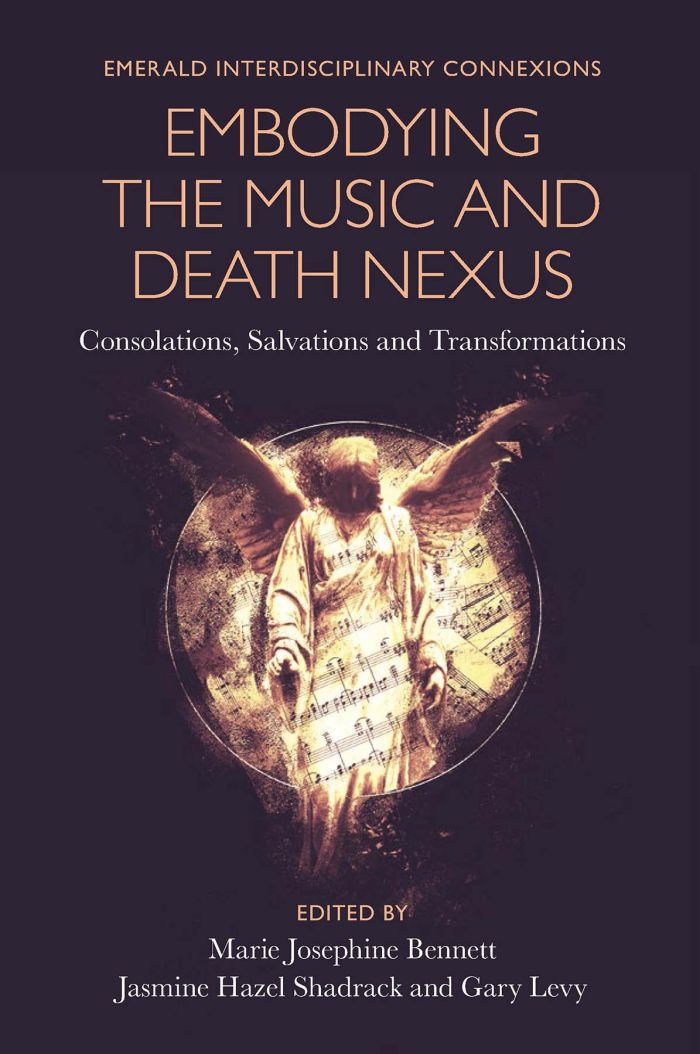

Embodying the Music and Death Nexus
Consolations, Salvations and Transformations

This book can be opened with

Note on our eBooks and Audiobooks: you can read our eBooks (ePUB or PDF) and listen to audiobooks on the free Emerald Books app on iOS, Android, and desktop. Or read and listen on Emerald's online reader (ePUB eBooks and audiobooks only). To purchase a digital book you will need to create an account if you don’t already have one. After purchasing you will receive instructions on how to get started.
- Description
- Contents
- About
Embodied encounters with death affect humans deeply, with the power to crush, transform and strengthen individuals and relationships. Understanding that these encounters often have a musical accompaniment, this edited collection offers a range of critical, analytic, discursive and personal reflections on how music provides both a container and a medium for experiencing, processing and integrating embodied encounters with death.
The collection showcases new and original interdisciplinary case studies written by authors from several different countries across Australia, France, The Netherlands, Poland and the UK. Taking an international, interdisciplinary and inclusive approach, this carefully curated collection elaborates embodied encounters with death through music across a variety of praxes and disciplines such as death & grief, queer studies, disability, philosophy, and more. Providing a mix of personal perspectives and insights on the impact of music and death alongside more conventional academic studies, the chapters reveal how music and human nature are intimately, and bodily, entwined.
Framed by opening and closing chapters written by the team of three editors, this core text in the field provides a unique overview of the implications and ramifications of the embodiment of death through music and the musicalisation of death through the body, and signposts possibilities for further research.
Section One. Death and the Canon: Classical Entanglements of Death, Grief and Perspective
- Chapter 1. Permeating the Membrane: Death as Life-Fulfilment Through the Prism of Bach’s Ich habe genug (BWV 82); Gary Levy
- Chapter 2. Mozart’s Music in Film: Death and Embodied Affects; Marie Josephine Bennett
- Chapter 3. Mahler’s Second Symphony: Intuitively Embodying Grief and Dying; Benjamin Lassauzet
- Section Two. Cthonics: Travelling Through Death on Black Metal’s Wings
- Chapter 4. Death as Negation: Black Metal’s Disturbing Apophatic Insight; Niall Scott
- Chapter 5. ‘I Saw the End’: An Autoethnographic Exploration of Music, Cancer Treatment and Death; Amanda DiGioia
- Chapter 6. Abyssal Noise: Representations of Death and Dying in Extreme Metal Music; Francesca Stevens
- Section Three. Death and Resurrection: Marginalised Voices
- Chapter 7. Naked History: A Musical Embodiment; Jenny Game
- Chapter 8. Death and a Life: Renihilative Metamorphosis; Nachthexe
- Chapter 9. Regulation, Resistance & Resurrection; Alison Duncan Kerr and Rebecca Jiggens
- Section Four. Life Beyond Death: Mourning, Mythology and the Sound of Loss
- Chapter 10. Sounding the Architecture of Grief: Requiem, Rhetoric, and Embodied Experience; Matthew McCullough
- Chapter 11. Experiencing the Sound of Loss: Music and Bereavement Theory; Janieke Bruin-Mollenhorst
- Chapter 12. Between a Man and a Myth: The Death of John Fitzgerald Kennedy and Popular Music; Marek Jeziński
Marie Josephine Bennett completed her doctoral thesis, which focused on critical readings of queer performance in mainstream Hollywood film musicals, at the University of Winchester.
Jasmine Hazel Shadrack is an independent scholar with the National Coalition of Independent Scholars and a visiting lecturer at Falmouth University. She is a composer and musician, whose research areas include trauma studies, disability studies, performance, extreme metal, autoethnography and feminist psychoanalysis.
Gary Levy works in teacher education and educational research at Deakin University, Melbourne, Australia. His interests are centred on questions in the philosophy, sociology and cultural politics of education.