
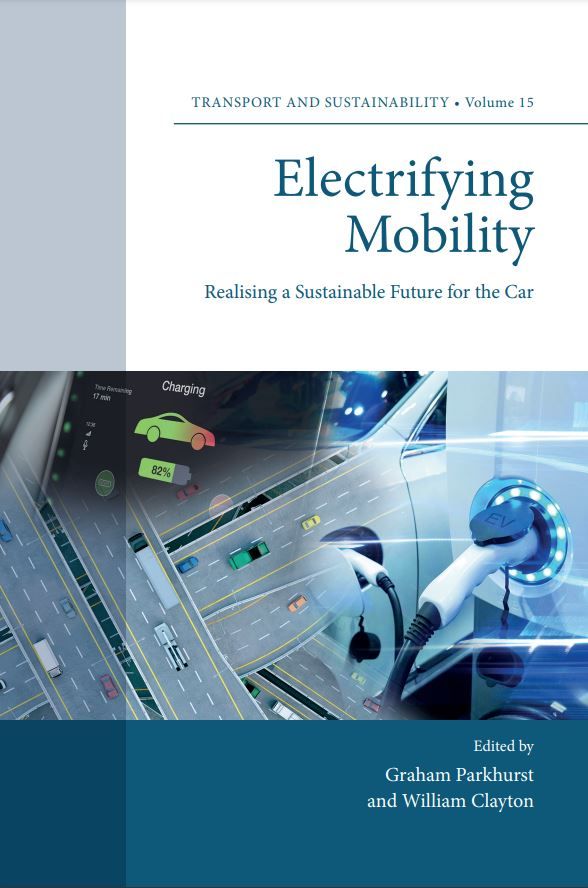

Electrifying Mobility
Realising a Sustainable Future for the Car

This book can be opened with

Note on our eBooks and Audiobooks: you can read our eBooks (ePUB or PDF) and listen to audiobooks on the free Emerald Books app on iOS, Android, and desktop. Or read and listen on Emerald's online reader (ePUB eBooks and audiobooks only). To purchase a digital book you will need to create an account if you don’t already have one. After purchasing you will receive instructions on how to get started.
- Description
- Contents
- About
Transport is responsible for a growing share of global energy consumption and greenhouse gas emissions, emerging as an economic sector for which technical solutions have shown limited benefits and a shift to electric mobility is seen as an essential part of tackling both problems. However, despite electric motive power being older technology than internal combustion engines and having many advantages, both inherent disadvantages and the inertia of not being the dominant road transport technology mean that it is only recently that electric vehicles (EVs) have attracted serious policy attention.
Electrifying Mobility: Realising a Sustainable Future for the Car examines the basis of this electric mobility ‘turn’, considering the drivers, barriers to adoption and the current lived experience of EV use, drawing upon this experience to inform planning for mass EV adoption and how regulation might change to reflect the specific needs and challenges raised. Considering future transport policy, practice, and management where EVs become an important part of the road transport fleet, and, it is assumed, eventually come to dominate it, chapters study how EV and Connected and Autonomous Vehicle (CAV) technologies relate, and whether there are synergies with shared mobility.
The Transport and Sustainability series addresses the important nexus between transport and sustainability containing volumes dealing with a wide range of issues relating to transport, its impact in economic, social, and environmental spheres, and its interaction with other policy sectors.
Part 1: The Political-Economic Context and Environmental Imperative
- Chapter 1. Introduction: The Electrification of Automobility; Graham Parkhurst
- Chapter 2. Easy Street for Low-Carbon Mobility? The Political Economy of Mass Electric Car Adoption; Cameron Roberts
- Chapter 3. The Energy and Emissions Case and The Lifecycle Impact of Electric Cars; Eckard Helmers
- Part 2: Overcoming Inertia: From Internal Combustion Engine to Electric Car
- Chapter 4. Producing the Electric Car; Peter Wells and Jean-Paul Skeete
- Chapter 5. Making the Market: The Transformation Pathway to Electric Car Mobility in The Netherlands; Marc Dijk
- Chapter 6. Choosing the Electric Car; Colin Whittle and Lorraine Whitmarsh
- Part 3: Living with the Electric Car
- Chapter 7. The Effect of Electric Car Adoption on Travel Patterns; Craig Morton
- Chapter 8. Becoming an Electric Car Owner: User Experience and the EV Community; William Clayton
- Chapter 9. Planning for Electric Car Charging: A Review of Technologies, Criteria and Methods; Stefania Boglietti, Martina Carra, Massimiliano Sotgiu, Benedetto Barabino, Michela Bonera, and Giulio Maternini
- Part 4: Electric Cars in the Future
- Chapter 10. Electric Cars: The Future Technological Potential; Javier Turienzo, Jesús F. Lampón, Roberto Chico-Tat, and Pablo Cabanelas
- Chapter 11. Americans’ Plans for Acquiring and Using Electric, Shared and Self-Driving Cars; Neil Quarles, Kara M. Kockelman, and Jooyong Lee
- Chapter 12. Conclusion: The Electric Car as a Component of Future Sustainable Mobility; Graham Parkhurst and William Clayton
Graham Parkhurst is Professor of Sustainable Mobility and Director of the Centre for Transport & Society at UWE Bristol, UK. Graham has more than two decades of experience researching and teaching transport and mobility studies.
William Clayton is a teaching member of UWE's BA Geography and MSc Transport Engineering and Planning programmes. William teaches across a range of subject areas within human geography, specialising in transport geography.