
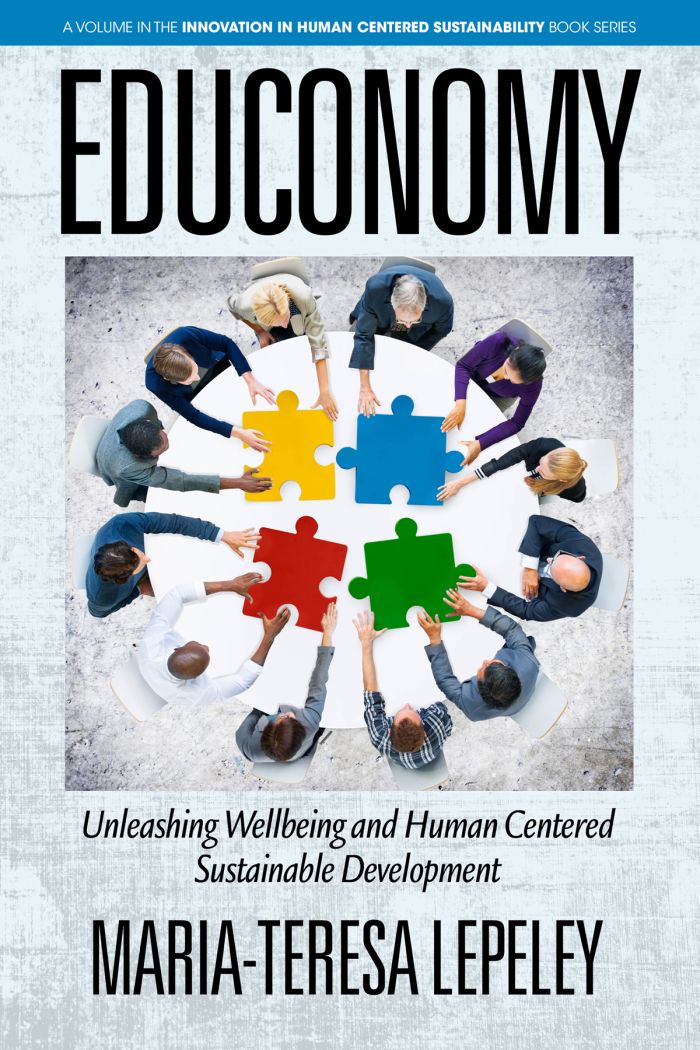
EDUCONOMY. Unleashing Wellbeing and Human Centered Sustainable Development

This book can be opened with

Note on our eBooks and Audiobooks: you can read our eBooks (ePUB or PDF) and listen to audiobooks on the free Emerald Books app on iOS, Android, and desktop. Or read and listen on Emerald's online reader (ePUB eBooks and audiobooks only). To purchase a digital book you will need to create an account if you don’t already have one. After purchasing you will receive instructions on how to get started.
- Description
- Contents
Investing in People is the world priority of the 21st century. The wellbeing of people is at the center of the agendas of the World Bank, International Monetary Fund, UN, OECD, ILO and all major development organizations. But the concern for people is not new. The celebrated books of Economics Nobel Awardees Theodore Schultz’s Investing in People. The Economics of Population Quality and Gary Becker’s Human Capital were published decades ago and challenged the same human dilemma. Yet, with few exceptions, most countries are still struggling for effective formulas to put people at the center of development.
The core issue is that investing in people means improving the quality of education for all. But the main problem is that countries continue to take education as an expense, not as an investment in people. National budgets consider education as a sunken cost, rather than as an investment expected to produce high returns to secure quality improvement as necessary condition for sustainability. Shortcomings are abundant but one thing is certain: unless the quality of education for all is placed front and center in development agendas, chances for progress in the VUCA (volatile, uncertain, complex, ambiguous) environment are curtailed, human centered sustainability and wellbeing will be restrained and inequality will persist.
The main problem it is not income inequality, it is education inequality.
In the Knowledge Economy the human (as) resources formula is no longer working. Segmentation of the economy and education is probing increasingly counterproductive. The EDUCONOMY is a human centered structure for progress to optimize returns and minimize costs of investing in people.
Gallup and Brandon Busteed coined the concept Educonomy to enhance the importance of quality in education backed up by extensive surveys and data bases. Lepeley’s EDUCONOMY. Unleashing Wellbeing and Human Centered Sustainable Development takes the discussion into new dimensions and addresses the complexity of the challenges.
People are the DNA of Sustainable Development. Says Lepeley challenging old constructs and presenting innovative formulas pioneering human centered economics and economics of wellbeing that frame the Balanced Sustainable Development ESTE (economic, social, technology, environment) Model. ESTE is the product of the Educonomy built on three fundamental pillars: the Talent Economy, the Agility Economy and the Quality Economy convergent with demands of the Knowledge Economy. In the ESTE Model education is no longer a national expense, it is an investment that secures high rates of returns and social and economic inclusiveness anchored in quality standards for all.
Introduction.
- Part I. The Wellbeing Pursuit: People Are The Dna Of Sustainable Development.
- Chapter 1. Human Centered Economics.
- Chapter 2. Economics of Wellbeing.
- Part II. Balanced Sustainable Development ESTE (Economic, Social, Technology, Environment).
- Chapter 3. Human Centered Balanced Sustainable Development ESTE Model: Putting The Pieces Together.
- Chapter 4. Global Pledge for Quality in Education: A Critique on Misleading Quality.
- Part III. The Educonomy And It's 3 Pillars
- Chapter 5. The Educonomy.
- Chapter 6. The Talent Economy.
- Chapter 7. The Agility Economy.
- Chapter 8. The Quality Economy.