
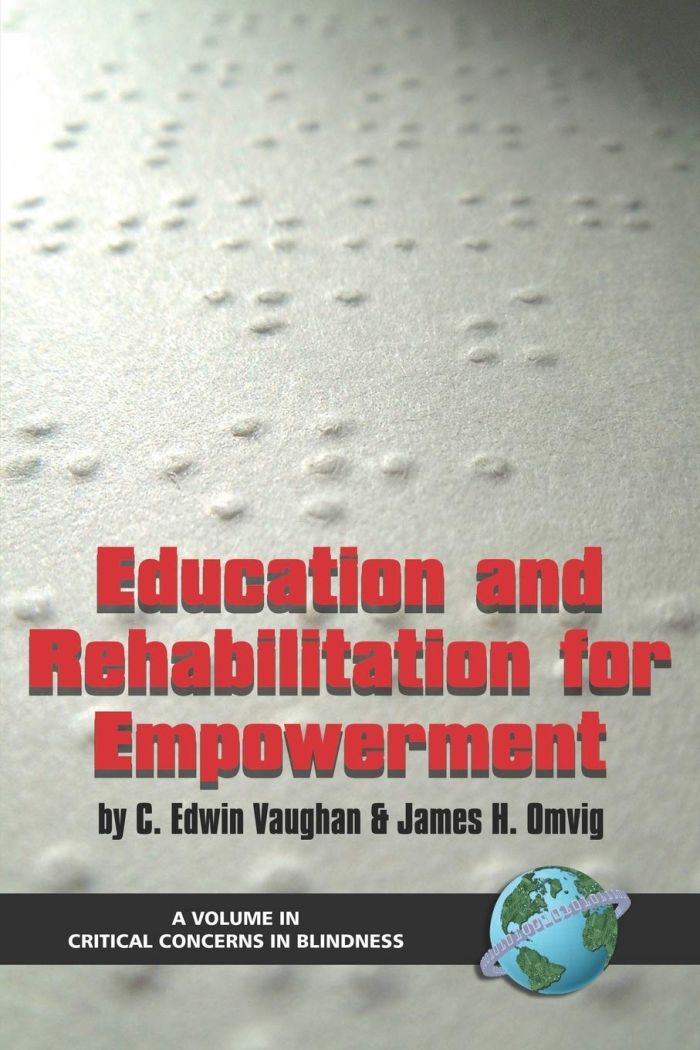
Education and Rehabilitation for Empowerment

This book can be opened with

Note on our eBooks and Audiobooks: you can read our eBooks (ePUB or PDF) and listen to audiobooks on the free Emerald Books app on iOS, Android, and desktop. Or read and listen on Emerald's online reader (ePUB eBooks and audiobooks only). To purchase a digital book you will need to create an account if you don’t already have one. After purchasing you will receive instructions on how to get started.
- Description
- Contents
In this book we are interested in patterns of education, rehabilitation service, socialization, and ideas about blindness that in large part produce the above-mentioned distinct patterns. We will examine the economic interests of professional groups and the patterns of domination and subordination, which are present in most rehabilitation relationships. Our central tenet is that the behavior of blind people is not a product of the physical condition of blindness or the amount of residual vision a blind person has. Rather, the behavior of blind people in our society is governed by socialization. Blindness is a social problem arising from erroneous, socially constructed negative beliefs about the capacities of blind people involuntarily assimilated from the broader society by the blind. People learn to live independently or they learn to be dependent. The reactions of parents, teachers, peers, the health professionals, rehabilitation counselors and the general public have defined the choices available to blind people. This is the case in every culture and society around the world. Differences result from different cultural values, levels of economic development, and historical traditions.
Introduction.
- Chapter 1. The Plan Of The Book.
- Chapter 2. Rehabilitation.
- Chapter 3. Ingredients Of Empowerment.
- Chapter 4. The Professional Worker And The Road To Empowerment.
- Chapter 5. Characteristics Of A Model State Agency.
- Chapter 6. Blending In.
- Chapter 7. Communication And Empowerment.
- Chapter 8. Mobility.
- References.